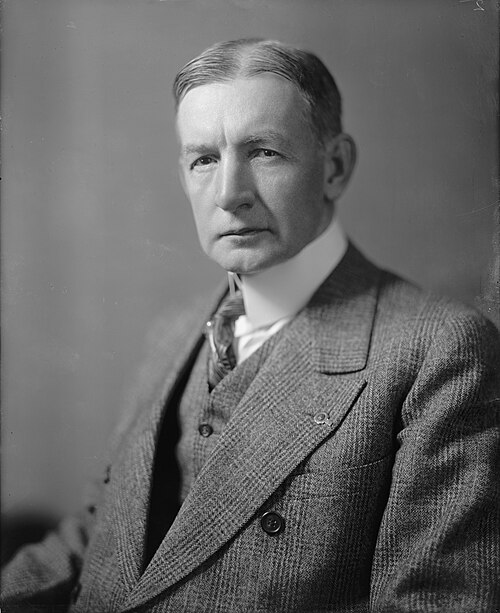
Composer
Charles Dawes
vice president of the United States from 1925 to 1929
1865–1951
1 works and musical collections
- Born
- 1865
- Died
- 1951
- Birthplace
- Marietta
- Place of death
- Evanston
- Citizenship / historical state
- United States
- Period (estimated from birth year)
- Modern
Biography
Charles Gates Dawes (August 27, 1865 – April 23, 1951) was the 30th vice president of the United States from 1925 to 1929 under President Calvin Coolidge. He was a co-recipient of the Nobel Peace Prize in 1925 for his work on the Dawes Plan for World War I reparations, and a member of the Republican Party.
Born in Marietta, Ohio, Dawes attended Cincinnati Law School before beginning a legal career in Lincoln, Nebraska. After serving as a gas plant executive, he managed William McKinley's 1896 presidential campaign in Illinois. After the election, McKinley appointed Dawes as the Comptroller of the Currency. He remained in that position until 1901 before forming the Central Trust Company of Illinois. Dawes served as a general during World War I and was the chairman of the general purchasing board for the American Expeditionary Forces. In 1921, President Warren G. Harding appointed Dawes as the first director of the Bureau of the Budget. Dawes served on the Allied Reparations Commission, where he helped formulate the Dawes Plan to aid the struggling German economy.
The 1924 Republican National Convention nominated President Calvin Coolidge without opposition. After former governor of Illinois Frank O. Lowden declined the vice-presidential nomination, the convention chose Dawes as Coolidge's running mate. The Republican ticket won the 1924 presidential election, and Dawes was sworn in as vice president in 1925. Dawes helped pass the McNary–Haugen Farm Relief Bill in Congress, but President Coolidge vetoed it. Dawes was a candidate for renomination at the 1928 Republican National Convention, but Coolidge's opposition to Dawes helped ensure that Charles Curtis was nominated instead. In 1929, President Herbert Hoover appointed Dawes to be the ambassador to the United Kingdom. Dawes also briefly led the Reconstruction Finance Corporation, which organized a government response to the Great Depression. He resigned from that position in 1932 to return to banking, and died in 1951 of coronary thrombosis.
Biography excerpt from Wikipedia contributors, available under CC BY-SA 4.0. Formatting and reference markers have been removed; the introduction may be shortened. View contributors and article history.
Life and musical career
- Occupations
- politician; diplomat; pianist; writer; economist; banker; songwriter; composer; lawyer; journalist; ambassador
- Recorded memberships
- American Legion; Forty and Eight; Delta Upsilon
- Instruments played
- piano
- Awards
- Nobel Peace Prize
- Native languages
- English
- Languages used
- English
- VIAF ID
- 44568420
- ISNI
- 0000000081234351
- GND ID
- 12348720X
- Library of Congress ID
- n79032944
- MusicBrainz ID
- 831fd885-7564-4389-9ae1-79d86c2df135
Recorded in Wikidata. Affiliations may refer to earlier stages of the composer's career.
In this catalogue
- Common listed instruments
- Guitar, Voice
- Source entries with composition dates
- 0
These details describe the indexed sheet music, including arrangements.
Catalogue
Sheet music catalogue
Instruments describe listed editions, including arrangements. Composition dates and keys appear where recorded; collection pages show their individual contents.
| Title | Work details | Listed instruments | Sheet music |
|---|---|---|---|
| It's All In The Game | See work details |
| View sheet music |
Biographical record: Wikidata, matched on name and checked against dates held in the catalogue. The period label is an estimate from birth year. Authority record: VIAF 44568420. Portrait: Harris & Ewing, Public domain, via Wikimedia Commons.