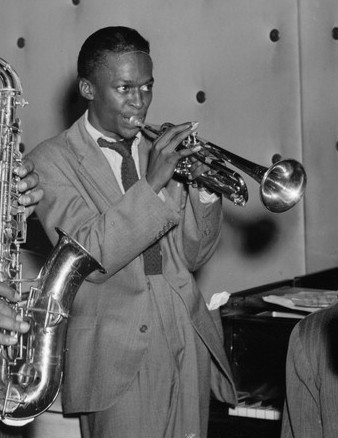
Composer
"Davis, Miles
American jazz trumpeter, bandleader, and composer (1926–1991)
1926–1991
3 works in the index
- Born
- 1926
- Died
- 1991
- Birthplace
- Alton
- Place of death
- Santa Monica
- Citizenship / historical state
- United States
- Period (estimated from birth year)
- Contemporary
Biography
Miles Dewey Davis III (May 26, 1926 – September 28, 1991) was an American trumpeter, bandleader, composer, and painter. He is among the most influential and acclaimed figures in the history of jazz and 20th-century music. In a career spanning nearly five decades, Davis was at the forefront of several major stylistic developments in jazz, including bebop, cool jazz, hard bop, third stream, modal jazz, avant-garde jazz and jazz fusion. His legacy extends into rock, funk, classical and hip-hop.
Born into an affluent family in Alton, Illinois, and raised in East St. Louis, Davis started on the trumpet in his early teens. He left to study at the Juilliard School in New York City, before dropping out and making his professional debut as a member of saxophonist Charlie Parker's bebop quintet from 1944 to 1948. Shortly afterwards, he recorded the Birth of the Cool sessions for Capitol Records, which were instrumental to the development of cool jazz. In the early 1950s, Davis recorded some of the earliest hard bop music under Prestige Records. After a widely acclaimed comeback performance at the Newport Jazz Festival, he signed a long-term contract with Columbia Records, and recorded the album 'Round About Midnight in 1955. It was his first work with saxophonist John Coltrane and bassist Paul Chambers, key members of the sextet he led into the early 1960s. During this period, he alternated between orchestral jazz collaborations with arranger Gil Evans, such as the Spanish music–influenced Sketches of Spain (1960), and band recordings, such as Milestones (1958) and Kind of Blue (1959). The latter recording remains one of the most popular jazz albums of all time, having sold more than five million copies in the U.S. alone and 6.4 million copies worldwide.
Davis made several lineup changes while recording Someday My Prince Will Come (1961), his 1961 Blackhawk concerts, and Seven Steps to Heaven (1963), another commercial success that introduced bassist Ron Carter, pianist Herbie Hancock and drummer Tony Williams. After adding saxophonist Wayne Shorter to his new quintet in 1964, Davis led them on a series of more abstract recordings often composed by the band members, helping pioneer the post-bop genre with albums such as E.S.P. (1965) and Miles Smiles (1967), before transitioning into his electric period. During the 1970s, he experimented with rock, funk, African rhythms, emerging electronic music technology, and an ever-changing lineup of musicians, including keyboardist Joe Zawinul, drummer Al Foster, bassist Michael Henderson and guitarist John McLaughlin. This period, beginning with Davis's 1969 studio album In a Silent Way and concluding with the 1975 concert recording Agharta, was the most controversial in his career, alienating and challenging many in jazz. His million-selling 1970 record Bitches Brew helped spark a resurgence in the genre's commercial popularity with jazz fusion as the decade progressed.
Biography excerpt from Wikipedia contributors, available under CC BY-SA 4.0. Formatting and reference markers have been removed; the introduction may be shortened. View contributors and article history.
Life and musical career
- Selected occupations
- composer; trumpeter; bandleader; conductor; autobiographer; jazz musician; actor; songwriter; film score composer; musician; television actor; recording artist
- Teachers
- Elwood Buchanan; William Vacchiano
- Recorded memberships
- The Miles Davis Sextet; Miles Davis Quintet; The Miles Davis Quartet; Miles Davis All Stars
- Instruments played
- trumpet; synthesizer; organ; flugelhorn
- Genres
- jazz; bebop; cool jazz; hard bop; modal jazz; jazz fusion
- Awards
- Léonie Sonning Music Prize; honorary doctorate of Paris Nanterre University; Grammy Lifetime Achievement Award; American Book Awards; Rock and Roll Hall of Fame; Paul Acket Award; star on Hollywood Walk of Fame; MOJO Awards; NEA Jazz Masters
- Official website
- https://www.milesdavis.com
- Pseudonym
- Cleo Henry
- Native languages
- American English
- Languages used
- English
- VIAF ID
- 97762193
- ISNI
- 000000012144707X
- GND ID
- 118524046
- Library of Congress ID
- n50035608
- MusicBrainz ID
- 561d854a-6a28-4aa7-8c99-323e6ce46c2a
Recorded in Wikidata. Affiliations may refer to earlier stages of the composer's career.
In this catalogue
- Common listed instruments
- Piano, Tenor Saxophone, Trumpet
- Genres represented
- Jazz
- Works with composition dates
- 0 of 3
These details describe the indexed sheet music, including arrangements.
Catalogue
Works
Years are composition dates where known. Instruments describe editions in our catalogue and may include arrangements. A dash means the detail is not recorded.
| Work | Year composed | Catalogue / opus | Key in title | Listed instruments | Genre | Editions |
|---|---|---|---|---|---|---|
| Jean Pierre | — | — | — | Piano, Trumpet | Jazz | 2 |
| Freddie Freeloader | — | — | — | Piano, Tenor Saxophone | Jazz | 1 |
| All Blues | — | — | — | Piano | Jazz | 1 |
Biographical record: Wikidata, matched on name and checked against dates held in the catalogue. The period label is an estimate from birth year. Authority record: VIAF 97762193. Portrait: William P. Gottlieb, Public domain, via Wikimedia Commons.