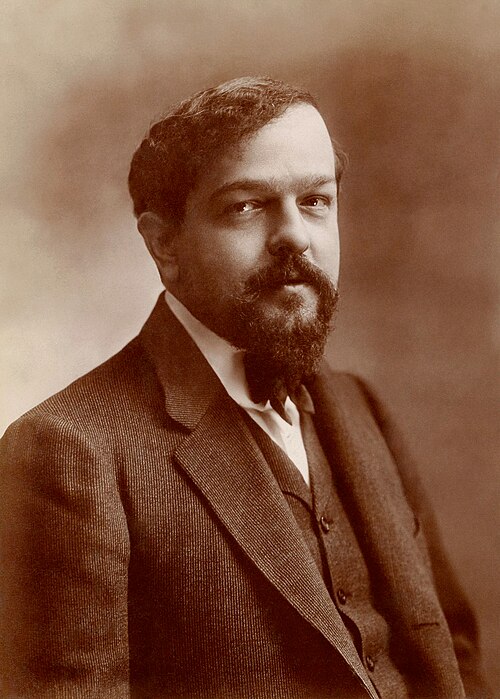
Composer
Debussy
French classical composer (1862–1918)
1862–1918
18 works and musical collections
- Born
- 1862
- Died
- 1918
- Birthplace
- Saint-Germain-en-Laye
- Place of death
- 16th arrondissement of Paris
- Citizenship / historical state
- France
- Period (estimated from birth year)
- Modern
Biography
Achille Claude Debussy (French: [aʃil klod dəbysi]; 22 August 1862 – 25 March 1918) was a French composer, born in Saint-Germain-en-Laye. He is sometimes seen as the first Impressionist composer, although he vigorously rejected the term. He was among the most influential composers of the late 19th and early 20th centuries.
Born to a family of modest means and little cultural involvement, Debussy showed enough musical talent to be admitted at the age of ten to France's leading music college, the Conservatoire de Paris. He originally studied the piano, but found his vocation in innovative composition, despite the disapproval of the Conservatoire's conservative professors. He took many years to develop his mature style, and was nearly 40 when he achieved international fame in 1902 with the only opera he completed, Pelléas et Mélisande.
Debussy's orchestral works include Prélude à l'après-midi d'un faune (1894), Nocturnes (1897–1899) and Images (1905–1912). His music was to a considerable extent a reaction against Wagner and the German musical tradition. He regarded the classical symphony as obsolete and sought an alternative in his "symphonic sketches", La mer (1903–1905). His piano works include sets of 24 Préludes and 12 Études. Throughout his career he wrote mélodies based on a wide variety of poetry, including his own. He was greatly influenced by the Symbolist poetic movement of the later 19th century. A small number of works, including the early La Damoiselle élue and the late Le Martyre de saint Sébastien have important parts for chorus. In his final years, he focused on chamber music, completing three of six planned sonatas for different combinations of instruments.
With early influences including Russian and Far Eastern music and works by Chopin and Liszt, Debussy developed his own style of harmony and orchestral colouring, derided – and unsuccessfully resisted – by much of the musical establishment of the day. His works have strongly influenced a wide range of composers including Béla Bartók, Igor Stravinsky, George Gershwin, Olivier Messiaen, George Benjamin, and the jazz pianist and composer Bill Evans. Debussy died from cancer at his home in Paris at the age of 55 after a composing career of a little more than 30 years.
Biography excerpt from Wikipedia contributors, available under CC BY-SA 4.0. Formatting and reference markers have been removed; the introduction may be shortened. View contributors and article history.
Life and musical career
- Occupations
- composer; pianist; music critic
- Education
- Conservatoire de Paris
- Recorded memberships
- Royal Swedish Academy of Music
- Instruments played
- piano
- Genres
- opera; classical music; impressionist music
- Movements
- impressionism in music; Symbolism
- Selected notable works
- Pelléas et Mélisande; Préludes; Children's Corner; La Damoiselle élue; Suite bergamasque; Prélude à l'après-midi d'un faune; Petite Suite; Deux arabesques; String Quartet; La mer; Images; PrincessesJeux de princess
- Birth name
- Claude Achille Debussy
- Languages used
- French
- VIAF ID
- 6219636
- ISNI
- 0000000121190614
- GND ID
- 118524186
- Library of Congress ID
- n79132137
- MusicBrainz ID
- be50643c-0377-4968-b48c-47e06b2e2a3b
Recorded in Wikidata. Affiliations may refer to earlier stages of the composer's career.
In this catalogue
- Common listed instruments
- Piano, harpsichord, Cello, Flute, Guitar
- Genres represented
- Classical, Blues, Jazz
- Source entries with composition dates
- 2
These details describe the indexed sheet music, including arrangements.
Catalogue
Sheet music catalogue
Instruments describe listed editions, including arrangements. Composition dates and keys appear where recorded; collection pages show their individual contents.
| Title | Work details | Listed instruments | Sheet music |
|---|---|---|---|
| Golliwog's Cakewalk | See work details |
| View sheet music |
| Morceau de Concours |
|
| View sheet music |
| Arietta, Op. 12, No. 1 |
|
| View sheet music |
| Des pas sur la niege | See work details |
| View sheet music |
| Arabesque | See work details |
| View sheet music |
| Afternoon of a Faun | See work details |
| View sheet music |
| Magic Carpet of Dreams | See work details |
| View sheet music |
| Album Leaf | See work details |
| View sheet music |
| Andantino | See work details | See edition details | View sheet music |
| Beau Soir | See work details | See edition details | View sheet music |
| Clair de Lune | See work details | See edition details | View sheet music |
| Le Petit Nègre | See work details | See edition details | View sheet music |
| Rêverie | See work details | See edition details | View sheet music |
| Sarabande | See work details | See edition details | View sheet music |
| Des pas sur la neige |
| See edition details | View sheet music |
| Nuit d' | See work details | See edition details | View sheet music |
| The Little Shepherd: No. 5 from 'Children's Corner' | See work details | See edition details | View sheet music |
| Arabesque No. 1 in E | See work details | See edition details | View sheet music |
Biographical record: Wikidata, matched on name and checked against dates held in the catalogue. The period label is an estimate from birth year. Authority record: VIAF 6219636. Portrait: Adam Cuerden, Public domain, via Wikimedia Commons.