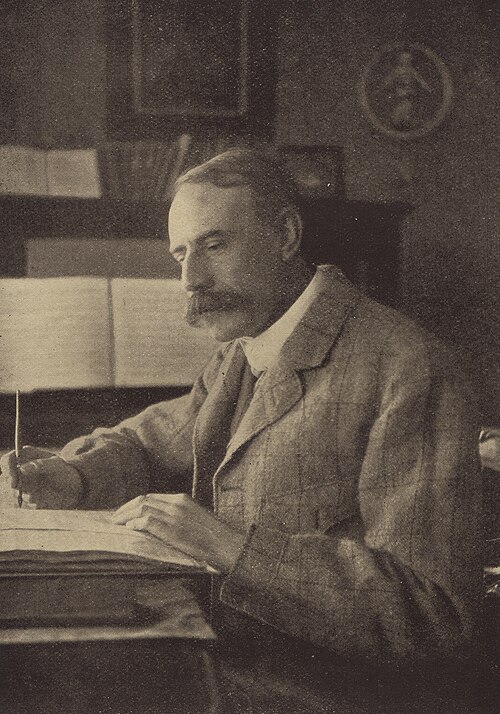
Composer
Edward William Elgar
English composer (1857-1934)
1857–1934
8 works and musical collections
- Born
- 1857
- Died
- 1934
- Birthplace
- Lower Broadheath
- Place of death
- Worcester
- Citizenship / historical state
- United Kingdom
- Period (estimated from birth year)
- Romantic
Biography
Sir Edward William Elgar, 1st Baronet ( ; 2 June 1857 – 23 February 1934) was an English composer, many of whose works have entered the British and international classical concert repertoire. Among his best-known compositions are orchestral works including the Enigma Variations, the Pomp and Circumstance Marches, concertos for violin and cello, and two symphonies. He also composed choral works, including The Dream of Gerontius, chamber music and songs. He was appointed Master of the King's Musick in 1924.
Although Elgar is often regarded as a typically English composer, most of his musical influences were not from England but from continental Europe. He felt himself to be an outsider, not only musically, but socially. In musical circles dominated by academics, he was a self-taught composer; in Protestant Britain, his Roman Catholicism was regarded with suspicion in some quarters; and in the class-conscious society of Victorian and Edwardian Britain, he was acutely sensitive about his humble origins even after he achieved recognition. He nevertheless married the daughter of a senior British Army officer. She inspired him both musically and socially, but he struggled to achieve success until his forties, when after a series of moderately successful works his Enigma Variations (1899) became immediately popular in Britain and overseas. He followed the Variations with a choral work, The Dream of Gerontius (1900), based on a Roman Catholic text that caused some disquiet in the Anglican establishment in Britain, but it became, and has remained, a core repertory work in Britain and elsewhere. His later full-length religious choral works were well received but have not entered the regular repertory.
In his fifties, Elgar composed a symphony and a violin concerto that were immensely successful. His second symphony and his cello concerto did not gain immediate public popularity and took many years to achieve a regular place in the concert repertory of British orchestras. Elgar's music came, in his later years, to be seen as appealing chiefly to British audiences. His stock remained low for a generation after his death. It began to revive significantly in the 1960s, helped by new recordings of his works. Some of his works have, in recent years, been taken up again internationally, but the music continues to be played more in Britain than elsewhere.
Elgar has been described as the first composer to take the gramophone seriously. Between 1914 and 1925, he conducted a series of acoustic recordings of his works. The introduction of the moving-coil microphone in 1923 made far more accurate sound reproduction possible, and Elgar made new recordings of most of his major orchestral works and excerpts from The Dream of Gerontius.
Biography excerpt from Wikipedia contributors, available under CC BY-SA 4.0. Formatting and reference markers have been removed; the introduction may be shortened. View contributors and article history.
Life and musical career
- Education
- New College Worcester
- Teachers
- Adolf Pollitzer
- Career institutions / employers
- University of Birmingham
- Instruments played
- organ
- Genres
- classical music; symphony
- Notable works
- Salut d'Amour; Concert Allegro; Dream Children; Enigma Variations; Pomp and Circumstance Marches; The Dream of Gerontius; Violin Concerto; Symphony No. 1; Symphony No. 2; Falstaff; Cello Concerto; Introduction and Allegro
- Awards
- Knight Grand Cross of the Royal Victorian Order; Royal Philharmonic Society Gold Medal; Walter Willson Cobbett Medal; Order of Merit; baronet
- Birth name
- Edward William Elgar
- Languages used
- English
- VIAF ID
- 76499978
- ISNI
- 000000012102494X
- GND ID
- 118688588
- Library of Congress ID
- n50026227
- MusicBrainz ID
- 4e60a56a-514a-4a19-a3cc-49927c96b3cb
Recorded in Wikidata. Affiliations may refer to earlier stages of the composer's career.
In this catalogue
- Common listed instruments
- Piano, Voice, Horn, Organ, Saxophone
- Genres represented
- Pop
- Source entries with composition dates
- 0
These details describe the indexed sheet music, including arrangements.
Catalogue
Sheet music catalogue
Instruments describe listed editions, including arrangements. Composition dates and keys appear where recorded; collection pages show their individual contents.
| Title | Work details | Listed instruments | Sheet music |
|---|---|---|---|
| Pomp and Circumstance | See work details |
1 more instruments
| View sheet music |
| Love's Greeting | See work details |
1 more instruments
| View sheet music |
| Where Corals Lie - No. 4 from "Sea Pictures" Op. 37 |
|
| View sheet music |
| The Swimmer - No. 5 from "Sea Pictures" Op. 37 |
|
| View sheet music |
| Sabbath Morning at Sea - No. 3 from "Sea Pictures" Op. 37 |
|
| View sheet music |
| For the Fallen, from "The Spirit of England", Op. 80, No. 3 |
|
| View sheet music |
| Sonata in G Major, Op. 28 |
| See edition details | View sheet music |
| Military March No. 1 in D Major, from "Pomp and Circumstance" |
| See edition details | View sheet music |
Biographical record: Wikidata, matched on name and checked against dates held in the catalogue. The period label is an estimate from birth year. Authority record: VIAF 76499978. Portrait: not stated, Public domain, via Wikimedia Commons.