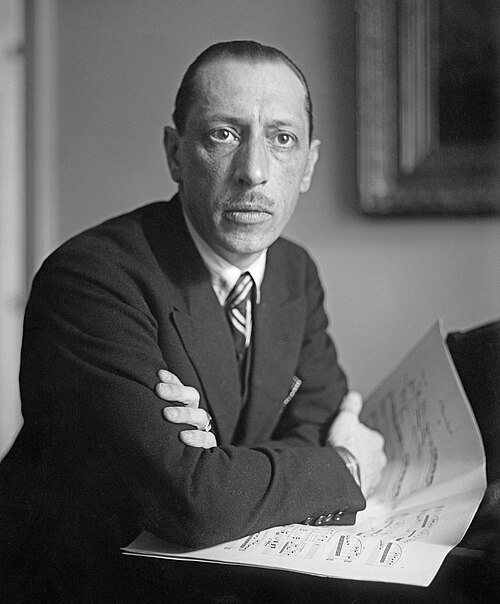
Composer
Igor Stravinsky
Russian, French, and American composer (1882–1971)
1882–1971
440 works in the index
- Born
- 1882
- Died
- 1971
- Birthplace
- Lomonosov
- Place of death
- New York City
- Citizenship / historical state
- France; Russian Empire; United States; Switzerland
- Period (estimated from birth year)
- Modern
Biography
Igor Fyodorovich Stravinsky (17 June [O.S. 5 June] 1882 – 6 April 1971) was a Russian composer and conductor with French (from 1934) and American citizenship (from 1945). He is widely considered one of the most important and influential composers of the 20th century and a pivotal figure in modernist music.
Born into a musical family in Saint Petersburg, Stravinsky grew up taking piano and music theory lessons. While studying law at the University of Saint Petersburg, he met Nikolai Rimsky-Korsakov and studied music under him until the latter's death in 1908. Soon after, Stravinsky met impresario Sergei Diaghilev, who commissioned him to write three ballets for the Ballets Russes's Paris seasons: The Firebird (1910), Petrushka (1911), and The Rite of Spring (1913), the last of which caused a near-riot at the premiere due to its avant-garde nature and later changed the way composers understood rhythmic structure.
Stravinsky's compositional career is often divided into three main periods: his Russian period (1913–1920), his neoclassical period (1920–1951), and his serial period (1954–1968). During his Russian period, Stravinsky was heavily influenced by Russian styles and folklore. Works such as Renard (1916) and Les noces (1923) drew upon Russian folk poetry, while compositions like L'Histoire du soldat (1918) integrated these folk elements with popular musical forms, including the tango, waltz, ragtime, and chorale. His neoclassical period exhibited themes and techniques from the classical period, like the use of the sonata form in his Octet (1923) and use of Greek mythological themes in works including Apollon musagète (1927), Oedipus rex (1927), and Persephone (1935). In his serial period, Stravinsky turned towards compositional techniques from the Second Viennese School like Arnold Schoenberg's twelve-tone technique. In Memoriam Dylan Thomas (1954) was the first of his compositions to be fully based on the technique, and Canticum Sacrum (1956) was his first to be based on a tone row. Stravinsky's last major work was the Requiem Canticles (1966), which was performed at his funeral.
While many supporters were confused by Stravinsky's constant stylistic changes, later writers recognized his versatile language as important in the development of modernist music. Stravinsky's revolutionary ideas influenced composers as diverse as Aaron Copland, Philip Glass, Béla Bartók, and Pierre Boulez, who were all challenged to innovate music in areas beyond tonality, especially rhythm and musical form. In 1998, Time magazine listed Stravinsky as one of the 100 most influential people of the century. Stravinsky died of pulmonary edema on 6 April 1971 in New York City, having left six memoirs written with his friend and assistant, Robert Craft, as well as an earlier autobiography and a series of lectures.
Biography excerpt from Wikipedia contributors, available under CC BY-SA 4.0. Formatting and reference markers have been removed; the introduction may be shortened. View contributors and article history.
Life and musical career
- Occupations
- composer; conductor; pianist; librettist
- Teachers
- Nikolai Rimsky-Korsakov; Wassili Kalafati
- Recorded memberships
- American Academy of Arts and Letters; American Academy of Arts and Sciences; Bavarian Academy of Fine Arts; Royal Swedish Academy of Music
- Instruments played
- piano
- Notable works
- The Rite of Spring; Movements for Piano and Orchestra; Symphony in E-flat; Scherzo fantastique; Petrushka; The Firebird
- Selected awards
- Grammy Lifetime Achievement Award; Léonie Sonning Music Prize; Grammy Award for Best Contemporary Classical Composition; Grammy Award for Best Orchestral Performance; Grammy Award for Best Classical Album; Grammy Hall of Fame; Royal Philharmonic Society Gold Medal; Wihuri Sibelius Prize; Commander of the Military Order of Saint James of the Sword; star on Hollywood Walk of Fame; Honorary Member of the International Society for Contemporary Music
- VIAF ID
- 17309155
- ISNI
- 0000000121224298
- GND ID
- 118642545
- Library of Congress ID
- n79070061
- MusicBrainz ID
- c278de2c-9696-4fdf-a919-0781cd945e2c
Recorded in Wikidata. Affiliations may refer to earlier stages of the composer's career.
In this catalogue
- Common listed instruments
- Piano, Orchestra, violin, Flute, Bassoon
- Genres represented
- Classical, Pop
- Works with composition dates
- 8 of 440
These details describe the indexed sheet music, including arrangements.
Catalogue
Works page 1 of 10
Years are composition dates where known. Instruments describe editions in our catalogue and may include arrangements. A dash means the detail is not recorded.
| Work | Year composed | Catalogue / opus | Key in title | Listed instruments | Genre | Editions |
|---|---|---|---|---|---|---|
| L’Oiseau de feu | — | — | — | Piano, Trombone | Classical, Pop | 74 |
| Petrouchka | — | — | — | Piano, Flute, percussion, Xylophone, Marimba | Classical | 26 |
| Stravinsky: Rite of Spring | — | — | — | Piano, Hands | — | 13 |
| Petrushka (Suite): Scene 1. IV. Russian Dance | — | — | — | Piano | Classical | 6 |
| Cinq Doigts, Les (the Five Fingers) | — | — | — | Piano | — | 5 |
| Berceuse | — | — | — | Piano, Harp, Flute, Oboe, Bassoon, Clarinet | Classical | 5 |
| Stravinsky: Petroushka | — | — | — | Piano, Hands | — | 10 |
| Lento | — | — | — | Piano | Classical | 4 |
| Orpheus | — | — | — | Oboe | Classical | 6 |
| Pater Noster | — | — | — | Choir | — | 4 |
| Stravinsky: The Five Fingers (Les Cinq Doigts) | — | — | — | Piano | — | 8 |
| The Shrove-Tide Fair | — | — | — | Piano | — | 3 |
| Napolitana | — | — | — | Piano | — | 5 |
| Larghetto | — | — | — | Piano, Organ, Guitar, Cello, Flute, Oboe, violin, Bassoon, Horn, Clarinet, Piccolo, Cornet, Flexible Instrument | — | 13 |
| Introduction | 1910-11IMSLP | — | — | Piano | — | 6 |
| Theme from the Fairy's Kiss | — | — | — | Piano | — | 5 |
| 6. Berceuse | — | — | — | — | — | 15 |
| Suite from "L'Histoire du soldat": III. Pastorale | — | — | — | Piano, Organ, Flute, violin, Voice, Bassoon, Double Bass, Clarinet, Trombone, Trumpet, percussion | Classical | 12 |
| Fragment des symphonies pour instruments a vent a la memoire de Achille-Claude Debussy | — | — | — | Piano | — | 3 |
| Tango | — | — | — | Piano, violin, Bassoon, Double Bass, Clarinet, Trombone, Trumpet, percussion | Classical | 10 |
| Les cinq doigts | 1921Wikidata | — | — | Piano | — | 3 |
| Balalaika | — | — | — | Piano, Organ, Guitar | — | 3 |
| Eight Instrumental Miniatures | — | — | — | Flute, Oboe, violin, Bassoon, Horn, Clarinet, Viola | — | 0 |
| l'Histoire du Soldat: The Devil's Dance | — | — | — | violin, Bassoon, Double Bass, Clarinet, Trombone, Trumpet, percussion | — | 10 |
| Fragment Des Symphonies (Solo) | — | — | — | — | — | 4 |
| Three Easy Pieces: 2. Valse | — | — | — | Piano | — | 7 |
| Lacrimosa | — | — | — | Choir | — | 3 |
| Excertp from the Five Fingers | — | — | — | — | — | 3 |
| Chorus From The Prologue | 1910IMSLP | — | — | Piano | — | 6 |
| Suite No. 1 for Small Orchestra | — | — | — | Piano, Harp, Organ, Cello, Flute, Oboe, violin, Bassoon, Orchestra, Double Bass, Horn, Clarinet, Timpani, percuss | — | 17 |
| Piano Rag-Music | 1919Wikidata | — | — | Piano | — | 5 |
| Valse Pour Les Enfants | — | — | — | Piano, Flute | Classical | 6 |
| Three Pieces For Clarinet Solo (Unaccompanied) | — | — | — | Clarinet | — | 3 |
| Chorus from the Prologue to Boris Godunov (Solo) | — | — | — | — | — | 3 |
| Firebird | — | — | — | Bassoon, Clarinet | Classical | 5 |
| Walking Piece | — | — | — | Piano | — | 5 |
| "Lento, No. 6 from Les Cinq Doigts" | — | — | — | Piano | — | 3 |
| Firebird Suite, 1919 Version : Variation De L'Oiseau De Feu | — | — | — | Piano, Flute | Classical | 2 |
| Musick to Heare | — | — | — | Flute, Clarinet, Mezzo Soprano Voice, Viola | — | 1 |
| Chanson Russe | — | — | — | Piano, violin | — | 2 |
| Suite after themes, fragments and pieces by Giambattista Pergolesi | — | — | — | Piano, violin | — | 2 |
| Sonata | — | — | — | Piano | — | 2 |
| Four Etudes | — | — | — | Piano | — | 4 |
| Souvenir d'une marche boche | — | — | — | Piano | — | 4 |
| Pulcinella - Overture | — | — | — | Piano, Organ, Guitar, Cello, Flute, Oboe, violin, Bassoon, Horn, Clarinet, English Horn, Viola | — | 11 |
| March, Waltz And Polka | — | — | — | Clarinet | — | 1 |
| 4. Round Dance of the Princesses (Khorovod) | — | — | — | Piano, Harp, Cello, Timpani, percussion | — | 2 |
| Valse Des Fleurs (Duet) | — | — | — | — | — | 3 |
Biographical record: Wikidata, matched on name and checked against dates held in the catalogue. The period label is an estimate from birth year. Authority record: VIAF 3416159248662204870003. Portrait: George Grantham Bain Collection, Public domain, via Wikimedia Commons.