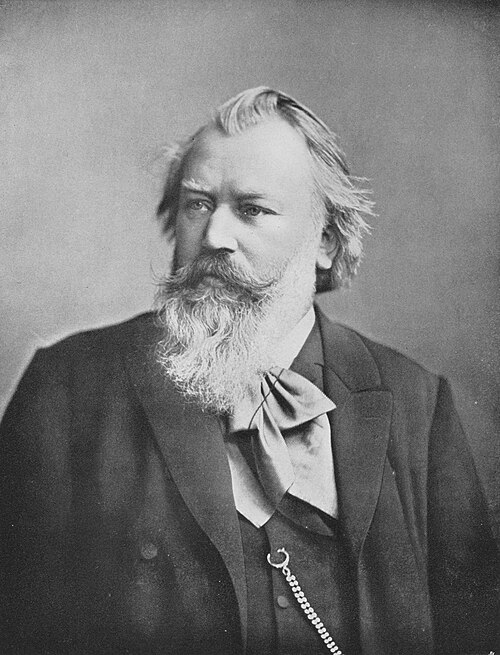
Composer
J. Brahms
German composer (1833–1897)
1833–1897
12 works and musical collections
- Born
- 1833
- Died
- 1897
- Birthplace
- Hamburg
- Place of death
- Vienna
- Citizenship / historical state
- Hamburg; Germany
- Period (estimated from birth year)
- Romantic
Biography
Johannes Brahms (; German: [joˈhanəs ˈbʁaːms] ; 7 May 1833 – 3 April 1897) was a German composer, pianist, and conductor of the mid-Romantic period. His music features expressive counterpoint, freer dissonance, rhythmic vitality, and traditional forms. His works include four symphonies, four concertos, a Requiem, much chamber music, and hundreds of folk-song arrangements and Lieder (German art songs).
Born in Hamburg to a musical family, Brahms composed and performed locally in his youth before touring Central Europe as a pianist, premiering his own works and meeting Franz Liszt in Weimar. He worked with Ede Reményi and, through Joseph Joachim, gained Robert and Clara Schumann's support and guidance. He lived with Clara in Düsseldorf, becoming devoted to her amid Robert's voluntary commitment. After Robert's death, they remained close friends. Brahms never married, focusing on his work as a composer prone to self-criticism.
Though innovative, he was deemed conservative in the War of the Romantics, in which he regretted his involvement. But his works succeeded, gaining him a circle of supporters, friends, and musicians. Eduard Hanslick hailed them as absolute music, and Hans von Bülow named him the heir to Johann Sebastian Bach and Ludwig van Beethoven, which Richard Wagner mocked. In Vienna, he led the Singakademie and Gesellschaft der Musikfreunde, programming the early and often "serious" music he studied. He considered retiring from composition late in life but kept writing chamber music for prized musicians.
He shared mutual admiration with Antonín Dvořák and Johann Strauss II. A new generation, including Max Reger and Alexander Zemlinsky, blended his style with Wagner's. So did Arnold Schoenberg, stressing the "progressive" structural coherence (developing variation) of Brahms's music. It remains a staple of the concert repertoire, influencing 21st-century composers.
Biography excerpt from Wikipedia contributors, available under CC BY-SA 4.0. Formatting and reference markers have been removed; the introduction may be shortened. View contributors and article history.
Life and musical career
- Teachers
- Eduard Marxsen
- Career institutions / employers
- University of Music and Performing Arts Vienna; Wiener Singakademie; Gesellschaft der Musikfreunde
- Recorded memberships
- Académie des beaux-arts; Academy of Arts, Berlin; University singers and bards of Vienna; Sängerschaft zu St. Pauli Jena
- Movements
- Romantic music
- Notable works
- Symphony No. 4; Symphony No. 1; Academic Festival Overture; Tragic Overture; A German Requiem; Symphony No. 3; Hungarian Dances; Clarinet Sonatas
- Awards
- Pour le Mérite for Sciences and Arts order; Bavarian Maximilian Order for Science and Art; Royal Philharmonic Society Gold Medal; honorary doctor of the University of Wrocław; honorary doctorate from the University of Cambridge; honorary citizen of Hamburg; Order of Leopold; Austrian Decoration for Science and Art
- Official website
- https://www.brahms-institut.de/index.php/de/allgemeines
- Pseudonym
- G.W. Marks
- Languages used
- German
- VIAF ID
- 7573295
- ISNI
- 0000000121195925
- GND ID
- 118514253
- Library of Congress ID
- n79077221
- MusicBrainz ID
- c70d12a2-24fe-4f83-a6e6-57d84f8efb51
Recorded in Wikidata. Affiliations may refer to earlier stages of the composer's career.
In this catalogue
- Common listed instruments
- Cello, Clarinet, Piano, Double Bass, Flute
- Genres represented
- Classical, Jazz, New Age, Pop
- Source entries with composition dates
- 2
These details describe the indexed sheet music, including arrangements.
Catalogue
Sheet music catalogue
Instruments describe listed editions, including arrangements. Composition dates and keys appear where recorded; collection pages show their individual contents.
| Title | Work details | Listed instruments | Sheet music |
|---|---|---|---|
| Hungarian Dance No. 5 | See work details |
11 more instruments
| View sheet music |
| Country Gardens | See work details |
| View sheet music |
| The Sandman | See work details |
| View sheet music |
| Danza Ungherese N. 5 | See work details | See edition details | View sheet music |
| Sapphische Ode | See work details | See edition details | View sheet music |
| Lullaby | See work details |
| View sheet music |
| Waltz | See work details | See edition details | View sheet music |
| Waltz, Op. 39, No. 15 |
| See edition details | View sheet music |
| Ave Maria | See work details | See edition details | View sheet music |
| Waltz Op 39 No 15 |
| See edition details | View sheet music |
| Cradle Song Guten Abend, gut Nacht | See work details | See edition details | View sheet music |
| Waltz, Op. 39, No. 15 for Piano |
| See edition details | View sheet music |
Biographical record: Wikidata, matched on name and checked against dates held in the catalogue. The period label is an estimate from birth year. Authority record: VIAF 7573295. Portrait: C. Brasch , Berlin ( biography ), Public domain, via Wikimedia Commons.