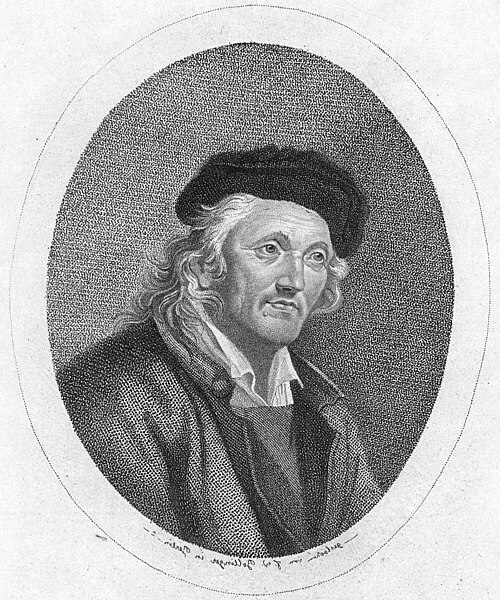
Composer
J. P. Kirnberger
German composer
1721–1783
1 works and musical collections
- Born
- 1721
- Died
- 1783
- Birthplace
- Saalfeld
- Place of death
- Berlin
- Citizenship / historical state
- Germany
- Period (estimated from birth year)
- Classical
Biography
Johann Philipp Kirnberger (also Kernberg; 24 April 1721, Saalfeld – 27 July 1783, Berlin) was a musician, composer (primarily of fugues) and music theorist. He studied the organ with Johann Peter Kellner and Heinrich Nicolaus Gerber, and starting in 1738 he studied with the violinist Meil in Sondershausen, but most significant is the time he spent from 1739 until 1741 (with breaks) studying performance and composition with Johann Sebastian Bach.
Between 1741 and 1751 Kirnberger lived and worked in Poland for powerful magnates including Lubomirski, Poninski, and Rzewuski before ending up at the Benedictine Cloister in Lviv (then part of Poland). He spent much time collecting Polish national dances and compiled them in his treatise Die Charaktere der Tänze. Kirnberger played a significant role in the intellectual and cultural exchange between Germany and Poland in the mid-18th century.
Kirnberger became a violinist at the court of Frederick the Great in 1751. He was the music director to the Prussian Princess Anna Amalia from 1758 until his death.
Kirnberger greatly admired Johann Sebastian Bach, deeming him "the greatest of all composers". Kirnberger sought to secure the publication of all of Bach's chorale settings, which finally appeared after Kirnberger's death; see Kirnberger chorale preludes (BWV 690–713). Many of Bach's manuscripts have been preserved in Kirnberger's library (the "Kirnberger collection").
Kirnberger is known today primarily for his theoretical work Die Kunst des reinen Satzes in der Musik (The Art of Strict Composition in Music, 1774, 1779). The well-tempered tuning systems known as "Kirnberger II" and "Kirnberger III" are associated with his name (see Kirnberger temperament), as is a rational version of equal temperament (see schisma). One of his most familiar compositions is Fuga in C-dur für Orgel ("Fanfare" Fugue), which was formerly attributed to Johann Sebastian Bach and then to his son Carl Philipp Emanuel Bach.
Biography excerpt from Wikipedia contributors, available under CC BY-SA 4.0. Formatting and reference markers have been removed; the introduction may be shortened. View contributors and article history.
Life and musical career
- Occupations
- composer; musicologist; conductor; music theorist
- Instruments played
- violin
- Genres
- classical music
- Movements
- Baroque music
- Languages used
- German
- VIAF ID
- 54412054
- ISNI
- 0000000109029342
- GND ID
- 118777238
- Library of Congress ID
- n81015265
- MusicBrainz ID
- 3addeeb4-e758-45cc-a655-8d7f1b3977af
Recorded in Wikidata. Affiliations may refer to earlier stages of the composer's career.
In this catalogue
- Source entries with composition dates
- 0
These details describe the indexed sheet music, including arrangements.
Catalogue
Sheet music catalogue
Instruments describe listed editions, including arrangements. Composition dates and keys appear where recorded; collection pages show their individual contents.
| Title | Work details | Listed instruments | Sheet music |
|---|---|---|---|
| Air | See work details | See edition details | View sheet music |
Biographical record: Wikidata, matched on name and checked against dates held in the catalogue. The period label is an estimate from birth year. Authority record: VIAF 54412054. Portrait: Friedrich Wilhelm Bollinger, Public domain, via Wikimedia Commons.