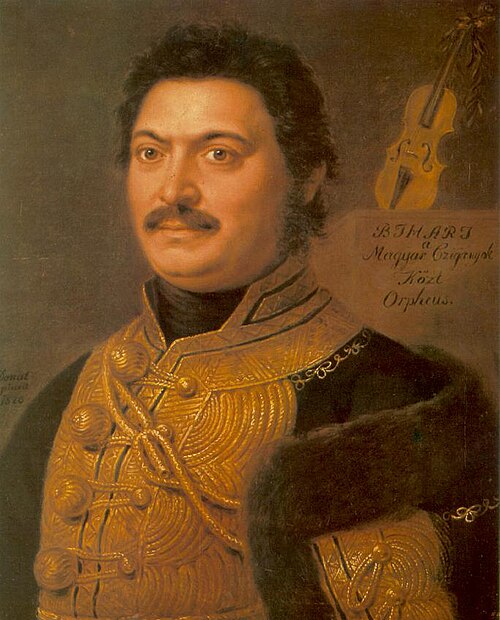
Composer
Janos Bihari
Hungarian musician and music composer
1764–1827
2 works and musical collections
- Born
- 1764
- Died
- 1827
- Birthplace
- Veľké Blahovo
- Place of death
- Pest
- Citizenship / historical state
- Hungary
- Period (estimated from birth year)
- Classical
Biography
János Bihari (21 October 1764 – 26 April 1827) was an influential Hungarian Romani violinist. He is one of the founders of Romani academic music and the musical genre verbunkos.
By the middle of the nineteenth century, "Gypsy music" was elevated to high fashion, the first great was that of János Bihari, the pianist Franz Liszt described: "The tones sung by his magic violin flow on our enchanted ears like the tears...".
Biography excerpt from Wikipedia contributors, available under CC BY-SA 4.0. Formatting and reference markers have been removed; the introduction may be shortened. View contributors and article history.
Life and musical career
- Instruments played
- violin
- Languages used
- Hungarian
- VIAF ID
- 23234570
- ISNI
- 0000000120223728
- GND ID
- 129996521
- Library of Congress ID
- no2005081340
- MusicBrainz ID
- d39b7b2a-0b82-4095-87f1-73208ce61dba
Recorded in Wikidata. Affiliations may refer to earlier stages of the composer's career.
In this catalogue
- Common listed instruments
- Accordion
- Genres represented
- Classical
- Source entries with composition dates
- 0
These details describe the indexed sheet music, including arrangements.
Catalogue
Sheet music catalogue
Instruments describe listed editions, including arrangements. Composition dates and keys appear where recorded; collection pages show their individual contents.
| Title | Work details | Listed instruments | Sheet music |
|---|---|---|---|
| Magyar toborzo Hungarian Recruiting Dance | See work details |
| View sheet music |
| Verbunkos | See work details |
| View sheet music |
Biographical record: Wikidata, matched on name and checked against dates held in the catalogue. The period label is an estimate from birth year. Authority record: VIAF 23234570. Portrait: János Donát, Public domain, via Wikimedia Commons.