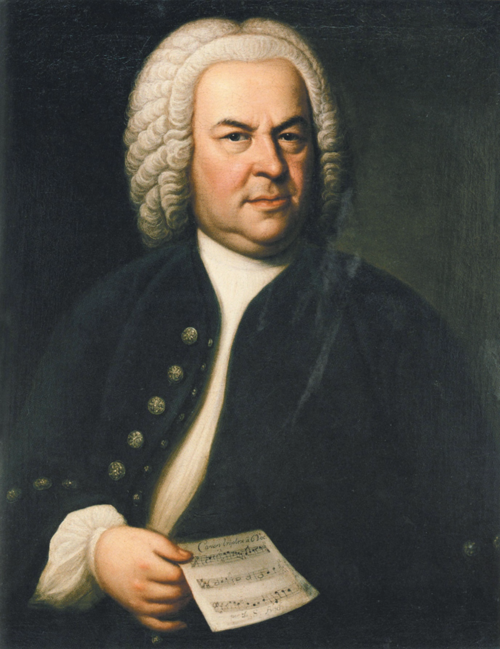
Composer
J.S.Bach
German composer (1685–1750)
1685–1750
3 works and musical collections
- Born
- 1685
- Died
- 1750
- Birthplace
- Eisenach
- Place of death
- Leipzig
- Citizenship / historical state
- Duchy of Saxe-Eisenach; Holy Roman Empire
- Period (estimated from birth year)
- Baroque
Biography
Johann Sebastian Bach (31 March [O.S. 21 March] 1685 – 28 July 1750) was a German composer and musician of the late Baroque period. He is known for his prolific output across a variety of instruments and forms, including the orchestral Brandenburg Concertos; solo instrumental works such as the Cello Suites and Sonatas and Partitas for Solo Violin; keyboard works such as the Goldberg Variations and The Well-Tempered Clavier; organ works such as the Schübler Chorales and the Toccata and Fugue in D minor; and choral works such as the St. Matthew Passion and the Mass in B minor. He is known for his mastery of counterpoint, as heard in The Musical Offering and The Art of Fugue. Felix Mendelssohn precipitated the Bach Revival with a performance of the St. Matthew Passion in 1829. Ever since, Bach has been acclaimed as one of the greatest composers in the history of Western music.
The Bach family had already produced several composers when Johann Sebastian was born in Eisenach, the youngest child of the city musician Johann Ambrosius Bach. After being orphaned at age 10, he lived for five years with his eldest brother, Johann Christoph, then continued his musical education in Lüneburg. In 1703 he returned to Thuringia, working as a musician for Protestant churches in Arnstadt and Mühlhausen. Around that time he also paid extended visits to the courts in Weimar, where he expanded his organ repertory, and the reformed court at Köthen, where he was mostly engaged with chamber music. By 1723 he was hired as Thomaskantor, church music director of the city of Leipzig and thus responsible for music in four Lutheran city churches and for the St. Thomas School. He decided to compose annual cycles of church cantatas, and also wrote music for Leipzig University's student ensemble, Collegium Musicum. In 1726 he began publishing his organ and other keyboard music. In Leipzig, he had difficult relations with his employer, as he had during some of his earlier positions. This situation was somewhat remedied when his sovereign, Augustus III of Poland, granted him the title of court composer of the Elector of Saxony in 1736. In the last decades of his life, Bach reworked and extended many of his earlier compositions. He died due to complications following eye surgery in 1750 at the age of 65. Four of his twenty children, Wilhelm Friedemann, Carl Philipp Emanuel, Johann Christoph Friedrich, and Johann Christian, became composers.
Biography excerpt from Wikipedia contributors, available under CC BY-SA 4.0. Formatting and reference markers have been removed; the introduction may be shortened. View contributors and article history.
Life and musical career
- Occupations
- composer; organist; harpsichordist; violinist; conductor; choir director; concertmaster; musicologist; music educator; virtuoso; school teacher
- Education
- St. Michael's School
- Teachers
- Johann Ambrosius Bach; Johann Christoph Bach III; Johann Ludwig Bach; Johann Christoph Bach II; Dietrich Buxtehude
- Career institutions / employers
- Johann Ernst III, Duke of Saxe-Weimar; Bachkirche Arnstadt; Saint Blaise; Leopold, Prince of Anhalt-Köthen; Thomasschule zu Leipzig; Collegium Musicum
- Instruments played
- organ; harpsichord; violin; viola; pipe organ
- Genres
- Baroque music
- Movements
- Baroque music
- Selected notable works
- Brandenburg Concertos; Cello Suites; Sonatas and partitas for solo violin; Notebook for Anna Magdalena Bach; Klavierbüchlein für Wilhelm Friedemann Bach; Mass in B minor; Violin Concerto in E major; Gottes Zeit ist die allerbeste Zeit, BWV 106; Toccata and Fugue in D minor, BWV 565; Italian Concerto; The Musical Offering; The Art of Fugue
- Native languages
- German
- VIAF ID
- 12304462
- ISNI
- 0000000122764157
- GND ID
- 11850553X
- Library of Congress ID
- n79021425
- MusicBrainz ID
- 24f1766e-9635-4d58-a4d4-9413f9f98a4c
Recorded in Wikidata. Affiliations may refer to earlier stages of the composer's career.
In this catalogue
- Source entries with composition dates
- 0
These details describe the indexed sheet music, including arrangements.
Catalogue
Sheet music catalogue
Instruments describe listed editions, including arrangements. Composition dates and keys appear where recorded; collection pages show their individual contents.
| Title | Work details | Listed instruments | Sheet music |
|---|---|---|---|
| Minuet and Badinerie | See work details | See edition details | View sheet music |
| First Prelude and Fugue from The Well-Tempered Clavier, Book I | See work details | See edition details | View sheet music |
| Little Prelude in C Major |
| See edition details | View sheet music |
Biographical record: Wikidata, matched on name and checked against dates held in the catalogue. The period label is an estimate from birth year. Authority record: VIAF 12304462. Portrait: Elias Gottlob Haussmann, Public domain, via Wikimedia Commons.