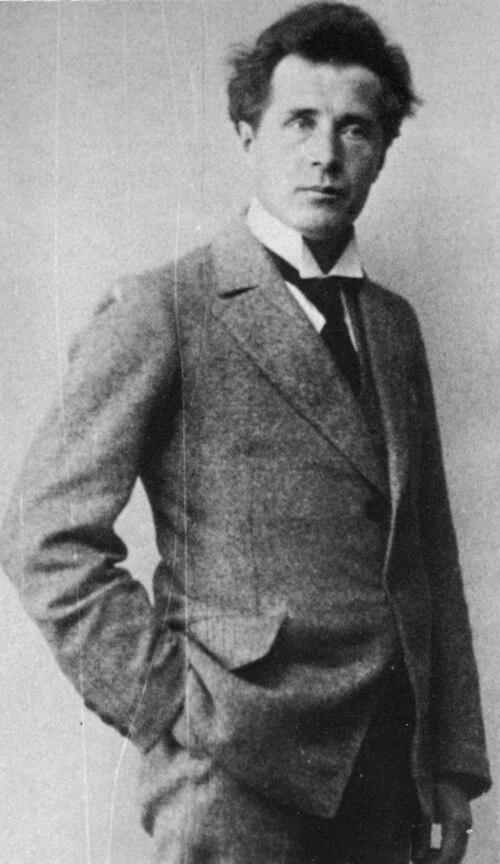
Composer
Leevi Madetoja
Finnish composer (1887–1947)
1887–1947
19 works and musical collections
- Born
- 1887
- Died
- 1947
- Birthplace
- Oulu
- Place of death
- Helsinki
- Citizenship / historical state
- Finland; Grand Duchy of Finland
- Period (estimated from birth year)
- Modern
Biography
Leevi Antti Madetoja (pronounced [ˈleːʋi ˈmɑdetˌojɑ]; 17 February 1887 – 6 October 1947) was a Finnish composer, music critic, conductor, and teacher of the late-Romantic and early-modern periods. He is widely recognized as one of the most significant Finnish contemporaries of Jean Sibelius, under whom he studied privately from 1908 to 1910.
The core of Madetoja's oeuvre consists of a set of three symphonies (1916, 1918, and 1926), arguably the finest early-twentieth century additions to the symphonic canon of any Finnish composer, Sibelius excepted. As central to Madetoja's legacy is Pohjalaisia (The Ostrobothnians, 1923), proclaimed Finland's "national opera" following its successful 1924 premiere and, even today, a stalwart of the country's repertoire. Other notable works include an Elegia for strings (1909); Kuoleman puutarha (The Garden of Death, 1918–21), a three-movement suite for solo piano; the Japanisme ballet-pantomime, Okon Fuoko (1927); and, a second opera, Juha (1935). Madetoja's fourth symphony, purportedly lost in 1938 at a Paris railway station, never materialized.
Acclaimed during his lifetime, Madetoja today is seldom heard outside the Nordic countries, although his music has in recent decades enjoyed a renaissance, as the recording projects of a number of Nordic orchestras and conductors evidence. His idiom is notably introverted for a national Romantic composer, a blend of Finnish melancholy, folk melodies from his native region of Ostrobothnia, and the elegance and clarity of the French symphonic tradition, founded on César Franck and guided by Vincent d'Indy. His music also reveals Sibelius's influence.
Madetoja was also an influential music critic, primarily with the newspaper Helsingin sanomat (1916–32), in which he reviewed the music scenes of France and Finland, praising Sibelius in particular. In 1918, he married the Finnish poet L. Onerva; their marriage was tempestuous and remained childless. His health failing due to alcoholism, Madetoja died from a heart attack on 6 October 1947 in Helsinki.
Biography excerpt from Wikipedia contributors, available under CC BY-SA 4.0. Formatting and reference markers have been removed; the introduction may be shortened. View contributors and article history.
Life and musical career
- Occupations
- conductor; composer; choreographer; musicologist; music critic; librettist
- Education
- University of Helsinki; Oulun Lyseon Lukio
- Teachers
- Jean Sibelius; Vincent d'Indy
- Genres
- opera; symphony; classical music; art song; chamber music
- Awards
- Knight First Class of the Order of the White Rose of Finland; Knight First Class of the Order of St. Olav
- Birth name
- Leevi Antti Madetoja
- Native languages
- Finnish
- Languages used
- Finnish
- VIAF ID
- 76427938
- ISNI
- 0000000081566225
- GND ID
- 118854887
- Library of Congress ID
- n81081339
- MusicBrainz ID
- a6d6e77f-e284-45b8-b54f-e6e881339d9a
Recorded in Wikidata. Affiliations may refer to earlier stages of the composer's career.
In this catalogue
- Common listed instruments
- Piano, Cello
- Genres represented
- Classical
- Source entries with composition dates
- 1
These details describe the indexed sheet music, including arrangements.
Catalogue
Sheet music catalogue
Instruments describe listed editions, including arrangements. Composition dates and keys appear where recorded; collection pages show their individual contents.
| Title | Work details | Listed instruments | Sheet music |
|---|---|---|---|
| Scherzino | See work details |
| View sheet music |
| Melancolie | See work details |
| View sheet music |
| Pianokappaletta, Op.31 |
|
| View sheet music |
| Kansanlaulu/Folk Song | See work details |
| View sheet music |
| Romanssi | See work details |
| View sheet music |
| Kuoleman Puutarha, Op.41 |
|
| View sheet music |
| Pastoraalisarja, Op.34 |
|
| View sheet music |
| Leikki/A Game | See work details |
| View sheet music |
| Menuetto Vanhaan Tyyliin | See work details |
| View sheet music |
| 6 Pianokappaletta, Op.12 |
|
| View sheet music |
| 2 Romances, Op.17 |
|
| View sheet music |
| Du Var Mig Mera Nara | See work details |
| View sheet music |
| Tanssi/Dance | See work details |
| View sheet music |
| Prelude | See work details |
| View sheet music |
| Kansanlaulu | See work details |
| View sheet music |
| Kleine Romanze / Pieni Romanssi | See work details |
| View sheet music |
| Paysage | See work details |
| View sheet music |
| Matin | See work details |
| View sheet music |
| Caprice | See work details |
| View sheet music |
Biographical record: Wikidata, matched on name and checked against dates held in the catalogue. The period label is an estimate from birth year. Authority record: VIAF 76427938. Portrait: Anonymous Unknown author, Public domain, via Wikimedia Commons.