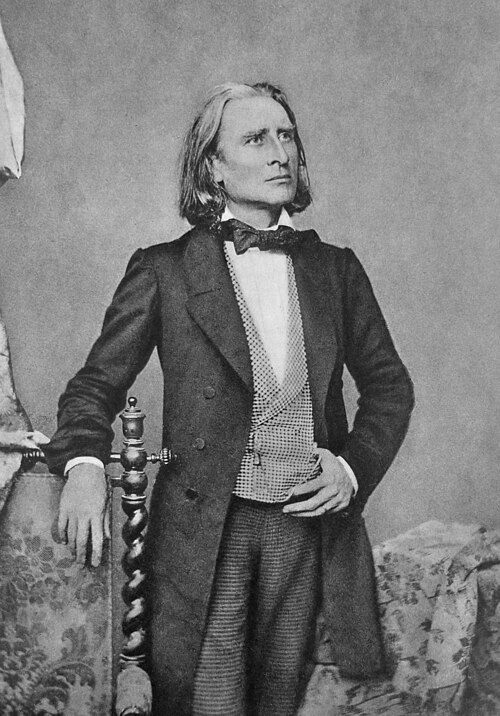
Composer
Liszt, Franz
Hungarian romantic composer and virtuoso pianist (1811-1886)
1811–1886
21 works in the index
- Born
- 1811
- Died
- 1886
- Birthplace
- Raiding
- Place of death
- Bayreuth
- Citizenship / historical state
- Kingdom of Hungary; Austrian Empire; Austria–Hungary
- Period (estimated from birth year)
- Romantic
Biography
Franz Liszt (22 October 1811 – 31 July 1886) was a Hungarian composer, virtuoso pianist, conductor and teacher of the Romantic period. With a diverse body of work spanning more than six decades, he is considered to be one of the most prolific and influential composers of his era, and his piano works continue to be widely performed and recorded.
Liszt achieved success as a concert pianist from an early age, and received lessons from the esteemed musicians Carl Czerny and Antonio Salieri. He gained further renown for his performances during tours of Europe in the 1830s and 1840s, developing a reputation for technical brilliance as well as physical attractiveness. In a phenomenon dubbed "Lisztomania", he rose to a degree of stardom and popularity among the public not experienced by the virtuosos who had preceded him.
During this period and into his later life, Liszt was a friend, musical promoter and benefactor to many composers of his time, including Hector Berlioz, Frédéric Chopin, Robert Schumann, Clara Schumann and Richard Wagner, among others. Liszt was the first to apply the terms "transcription" and "paraphrase" to music, and would perform arrangements of his contemporaries' music to popularise it. Alongside Wagner, Liszt was one of the most prominent representatives of the New German School, a progressive group of composers involved in the "War of the Romantics" who developed ideas of programmatic music and harmonic experimentation.
Liszt taught piano performance to hundreds of students throughout his life, many of whom went on to become notable performers. He left behind an extensive and diverse body of work that influenced his forward-looking contemporaries and anticipated 20th-century ideas and trends. Among Liszt's musical contributions were the concept of the symphonic poem, innovations in thematic transformation and Impressionism in music, and the invention of the masterclass as a method of teaching performance. In a radical departure from his earlier compositional styles, many of Liszt's later works also feature experiments in atonality, foreshadowing developments in 20th-century classical music. Today he is best known for his original piano works, such as the Hungarian Rhapsodies, Années de pèlerinage, Transcendental Études, "La campanella", and the Piano Sonata in B minor.
Biography excerpt from Wikipedia contributors, available under CC BY-SA 4.0. Formatting and reference markers have been removed; the introduction may be shortened. View contributors and article history.
Life and musical career
- Occupations
- classical composer; pianist; conductor; music educator; virtuoso; composer; writer; Catholic priest; musician; piano teacher
- Teachers
- Adam Liszt; Carl Czerny; Antonio Salieri; Anton Reicha; Ferdinando Paër
- Career institutions / employers
- Franz Liszt Academy of Music
- Recorded memberships
- Sängerschaft zu St. Pauli Jena; Accademia Tiberina
- Movements
- Romantic music
- Notable works
- Hamlet; Dante Symphony; Mazeppa; Hungarian Rhapsody No. 1; Hungarian Roidy No. 2
- Awards
- Pour le Mérite for Sciences and Arts order; Order of the Golden Spur; Bavarian Maximilian Order for Science and Art; Commander of the Order of Christ; honorary doctor of the University of Königsberg; Knight of the Order of the Iron Crown (Austria)
- Birth name
- Franz Liszt
- Native languages
- German
- VIAF ID
- 64199483
- ISNI
- 000000012280979X
- GND ID
- 118573527
- Library of Congress ID
- n79079048
- MusicBrainz ID
- 2cd475bb-1abd-40c4-9904-6d4b691c752c
Recorded in Wikidata. Affiliations may refer to earlier stages of the composer's career.
In this catalogue
- Works with composition dates
- 0 of 21
These details describe the indexed sheet music, including arrangements.
Catalogue
Works
Years are composition dates where known. Instruments describe editions in our catalogue and may include arrangements. A dash means the detail is not recorded.
Biographical record: Wikidata, matched on name and checked against dates held in the catalogue. The period label is an estimate from birth year. Authority record: VIAF 64199483. Portrait: Franz Hanfstaengl, Public domain, via Wikimedia Commons.