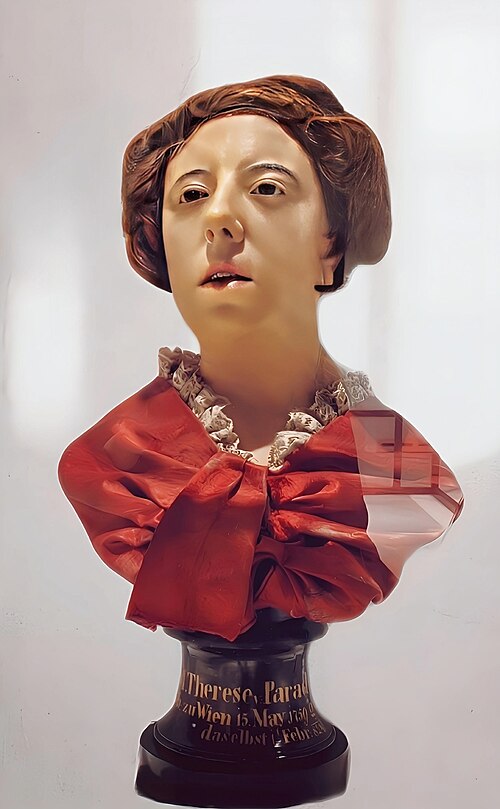
Composer
Maria Theresia Von Paradis
Austrian musician and composer (1759–1824)
1759–1824
1 work in the index
- Born
- 1759
- Died
- 1824
- Birthplace
- Vienna
- Citizenship / historical state
- Austrian Empire
- Period (estimated from birth year)
- Classical
Biography
Maria Theresia Von Paridis, an Austrian vocalist, pianist and composer, a blind woman firmly grounded socially in the Imperial court in Vienna Austria in the late 18th century, performed in salons and concert halls in that city. She also toured to perform in Paris; London (where she played Handel fugues to King George III and later accompanied a prominent cellist, the Prince of Wales); Germany; and Switzerland. She was instrumental in the development of devices used by the blind to score music. Her acquaintances included Wolfgang Amadeus Mozart and C.P.E. Bach and her compositional style combined the lyrical features of the music of Vienna and Italy with the more dramatic nature of music in Berlin. In 1797 her opera, “Rinalda und Alcina” opened in Prague. Unfortunately, this was not a success: it closed after only two performances. The failure induced Paridis to work less on composition and more on education. She founded a music school thereafter, as well as a school for the blind.
In this catalogue
- Common listed instruments
- Organ, Piano, Trombone
- Genres represented
- Classical
- Works with composition dates
- 0 of 1
These details describe the indexed sheet music, including arrangements.
Catalogue
Works
Years are composition dates where known. Instruments describe editions in our catalogue and may include arrangements. A dash means the detail is not recorded.
| Work | Year composed | Catalogue / opus | Key in title | Listed instruments | Genre | Editions |
|---|---|---|---|---|---|---|
| Sicilienne | — | — | — | Piano, Organ, Trombone | Classical | 8 |
Biographical record: Wikidata, matched on name and checked against dates held in the catalogue. The period label is an estimate from birth year. Authority record: VIAF 24867189. Portrait: R i p, CC BY-SA 4.0, via Wikimedia Commons.