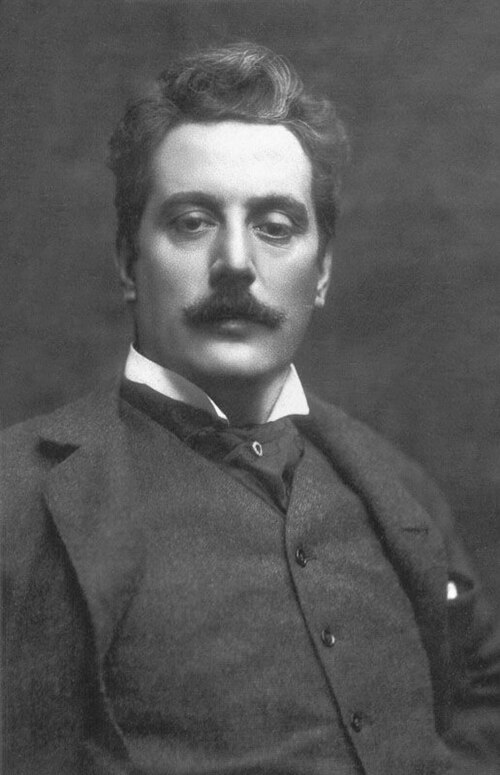
Composer
Puccini
Italian opera composer (1858–1924)
1858–1924
7 works and musical collections
- Born
- 1858
- Died
- 1924
- Birthplace
- Lucca
- Place of death
- Brussels
- Citizenship / historical state
- Kingdom of Italy; Grand Duchy of Tuscany
- Period (estimated from birth year)
- Romantic
Biography
Giacomo Antonio Domenico Michele Secondo Maria Puccini (1858 – 1924) was an Italian composer known primarily for his operas. Widely regarded as the greatest and most successful proponent of Italian opera after Verdi, he was descended from a long line of composers, stemming from the late Baroque era. Though his early work was firmly rooted in traditional late-nineteenth-century Romantic Italian opera, it later developed in the realistic verismo style, of which he became one of the leading exponents.
His most renowned works are La bohème (1896), Tosca (1900), Madama Butterfly (1904), and the unfinished Turandot (1926, posthumously completed by Franco Alfano), all of which are among the most frequently performed and recorded in the entirety of the operatic repertoire.
Biography excerpt from Wikipedia contributors, available under CC BY-SA 4.0. Formatting and reference markers have been removed; the introduction may be shortened. View contributors and article history.
Life and musical career
- Occupations
- opera composer; composer; politician; conductor; organist
- Education
- Milan Conservatory
- Teachers
- Amilcare Ponchielli; Antonio Bazzini
- Recorded memberships
- Royal Swedish Academy of Music
- Instruments played
- organ
- Genres
- classical music; opera; verismo; religious music
- Notable works
- La bohème; Tosca; Madama Butterfly; Turandot; Gianni Schicchi; Crisantemi
- Birth name
- Giacomo Antonio Domenico Michele Secondo Maria Puccini
- Languages used
- Italian
- VIAF ID
- 95156473
- ISNI
- 0000000121031832
- GND ID
- 118596942
- Library of Congress ID
- n79119152
- MusicBrainz ID
- a693df4a-8762-4a45-b7fd-6695b558385e
Recorded in Wikidata. Affiliations may refer to earlier stages of the composer's career.
In this catalogue
- Common listed instruments
- Trombone, Viola, Accordion, Cello, Clarinet
- Genres represented
- Classical
- Source entries with composition dates
- 2
These details describe the indexed sheet music, including arrangements.
Catalogue
Sheet music catalogue
Instruments describe listed editions, including arrangements. Composition dates and keys appear where recorded; collection pages show their individual contents.
| Title | Work details | Listed instruments | Sheet music |
|---|---|---|---|
| In Quelle Trine Morbide | See work details |
6 more instruments
| View sheet music |
| Vals De Mussetta |
| See edition details | View sheet music |
| "Oh my beloved Papa, from Gianni Schicchi" | See work details |
| View sheet music |
| La Bohème |
| See edition details | View sheet music |
| O Mio Babbino Caro | See work details | See edition details | View sheet music |
| Nessun Dorma | See work details |
4 more instruments
| View sheet music |
| Musetta's Waltz from the Opera "La Boheme" | See work details | See edition details | View sheet music |
Biographical record: Wikidata, matched on name and checked against dates held in the catalogue. The period label is an estimate from birth year. Authority record: VIAF 95156473. Portrait: Unknown author Unknown author, Public domain, via Wikimedia Commons.