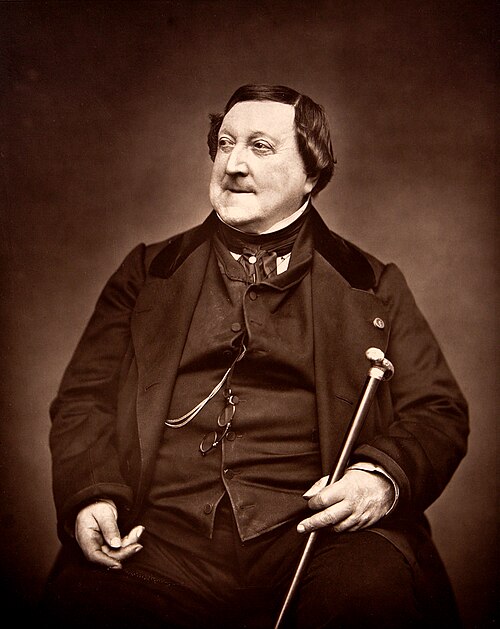
Composer
Rossini, Gioachino
Italian opera composer (1792–1868)
1792–1868
2 works and musical collections
- Born
- 1792
- Died
- 1868
- Birthplace
- Pesaro
- Place of death
- Passy
- Citizenship / historical state
- Kingdom of Italy; Papal States
- Period (estimated from birth year)
- Romantic
Biography
Gioachino Antonio Rossini (29 February 1792 – 13 November 1868) was an Italian composer and conductor of the late Classical and early Romantic eras. While he gained most of his fame for his 39 operas, he also wrote many pieces of chamber music, piano, and some sacred music. He set new standards for both comic and serious opera before retiring from large-scale composition while still in his thirties, at the height of his popularity.
Born in Pesaro to parents who were both musicians (his father a trumpeter, his mother a singer), Rossini began to compose by the age of twelve and was educated at music school in Bologna. His first opera was performed in Venice in 1810 when he was 18 years old. In 1815 he was engaged to write operas and manage theatres in Naples. In the period 1810–1823, he wrote 34 operas for the Italian stage that were performed in Venice, Milan, Ferrara, Naples and elsewhere; this productivity necessitated an almost formulaic approach for some components (such as overtures) and a certain amount of self-borrowing. During this period he produced his most popular works, including the comic operas L'italiana in Algeri, Il barbiere di Siviglia (known in English as The Barber of Seville) and La Cenerentola, which brought to a peak the opera buffa tradition he inherited from masters such as Wolfgang Amadeus Mozart, Domenico Cimarosa and Giovanni Paisiello. He also composed opera seria works such as Tancredi, Otello and Semiramide. All of these attracted admiration for their innovation in melody, harmonic and instrumental colour, and dramatic form. In 1824 he was contracted by the Opéra in Paris, for which he produced an opera to celebrate the coronation of Charles X, Il viaggio a Reims (half the music of which was later reused for his first opera in French, Le comte Ory), revisions of two of his Italian operas, Le siège de Corinthe and Moïse, and in 1829 his last opera, Guillaume Tell.
Rossini's withdrawal from opera for the last 40 years of his life has never been fully explained; contributory factors may have been ill-health, the wealth his success had brought him, and the rise of spectacular grand opera under composers such as Giacomo Meyerbeer. From the early 1830s to 1855, when he left Paris and was based in Bologna, Rossini wrote relatively little. On his return to Paris in 1855 he became renowned for his musical salons on Saturdays, regularly attended by musicians and the artistic and fashionable circles of Paris, for which he wrote the entertaining pieces Péchés de vieillesse. Guests included Franz Liszt, Anton Rubinstein, Giuseppe Verdi, Meyerbeer, and Joseph Joachim. Rossini's last major composition was his Petite messe solennelle (1863).
Biography excerpt from Wikipedia contributors, available under CC BY-SA 4.0. Formatting and reference markers have been removed; the introduction may be shortened. View contributors and article history.
Life and musical career
- Occupations
- composer
- Teachers
- Stanislao Mattei
- Recorded memberships
- Académie des beaux-arts; Accademia Tiberina
- Instruments played
- cello
- Genres
- opera; cantata; classical music
- Notable works
- The Barber of Seville; La Cenerentola; L'italiana in Algeri; Il turco in Italia; Il viaggio a Reims
- Awards
- Pour le Mérite for Sciences and Arts order; Grand Officer of the Legion of Honour; Order of Saint Stanislaus
- Birth name
- Gioachino Antonio Rossini
- Languages used
- Italian
- VIAF ID
- 34644407
- ISNI
- 000000012127560X
- GND ID
- 118602985
- Library of Congress ID
- n79074352
- MusicBrainz ID
- 846be3c9-5f94-46ab-97b9-531335dd3658
Recorded in Wikidata. Affiliations may refer to earlier stages of the composer's career.
In this catalogue
- Common listed instruments
- Clarinet, Piano
- Source entries with composition dates
- 1
These details describe the indexed sheet music, including arrangements.
Catalogue
Sheet music catalogue
Instruments describe listed editions, including arrangements. Composition dates and keys appear where recorded; collection pages show their individual contents.
| Title | Work details | Listed instruments | Sheet music |
|---|---|---|---|
| William Tell Overture |
|
| View sheet music |
| Tarantella Napoletana, La Danza | See work details |
| View sheet music |
Biographical record: Wikidata, matched on name and checked against dates held in the catalogue. The period label is an estimate from birth year. Authority record: VIAF 34644407. Portrait: Étienne Carjat, Public domain, via Wikimedia Commons.