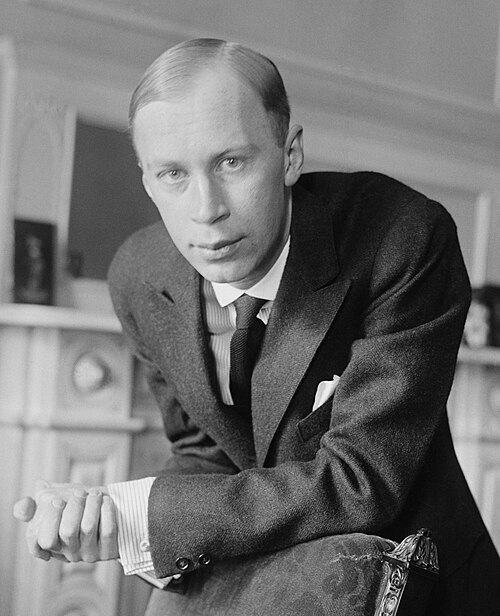
Composer
Serge Prokofieff
Russian and Soviet pianist, composer and conductor (1891–1953)
1891–1953
5 works and musical collections
- Born
- 1891
- Died
- 1953
- Birthplace
- Sontsivka
- Place of death
- Moscow
- Citizenship / historical state
- Russian Empire; Soviet Union
- Period (estimated from birth year)
- Modern
Biography
Sergei Sergeyevich Prokofiev (27 April [O.S. 15 April] 1891 – 5 March 1953) was a Russian composer, pianist, and conductor who later worked in the Soviet Union. As the creator of acknowledged masterpieces across numerous music genres, he is regarded as one of the major composers of the 20th century. His works include such widely heard pieces as the March from The Love for Three Oranges, the suite Lieutenant Kijé, the ballet Romeo and Juliet—from which "Dance of the Knights" is taken—and Peter and the Wolf. Of the established forms and genres in which he worked, he created—excluding juvenilia—seven completed operas, seven symphonies, eight ballets, five piano concertos, two violin concertos, a cello concerto, a symphony-concerto for cello and orchestra, and nine completed piano sonatas.
A graduate of the Saint Petersburg Conservatory, Prokofiev initially made his name as an iconoclastic composer-pianist, achieving notoriety with a series of ferociously dissonant and virtuosic works for his instrument, including his first two piano concertos. In 1915, Prokofiev made a decisive break from the standard composer-pianist category with his orchestral Scythian Suite, compiled from music originally composed for a ballet commissioned by Sergei Diaghilev of the Ballets Russes. Diaghilev commissioned three further ballets from Prokofiev—Chout, Le pas d'acier and The Prodigal Son—which, at the time of their original production, all caused a sensation among both critics and colleagues. But Prokofiev's greatest interest was opera, and he composed several works in that genre, including The Gambler and The Fiery Angel. Prokofiev's one operatic success during his lifetime was The Love for Three Oranges, composed for the Chicago Opera and performed over the following decade in Europe and Russia.
After the Revolution of 1917, Prokofiev left Russia with the approval of Soviet People's Commissar Anatoly Lunacharsky, and resided in the United States, then Germany, then Paris, making his living as a composer, pianist and conductor. In 1923 he married a Spanish singer, Carolina (Lina) Codina, with whom he had two sons; they divorced in 1947. In the early 1930s, the Great Depression diminished opportunities for Prokofiev's ballets and operas to be staged in America and Western Europe. Prokofiev, who regarded himself as a composer foremost, resented the time taken by touring as a pianist, and increasingly turned to the Soviet Union for commissions of new music; in 1936, he finally returned to his homeland with his family. His greatest Soviet successes included Lieutenant Kijé, Peter and the Wolf, Romeo and Juliet, Cinderella, Alexander Nevsky, the Fifth and Sixth Symphonies, On Guard for Peace, and the Piano Sonatas Nos. 6–8.
Biography excerpt from Wikipedia contributors, available under CC BY-SA 4.0. Formatting and reference markers have been removed; the introduction may be shortened. View contributors and article history.
Life and musical career
- Education
- Saint Petersburg Conservatory
- Recorded memberships
- Union of Soviet Composers
- Instruments played
- piano
- Genres
- opera; symphony; ballet; classical music
- Notable works
- Symphony No. 1; Symphony No. 4; Symphony No. 2; The Love for Three Oranges; Peter and the Wolf
- Selected awards
- Stalin Prize; Lenin Prize; Order of the Red Banner of Labour; Medal "For Valiant Labour in the Great Patriotic War 1941–1945"; Royal Philharmonic Society Gold Medal; People's Artist of the RSFSR; Medal "In Commemoration of the 800th Anniversary of Moscow"; Honored art worker of the Russian Soviet Federative Socialist Republic; Stalin Prize, 2nd degree; State Stalin Prize, 1st degree
- Languages used
- Russian
- VIAF ID
- 71579098
- ISNI
- 0000000121389711
- GND ID
- 118596721
- Library of Congress ID
- n80020330
- MusicBrainz ID
- 0e43fe9d-c472-4b62-be9e-55f971a023e1
Recorded in Wikidata. Affiliations may refer to earlier stages of the composer's career.
In this catalogue
- Common listed instruments
- Marimba, percussion, Piano, Xylophone, Double Bass
- Genres represented
- Classical
- Source entries with composition dates
- 1
These details describe the indexed sheet music, including arrangements.
Catalogue
Sheet music catalogue
Instruments describe listed editions, including arrangements. Composition dates and keys appear where recorded; collection pages show their individual contents.
| Title | Work details | Listed instruments | Sheet music |
|---|---|---|---|
| promenade | See work details |
| View sheet music |
| Scythian Suite |
|
1 more instruments
| View sheet music |
| Rain And The Rainbow | See work details |
| View sheet music |
| Alexander Nevsky | See work details |
| View sheet music |
| Romance | See work details |
| View sheet music |
Biographical record: Wikidata, matched on name and checked against dates held in the catalogue. The period label is an estimate from birth year. Authority record: VIAF 71579098. Portrait: Bain News Service, publisher, Public domain, via Wikimedia Commons.