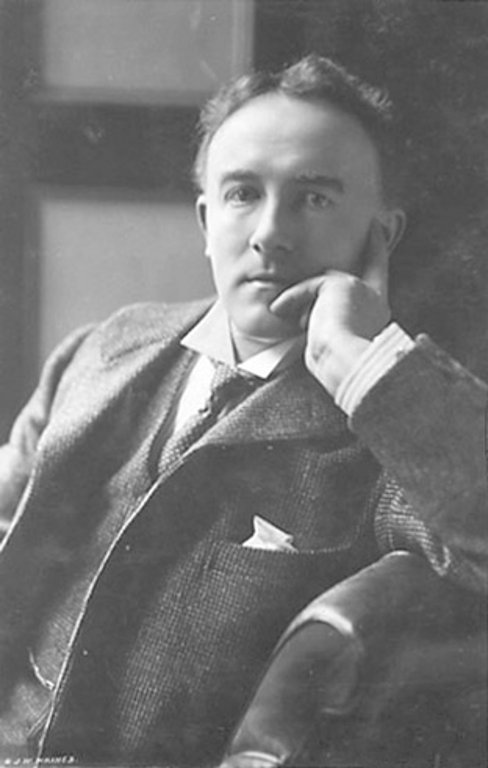
Composer
Sir Edward German
English musician and composer (1862–1936)
1862–1936
21 works and musical collections
- Born
- 1862
- Died
- 1936
- Birthplace
- Whitchurch
- Place of death
- London
- Citizenship / historical state
- United Kingdom; United Kingdom of Great Britain and Ireland
- Period (estimated from birth year)
- Modern
Biography
Sir Edward German (born German Edward Jones; 17 February 1862 – 11 November 1936) was an English musician and composer of Welsh descent, best remembered for his extensive output of incidental music for the stage and as a successor to Arthur Sullivan in the field of English comic opera. Some of his light operas, especially Merrie England, are still occasionally performed.
As a youth, German played the violin and led the town orchestra of Whitchurch, Shropshire. He also began to compose music. While performing and teaching violin at the Royal Academy of Music, German began to build a career as a composer in the mid-1880s, writing serious music as well as light opera. In 1888, he became music director of the Globe Theatre in London. He provided popular incidental music for many productions at the Globe and other London theatres, including Richard III (1889), Henry VIII (1892) and Nell Gwynn (1900). He also wrote symphonies, orchestral suites, symphonic poems and other works. He also wrote a considerable body of songs, piano music, and symphonic suites and other concert music, of which his Welsh Rhapsody (1904) is perhaps best known.
German was engaged to finish The Emerald Isle after the death of Arthur Sullivan in 1900, the success of which led to more comic operas, including Merrie England (1902) and Tom Jones (1907). He also wrote the Just So Song Book in 1903 to Rudyard Kipling's texts and continued to write orchestral music. German wrote little new music of his own after 1912, but he continued to conduct until 1928, the year in which he was knighted.
Biography excerpt from Wikipedia contributors, available under CC BY-SA 4.0. Formatting and reference markers have been removed; the introduction may be shortened. View contributors and article history.
Life and musical career
- Occupations
- composer; conductor; music educator
- Education
- Royal Academy of Music
- Career institutions / employers
- Royal Academy of Music
- Instruments played
- organ
- Genres
- opera
- Languages used
- English
- VIAF ID
- 79166704
- ISNI
- 0000000368502501; 0000000081591615
- GND ID
- 118957627
- Library of Congress ID
- n80166825
- MusicBrainz ID
- a6b017d9-7a17-42f1-a036-8829c449b6e5
Recorded in Wikidata. Affiliations may refer to earlier stages of the composer's career.
In this catalogue
- Common listed instruments
- percussion, Timpani, Harp, Organ, Piano
- Genres represented
- Classical
- Source entries with composition dates
- 0
These details describe the indexed sheet music, including arrangements.
Catalogue
Sheet music catalogue
Instruments describe listed editions, including arrangements. Composition dates and keys appear where recorded; collection pages show their individual contents.
| Title | Work details | Listed instruments | Sheet music |
|---|---|---|---|
| 2. Shepherd's Dance | See work details |
| View sheet music |
| Who'll Buy My Lavender? | See work details | See edition details | View sheet music |
| 1. Morris Dance | See work details |
1 more instruments
| View sheet music |
| 1. Valse-Lonely Life | See work details |
| View sheet music |
| 2. Allegro di Bravura | See work details |
| View sheet music |
| 2. Pastoral Dance | See work details |
| View sheet music |
| Interlude | See work details | See edition details | View sheet music |
| II. The Nodding Mandarin | See work details | See edition details | View sheet music |
| 2. Gavotte | See work details |
| View sheet music |
| 4. Tarantella | See work details |
| View sheet music |
| 3. Merrymaker's Dance | See work details |
| View sheet music |
| 3. Menuetto-Love Duet | See work details |
| View sheet music |
| German: Song Without Words | See work details | See edition details | View sheet music |
| I. Wondering | See work details | See edition details | View sheet music |
| III. Byelow Land | See work details | See edition details | View sheet music |
| 3. Jig | See work details |
| View sheet music |
| 1. Country Dance | See work details |
| View sheet music |
| 3. Torch Dance | See work details |
| View sheet music |
| Thanksgiving Hymn, Prelude to Act 5 "Henry VIII" | See work details |
| View sheet music |
| Intermezzo, Prelude to Act 2 "Henry VIII" | See work details |
| View sheet music |
| Henry VIII; Three Dances | See work details | See edition details | View sheet music |
Biographical record: Wikidata, matched on name and checked against dates held in the catalogue. The period label is an estimate from birth year. Authority record: VIAF 79166704. Portrait: Unknown author, Public domain, via Wikimedia Commons.