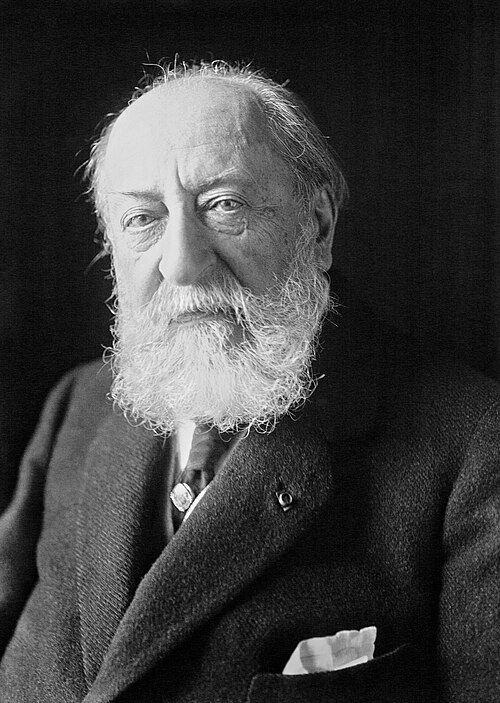
Composer
Camille Saint-Saëns
French composer, organist, conductor and pianist (1835–1921)
1835–1921
624 works and musical collections
- Born
- 1835
- Died
- 1921
- Birthplace
- 11th arrondissement of Paris
- Place of death
- Algiers
- Citizenship / historical state
- France
- Period (estimated from birth year)
- Romantic
Biography
Charles-Camille Saint-Saëns (UK: , US: ; French: [ʃaʁl kamij sɛ̃sɑ̃(s)] 9 October 1835 – 16 December 1921) was a French composer, organist, conductor and pianist of the Romantic era. His best-known works include Introduction and Rondo Capriccioso (1863), the Second Piano Concerto (1868), the First Cello Concerto (1872), Danse macabre (1874), the opera Samson and Delilah (1877), the Third Violin Concerto (1880), the Third ("Organ") Symphony (1886) and The Carnival of the Animals (1886).
Saint-Saëns was a musical prodigy; he made his concert debut at the age of ten. After studying at the Paris Conservatoire he followed a conventional career as a church organist, first at Saint-Merri, Paris and, from 1858, La Madeleine, the official church of the French Empire. After leaving the post twenty years later, he was a successful freelance pianist and composer, in demand in Europe and the Americas.
As a young man, Saint-Saëns was enthusiastic for the most modern music of the day, particularly that of Schumann, Liszt and Wagner, although his own compositions were generally within a conventional classical tradition. He was a scholar of musical history and remained committed to the structures worked out by earlier French composers. This brought him into conflict in his later years with composers of the impressionist and expressionist schools of music; although there were neoclassical elements in his music, foreshadowing works by Stravinsky and Les Six, he was often regarded as a reactionary in the decades around the time of his death.
Saint-Saëns held only one teaching post, at the École Niedermeyer in Paris, and remained there for less than five years. It was nevertheless important in the development of French music: his students included Gabriel Fauré, among whose own later pupils was Maurice Ravel. Both of them were strongly influenced by Saint-Saëns, whom they revered as a genius.
Biography excerpt from Wikipedia contributors, available under CC BY-SA 4.0. Formatting and reference markers have been removed; the introduction may be shortened. View contributors and article history.
Life and musical career
- Occupations
- composer; organist; conductor; pianist; music critic; music teacher; clarinetist; musicologist
- Education
- Conservatoire de Paris
- Recorded memberships
- Académie des beaux-arts
- Instruments played
- piano; violin; pipe organ
- Genres
- opera; symphony; classical music; concerto
- Movements
- classical music; Romantic music
- Notable works
- Piano Concerto No. 1; Piano Concerto No. 2; Symphony No. 3; Danse macabre; The Carnival of the Animals
- Awards
- Grand Cross of the Legion of Honour; Pour le Mérite for Sciences and Arts order; Grand Officer of the Legion of Honour; Commander of the Legion of Honour; Officer of the Legion of Honour; Knight of the Legion of Honour; Pour le Mérite; Royal Victorian Order; honorary doctorate from the University of Cambridge; Honorary doctor of the University of Oxford; Grand Cross of the Order of Saint-Charles
- Birth name
- Charles Camille Saint-Saëns
- Languages used
- French
- VIAF ID
- 7575200
- ISNI
- 0000000121195968
- GND ID
- 11875081X
- Library of Congress ID
- n50041617
- MusicBrainz ID
- 4137c070-15b2-4d00-a9f0-3517d02a9ba8
Recorded in Wikidata. Affiliations may refer to earlier stages of the composer's career.
In this catalogue
- Common listed instruments
- Piano, Orchestra, Voice, Organ, violin
- Genres represented
- Classical, Jazz, Christmas, Pop, Children
- Source entries with composition dates
- 164
These details describe the indexed sheet music, including arrangements.
Catalogue
Sheet music catalogue page 2 of 13
Instruments describe listed editions, including arrangements. Composition dates and keys appear where recorded; collection pages show their individual contents.
| Title | Work details | Listed instruments | Sheet music |
|---|---|---|---|
| Violin Concerto No.1, Op.20 |
|
| View sheet music |
| Violin Sonata No.1, Op.75 |
| See edition details | View sheet music |
| Violin Sonata No.2, Op.102 |
| See edition details | View sheet music |
| Danse Macabre them | See work details | See edition details | View sheet music |
| My Bonnie Lies Over The Ocean | See work details |
6 more instruments
| View sheet music |
| Kookaburra | See work details | See edition details | View sheet music |
| Pray to God on your knees | See work details |
| View sheet music |
| Printemps Qui Commence | See work details |
| View sheet music |
| Morceau de concert in E minor, Op. 62 |
|
| View sheet music |
| Ascanio |
| See edition details | View sheet music |
| Caprice héroïque, Op.106 |
| See edition details | View sheet music |
| Cello Sonata No.2, Op.123 |
| See edition details | View sheet music |
| 2 Choeurs, Op.68 |
| See edition details | View sheet music |
| Les cloches du soir, Op.85 |
|
| View sheet music |
| Tragédie lyrique |
| See edition details | View sheet music |
| 6 Etudes for the left hand, Op. 135 |
| See edition details | View sheet music |
| 6 Fugues, Op.161 |
|
| View sheet music |
| Henry VIII |
| See edition details | View sheet music |
| Litanies de la Sainte Vierge |
| See edition details | View sheet music |
| Marche Religieuse Op.107 |
|
| View sheet music |
| Coronation March |
|
5 more instruments
| View sheet music |
| Trois Mazurkas |
|
| View sheet music |
| Mélodies Persanes, op.26 |
|
| View sheet music |
| Troisième Concerto pour Piano et Orchestre, Op.29 |
|
| View sheet music |
| Polonaise, Op.77 |
| See edition details | View sheet music |
| Quam dilecta, Op.148 |
| See edition details | View sheet music |
| Rhapsodie d'Auvergne, Op.73 |
|
3 more instruments
| View sheet music |
| Samson et Dalila, Op.47 |
| See edition details | View sheet music |
| Suite for Cello and Piano, Op.16 |
| See edition details | View sheet music |
| Wedding Cake, Op. 76 |
|
| View sheet music |
| Finale (from Carnival of the Animals) | See work details |
| View sheet music |
| "Patiently, patiently have I waited do not have from Christmas Oratorio" | See work details | See edition details | View sheet music |
| Reverie Du Soir |
|
| View sheet music |
| Glory Be Unto God | See work details |
| View sheet music |
| Arise Now, Daughter | See work details |
| View sheet music |
| The rays of the dawn | See work details |
| View sheet music |
| 17. Prelude et Fugue | See work details |
| View sheet music |
| Introduction et Rondo capriccioso en la mineur pour violon et orchestre, op. 28 |
|
1 more instruments
| View sheet music |
| Marche héroïque in E-flat, op. 34 |
|
4 more instruments
| View sheet music |
| Ave Verum in E-flat (ca. 1860) |
| See edition details | View sheet music |
| Bénédiction Nuptiale Op.9 |
|
| View sheet music |
| Berceuse, Op.38 |
| See edition details | View sheet music |
| Cadenza for Beethoven's Violin Concerto, Op.61 |
|
| View sheet music |
| Caprice Andalous, Op.122 |
|
| View sheet music |
| Caprice arabe, Op.96 |
| See edition details | View sheet music |
| Cello Concerto No.1 |
|
| View sheet music |
| La cloche |
| See edition details | View sheet music |
| Deus Abraham |
| See edition details | View sheet music |
Biographical record: Wikidata, matched on name and checked against dates held in the catalogue. The period label is an estimate from birth year. Authority record: VIAF 7575200. Portrait: Agence de presse Meurisse, Public domain, via Wikimedia Commons.