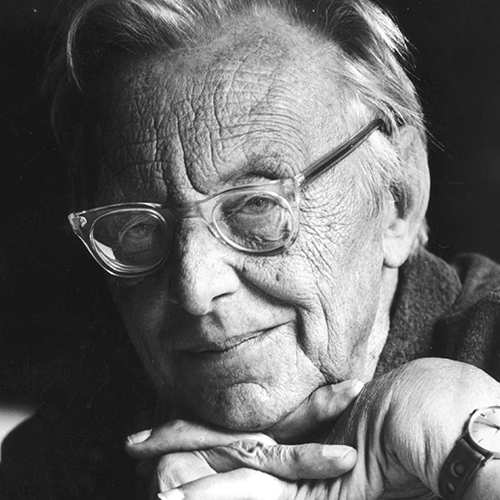
Composer
Carl Orff
German composer (1895–1982)
1895–1982
63 works and musical collections
- Born
- 1895
- Died
- 1982
- Birthplace
- Munich
- Place of death
- Munich
- Citizenship / historical state
- German Reich; Germany
- Period (estimated from birth year)
- Modern
Biography
Carl Heinrich Maria Orff (German: [kaʁl ˈʔɔʁf] ; 10 July 1895 – 29 March 1982) was a German composer and music educator who is best known for composing the cantata Carmina Burana and formulating concepts of his Schulwerk (lit. 'schoolwork'), which became influential for children's music education.
Born in Munich, Orff was raised in a military family that was scholarly and musical, and later attended the Munich Academy of Music. After composing a number of Lieder and other orchestral works, he completed his Carmina Burana for voices and large orchestra in 1936, setting poems from the medieval poetry collection of the same name. Its première was an immediate great success and Orff considered it the first time he had done exactly what he wanted, although he did not have his previous works destroyed as sometimes claimed. While the cantata was initially hampered by a small group of critics and officials, its popularity dramatically rose throughout and after World War II, Orff never received nearly as much recognition or attention for his later works, like the latter two parts of his triptych Trionfi, of which Carmina Burana is the first installment.
Orff was also an influential pedagogue who, along with colleagues like Gunild Keetman, developed an approach (the "Orff Schulwerk") to teaching children, which is a collection of fundamental principles to ensure every child learns music, much like a new language, in a comfortable environment. It involves tools like elementary forms of instruments and specifically composed music (the original form of the Schulwerk).
A member of the Reichsmusikkammer but not the Nazi Party, Orff's relationship with the Third Reich has been analysed by many as he was considerably successful (musically and financially) under its rule, and his work was well-liked by contemporary critics. Having concealed his part-Jewish ancestry throughout his life, Orff underwent denazification and was rated "'Grey C', acceptable" by psychiatrist Bertram Schaffner, who characterized him as a passive anti-Nazi. He was granted an unrestricted license with no further prohibitions from public musical activities, and continued to compose stage works and rework previous compositions until his death in 1982.
Biography excerpt from Wikipedia contributors, available under CC BY-SA 4.0. Formatting and reference markers have been removed; the introduction may be shortened. View contributors and article history.
Life and musical career
- Occupations
- composer; musicologist; music educator; university teacher; music theorist; librettist; conductor; répétiteur; docent
- Education
- University of Music and Theatre Munich; Wittelsbacher-Gymnasium München; Ludwig Gymnasium Munich; Mozarteum University Salzburg
- Teachers
- Hermann Zilcher
- Career institutions / employers
- University of Music and Theatre Munich; Mozarteum University Salzburg; Musikheim
- Recorded memberships
- Bavarian Academy of Fine Arts
- Instruments played
- organ; piano; cello; percussion guitare; xylophone
- Genres
- opera
- Notable works
- Die Kluge; Carmina Burana; Der Mond; Catulli Carmina
- Selected awards
- Pour le Mérite for Sciences and Arts order; honorary citizen of Munich; Bavarian Order of Merit; National Prize of East Germany; Great Cross with Star and Sash of the Order of Merit of the Federal Republic of Germany; Goethe Plaque of the City of Frankfurt; Bavarian Maximilian Order for Science and Art; Bayerischer Poetentaler; Austrian Decoration for Science and Art; honorary doctor of the University of Munich; honorary doctor of the University of Tübingen; Pour le Mérite
- Languages used
- German; Latin; Ancient Greek
- VIAF ID
- 111157386
- ISNI
- 0000000109354153
- GND ID
- 118590219
- Library of Congress ID
- n50002347
- MusicBrainz ID
- 0b3ee6cd-a2df-4144-adf9-7807ee7ecc4f
Recorded in Wikidata. Affiliations may refer to earlier stages of the composer's career.
In this catalogue
- Common listed instruments
- Choir, Piano, Voice, Alto, bass
- Genres represented
- Classical
- Source entries with composition dates
- 0
These details describe the indexed sheet music, including arrangements.
Catalogue
Sheet music catalogue page 2 of 2
Instruments describe listed editions, including arrangements. Composition dates and keys appear where recorded; collection pages show their individual contents.
| Title | Work details | Listed instruments | Sheet music |
|---|---|---|---|
| Work & excerpts Carmina Burana | See work details | Check individual editions | View sheet music |
| Schlaflied fur Mirijam | See work details |
| View sheet music |
| Immer Leiser Wird Mein Schlummer | See work details |
| View sheet music |
| Bitte | See work details |
| View sheet music |
| Mein Herz ist wie ein See so weit | See work details |
| View sheet music |
| Zwiegesprach | See work details |
| View sheet music |
| Blond ist mein Haar | See work details |
| View sheet music |
| Herr, ich liebte | See work details |
| View sheet music |
| Als ich dein Wandeln an den Tod verzuckte | See work details |
| View sheet music |
| Rache | See work details |
| View sheet music |
| Ein Liebeslied | See work details |
| View sheet music |
| Mondlied eines Madchens | See work details |
| View sheet music |
| Litanei eines Kranken | See work details |
| View sheet music |
| Nacht | See work details |
| View sheet music |
| Der gute Mensch | See work details |
| View sheet music |
Biographical record: Wikidata, matched on name and checked against dates held in the catalogue. The period label is an estimate from birth year. Authority record: VIAF 111157386. Portrait: Orff-Zentrum München, CC BY-SA 4.0, via Wikimedia Commons.