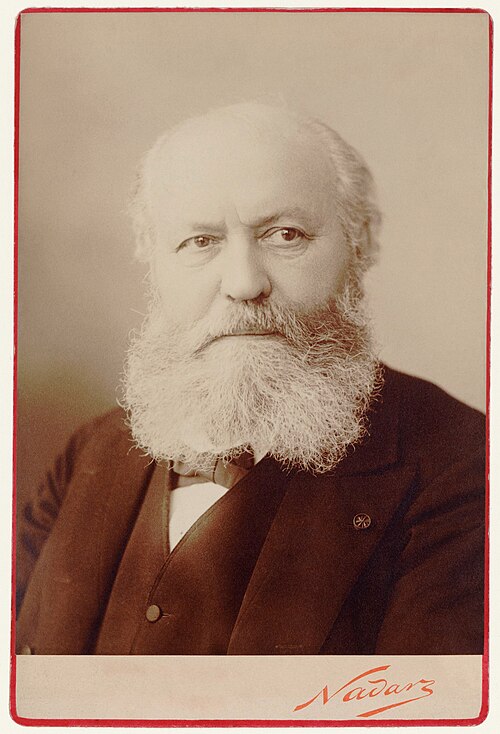
Composer
Charles Francois Gounod
French composer (1818–1893)
1818–1893
383 works and musical collections
- Born
- 1818
- Died
- 1893
- Birthplace
- Paris
- Place of death
- Saint-Cloud
- Citizenship / historical state
- France
- Period (estimated from birth year)
- Romantic
Biography
Charles-François Gounod (UK: GOO-noh, US: goo-NOH; French: [ʃaʁl fʁɑ̃swa ɡuno]; 17 June 1818 – 18 October 1893) was a French composer, conductor, and organist of the Romantic era. He wrote twelve operas, of which the most popular has always been Faust (1859); his Roméo et Juliette (1867) also remains in the international repertoire. He composed a large amount of church music, many songs, and popular short pieces including his "Ave Maria" (an elaboration of a Bach piece) and "Funeral March of a Marionette".
Born in Paris into an artistic and musical family, Gounod was a student at the Conservatoire de Paris and won France's most prestigious musical prize, the Prix de Rome. His studies took him to Italy, Austria and then Prussia, where he met Felix Mendelssohn, whose advocacy of the music of Bach was an early influence on him. He was deeply religious, and after his return to Paris, he briefly considered becoming a priest. He composed prolifically, writing church music, songs, orchestral music and operas.
Gounod's career was disrupted by the Franco-Prussian War. He moved to England with his family for refuge from the Prussian advance on Paris in 1870. After peace was restored in 1871 his family returned to Paris but he remained in London, living in the house of an amateur singer, Georgina Weldon, who became the controlling figure in his life. After nearly three years he broke away from her and returned to his family in France. His absence, and the appearance of younger French composers, meant that he was no longer at the forefront of French musical life; although he remained a respected figure he was regarded as old-fashioned during his later years, and operatic success eluded him. He died at his house in Saint-Cloud, near Paris, at the age of 75.
Few of Gounod's works remain in the regular international repertoire, but his influence on later French composers was considerable. In his music there is a strand of romantic sentiment that is continued in the operas of Jules Massenet and others; there is also a strand of classical restraint and elegance that influenced Gabriel Fauré. Claude Debussy wrote that Gounod represented the essential French sensibility of his time.
Biography excerpt from Wikipedia contributors, available under CC BY-SA 4.0. Formatting and reference markers have been removed; the introduction may be shortened. View contributors and article history.
Life and musical career
- Occupations
- classical composer; musicologist; music educator; organist; composer
- Education
- Conservatoire de Paris; Lycée Saint-Louis
- Teachers
- Anton Reicha; Fromental Halévy
- Recorded memberships
- Académie des beaux-arts
- Instruments played
- organ
- Genres
- opera; symphony; classical music; oratorio
- Movements
- classical music
- Notable works
- Faust; Roméo et Juliete; Funeral March of a Marionette
- Awards
- Prix de Rome; Royal Philharmonic Society Gold Medal; Commander of the Legion of Honour; Grand Officer of the Legion of Honour
- Birth name
- Charles-François Gounod
- Native languages
- French
- Languages used
- French
- VIAF ID
- 32183285
- ISNI
- 0000000122780819
- GND ID
- 118718312
- Library of Congress ID
- n79107989
- MusicBrainz ID
- cd4636e1-06a3-41fc-848a-624b84bbb023; ce348f4e-fa46-488f-b9f2-60c19c871c81
Recorded in Wikidata. Affiliations may refer to earlier stages of the composer's career.
In this catalogue
- Common listed instruments
- Voice, Piano, Low Voice, Organ, Choir
- Genres represented
- Classical, pop, Jazz, Blues, Christmas
- Source entries with composition dates
- 2
These details describe the indexed sheet music, including arrangements.
Catalogue
Sheet music catalogue page 2 of 8
Instruments describe listed editions, including arrangements. Composition dates and keys appear where recorded; collection pages show their individual contents.
| Title | Work details | Listed instruments | Sheet music |
|---|---|---|---|
| Ragtime Waltz | See work details |
| View sheet music |
| See work details |
| View sheet music | |
| What are you doing, white turtle-dove | See work details |
| View sheet music |
| Danse Macabre | See work details | See edition details | View sheet music |
| Nazareth | See work details |
| View sheet music |
| Ave Maria - C-Dur/C major | See work details |
| View sheet music |
| Kyrie | See work details |
3 more instruments
| View sheet music |
| Benedictus | See work details |
3 more instruments
| View sheet music |
| Solitude | See work details | See edition details | View sheet music |
| Jerusalem | See work details | See edition details | View sheet music |
| Invocation | See work details | See edition details | View sheet music |
| 2. Gloria in Excelsis | See work details |
3 more instruments
| View sheet music |
| 6. Entracte and Chorus | See work details |
| View sheet music |
| Merci de ta chanson! (Gounod-Faust) | See work details |
| View sheet music |
| Il ne revient (Gounod-Faust) | See work details |
| View sheet music |
| Va t'en! Le jour (Gounod-Faust) | See work details |
| View sheet music |
| "Le Soir (The Evening), Romance sans Paroles" | See work details |
| View sheet music |
| Prelude in C Minor |
|
| View sheet music |
| 1. Larghetto | See work details |
| View sheet music |
| Salut, demeure chaste et pure | See work details |
| View sheet music |
| Gold regiert die Welt | See work details |
| View sheet music |
| Introduction to "Faust" | See work details |
| View sheet music |
| Les Deux Pigeons | See work details | See edition details | View sheet music |
| Chanson de printemps | See work details | See edition details | View sheet music |
| King Of Thule & The Jewel Song | See work details |
| View sheet music |
| Elegy | See work details |
| View sheet music |
| Ah! leve-toi, soleil | See work details |
| View sheet music |
| Qu'ils sont doux | See work details | See edition details | View sheet music |
| Ballet from Faust | See work details |
7 more instruments
| View sheet music |
| Scene et Air des Bijoux | See work details |
| View sheet music |
| Plus grand dans son obscurite | See work details | See edition details | View sheet music |
| O ma lyre immortelle | See work details | See edition details | View sheet music |
| Notre-Dame des Petits Enfants | See work details |
| View sheet music |
| Nuit Silencieuse | See work details |
| View sheet music |
| Temple Ouvre-Toi | See work details |
| View sheet music |
| Le Nom de Marie | See work details |
| View sheet music |
| Le Chant d'Euryclee | See work details | See edition details | View sheet music |
| Envoi de Fleurs | See work details | See edition details | View sheet music |
| Au Printemps | See work details | See edition details | View sheet music |
| La Paquerette | See work details | See edition details | View sheet music |
| Blanche Colombe | See work details | See edition details | View sheet music |
| Chanter et Souffrir | See work details | See edition details | View sheet music |
| 8. Scene and Chorus | See work details |
| View sheet music |
| Avant De Quitter Ces Lie | See work details |
3 more instruments
| View sheet music |
| Vin ou biere (Gounod-Faust) | See work details |
| View sheet music |
| Avant de quitter (Gounod-Faust) | See work details |
| View sheet music |
| Le veau d'or (Gounod-Faust) | See work details |
| View sheet music |
| Mon Coeur est penetre (Gounod-Faust) | See work details |
| View sheet music |
Biographical record: Wikidata, matched on name and checked against dates held in the catalogue. The period label is an estimate from birth year. Authority record: VIAF 32183285. Portrait: Nadar / Adam Cuerden, Public domain, via Wikimedia Commons.