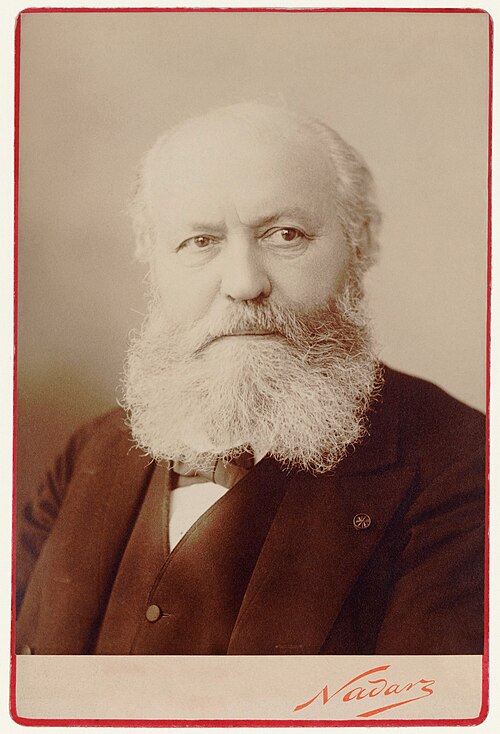
Composer
Charles Gounod
French composer (1818–1893)
1818–1893
325 works and musical collections
- Born
- 1818
- Died
- 1893
- Birthplace
- Paris
- Place of death
- Saint-Cloud
- Citizenship / historical state
- France
- Period (estimated from birth year)
- Romantic
Biography
Charles-François Gounod (UK: GOO-noh, US: goo-NOH; French: [ʃaʁl fʁɑ̃swa ɡuno]; 17 June 1818 – 18 October 1893) was a French composer, conductor, and organist of the Romantic era. He wrote twelve operas, of which the most popular has always been Faust (1859); his Roméo et Juliette (1867) also remains in the international repertoire. He composed a large amount of church music, many songs, and popular short pieces including his "Ave Maria" (an elaboration of a Bach piece) and "Funeral March of a Marionette".
Born in Paris into an artistic and musical family, Gounod was a student at the Conservatoire de Paris and won France's most prestigious musical prize, the Prix de Rome. His studies took him to Italy, Austria and then Prussia, where he met Felix Mendelssohn, whose advocacy of the music of Bach was an early influence on him. He was deeply religious, and after his return to Paris, he briefly considered becoming a priest. He composed prolifically, writing church music, songs, orchestral music and operas.
Gounod's career was disrupted by the Franco-Prussian War. He moved to England with his family for refuge from the Prussian advance on Paris in 1870. After peace was restored in 1871 his family returned to Paris but he remained in London, living in the house of an amateur singer, Georgina Weldon, who became the controlling figure in his life. After nearly three years he broke away from her and returned to his family in France. His absence, and the appearance of younger French composers, meant that he was no longer at the forefront of French musical life; although he remained a respected figure he was regarded as old-fashioned during his later years, and operatic success eluded him. He died at his house in Saint-Cloud, near Paris, at the age of 75.
Few of Gounod's works remain in the regular international repertoire, but his influence on later French composers was considerable. In his music there is a strand of romantic sentiment that is continued in the operas of Jules Massenet and others; there is also a strand of classical restraint and elegance that influenced Gabriel Fauré. Claude Debussy wrote that Gounod represented the essential French sensibility of his time.
Biography excerpt from Wikipedia contributors, available under CC BY-SA 4.0. Formatting and reference markers have been removed; the introduction may be shortened. View contributors and article history.
Life and musical career
- Occupations
- classical composer; musicologist; music educator; organist; composer
- Education
- Conservatoire de Paris; Lycée Saint-Louis
- Teachers
- Anton Reicha; Fromental Halévy
- Recorded memberships
- Académie des beaux-arts
- Instruments played
- organ
- Genres
- opera; symphony; classical music; oratorio
- Movements
- classical music
- Notable works
- Faust; Roméo et Juliete; Funeral March of a Marionette
- Awards
- Prix de Rome; Royal Philharmonic Society Gold Medal; Commander of the Legion of Honour; Grand Officer of the Legion of Honour
- Birth name
- Charles-François Gounod
- Native languages
- French
- Languages used
- French
- VIAF ID
- 32183285
- ISNI
- 0000000122780819
- GND ID
- 118718312
- Library of Congress ID
- n79107989
- MusicBrainz ID
- cd4636e1-06a3-41fc-848a-624b84bbb023; ce348f4e-fa46-488f-b9f2-60c19c871c81
Recorded in Wikidata. Affiliations may refer to earlier stages of the composer's career.
In this catalogue
- Common listed instruments
- Piano, Tenor, Flute, Bassoon, Clarinet
- Genres represented
- Classical, pop, Pop, Religious
- Source entries with composition dates
- 18
These details describe the indexed sheet music, including arrangements.
Catalogue
Sheet music catalogue page 1 of 7
Instruments describe listed editions, including arrangements. Composition dates and keys appear where recorded; collection pages show their individual contents.
| Title | Work details | Listed instruments | Sheet music |
|---|---|---|---|
| Ave Maria |
|
12 more instruments
| View sheet music |
| Funeral March of a Marionette (Theme from "Alfred Hitchcock Presents") | See work details |
2 more instruments
| View sheet music |
| Repentir ("O Divine Redeemer") | See work details |
2 more instruments
| View sheet music |
| Roméo et Juliette |
|
2 more instruments
| View sheet music |
| Entreat Me Not To Leave Thee | See work details |
| View sheet music |
| 2. Serenade | See work details | See edition details | View sheet music |
| Work & excerpts Mireille | See work details | Check individual editions | View sheet music |
| There Is A Green Hill Far Away | See work details |
| View sheet music |
| Ah Je Veux Vivre (Ah! I would linger) | See work details | See edition details | View sheet music |
| "Glory To Thee, My God, This Night" | See work details |
| View sheet music |
| You're A Grand Old Flag | See work details |
6 more instruments
| View sheet music |
| Petite Symphonie |
|
| View sheet music |
| Juliet's Waltz Song | See work details |
| View sheet music |
| Waltz of the Flowers | See work details |
| View sheet music |
| Soldier's Chorus from Faust | See work details |
4 more instruments
| View sheet music |
| Waltz From Faust | See work details |
3 more instruments
| View sheet music |
| "O, Divine Redeemer! (Db)" | See work details | See edition details | View sheet music |
| Etude | See work details |
| View sheet music |
| Country Gardens | See work details |
6 more instruments
| View sheet music |
| The British Grenadiers | See work details | See edition details | View sheet music |
| Avant De Quitter Ces Lie | See work details |
| View sheet music |
| Dio possente, Dio d'amor from FAUST | See work details |
| View sheet music |
| Marche Funèbre d'une Marionnette |
| See edition details | View sheet music |
| Mass No. 2 in G Major |
| See edition details | View sheet music |
| Faites-Lui Mes Aveux | See work details |
| View sheet music |
| What are you doing, white turtle-dove | See work details | See edition details | View sheet music |
| Fascination-Marchetti | See work details |
| View sheet music |
| Faust: Avant de quitter ces lieux | See work details |
1 more instruments
| View sheet music |
| Adore and Quiet Be (Le ciel ? visite la terre) | See work details | See edition details | View sheet music |
| There Is a Green Hill Far Way | See work details | See edition details | View sheet music |
| Praise Ye the Father | See work details |
7 more instruments
| View sheet music |
| Pomp and Circumstance | See work details |
6 more instruments
| View sheet music |
| Peace Of God,The | See work details |
| View sheet music |
| Chants Sacres | See work details | See edition details | View sheet music |
| Hymne à Sainte Cécile: Méditation Religieuse |
| See edition details | View sheet music |
| Le Médecin Malgré Lui |
| See edition details | View sheet music |
| St. Cecilia Mass |
| See edition details | View sheet music |
| Salut! Demeure Chaste Et Pure (From Faust) | See work details |
| View sheet music |
| 3) Original Fanfare | See work details |
| View sheet music |
| The Cross of Calvary | See work details | See edition details | View sheet music |
| The Peace of God | See work details | See edition details | View sheet music |
| Et Expecto | See work details |
| View sheet music |
| Le veau d'or from FAUST | See work details |
| View sheet music |
| Rondeau | See work details |
| View sheet music |
| 1. Ave Maria | See work details | See edition details | View sheet music |
| Faust Waltz | See work details | See edition details | View sheet music |
| Fantaisie sur l'hymne national russe | See work details | See edition details | View sheet music |
| Matinée de Mai | See work details |
| View sheet music |
Biographical record: Wikidata, matched on name and checked against dates held in the catalogue. The period label is an estimate from birth year. Authority record: VIAF 32183285. Portrait: Nadar / Adam Cuerden, Public domain, via Wikimedia Commons.