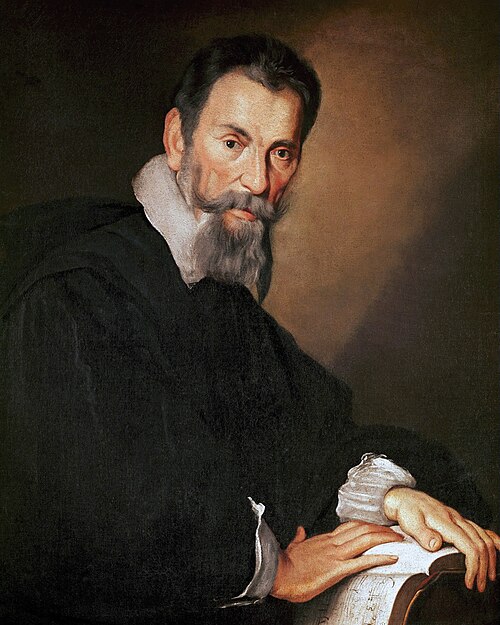
Composer
Claudio Monteverdi
Italian composer, string player, choirmaster, and priest (1567–1643)
1567–1643
522 works and musical collections
- Born
- 1567
- Died
- 1643
- Birthplace
- Cremona
- Place of death
- Venice
- Citizenship / historical state
- Republic of Venice
- Period (estimated from birth year)
- Renaissance
Biography
Claudio Giovanni Antonio Monteverdi (baptized 15 May 1567 – 29 November 1643) was an Italian composer, choirmaster and string player. A composer of both secular and sacred music, and a pioneer in the development of opera, he is considered a crucial transitional figure between the Renaissance and Baroque periods of music history.
Born in Cremona, where he undertook his first musical studies and compositions, Monteverdi developed his career first at the court of Mantua (c. 1590–1613) and then until his death in the Republic of Venice where he was maestro di cappella at the basilica of San Marco. His surviving letters give insight into the life of a professional musician in Italy of the period, including problems of income, patronage and politics.
Much of Monteverdi's output, including many stage works, has been lost. His surviving music includes nine books of madrigals, large-scale religious works, such as his Vespro della Beata Vergine (Vespers for the Blessed Virgin) of 1610, and three complete operas. His opera L'Orfeo (1607) is the earliest of the genre still widely performed; towards the end of his life he wrote works for Venice, including Il ritorno d'Ulisse in patria and L'incoronazione di Poppea.
While he worked extensively in the tradition of earlier Renaissance polyphony, as evidenced in his madrigals, he undertook great developments in form and melody, and began to employ the basso continuo technique, distinctive of the Baroque. No stranger to controversy, he defended his sometimes novel techniques as elements of a seconda pratica, contrasting with the more orthodox earlier style which he termed the prima pratica. Largely forgotten during the eighteenth and much of the nineteenth centuries, his works enjoyed a rediscovery around the beginning of the twentieth century. He is now established both as a significant influence in European musical history and as a composer whose works are regularly performed and recorded.
Biography excerpt from Wikipedia contributors, available under CC BY-SA 4.0. Formatting and reference markers have been removed; the introduction may be shortened. View contributors and article history.
Life and musical career
- Occupations
- music theorist; viol player; Catholic priest; classical composer; singer; composer; opera composer; choreographer; musicologist; court chapel master; church musician
- Teachers
- Marc'Antonio Ingegneri
- Instruments played
- viola da braccio; viol; pipe organ
- Genres
- opera; Baroque music
- Movements
- Renaissance music; Baroque music
- Notable works
- L'incoronazione di Poppea; L'Orfeo; Il ritorno d'Ulisse in patria; Il combattimento di Tancredi e Clorinda
- Languages used
- Italian
- VIAF ID
- 44485902
- ISNI
- 0000000122791833
- GND ID
- 118583700
- Library of Congress ID
- n79074370
- MusicBrainz ID
- 9a33a7ad-f725-473a-b50a-1d1796183af1
Recorded in Wikidata. Affiliations may refer to earlier stages of the composer's career.
In this catalogue
- Common listed instruments
- Voice, Piano, violin, Choir, Viola
- Genres represented
- Classical
- Source entries with composition dates
- 11
These details describe the indexed sheet music, including arrangements.
Catalogue
Sheet music catalogue page 10 of 11
Instruments describe listed editions, including arrangements. Composition dates and keys appear where recorded; collection pages show their individual contents.
Biographical record: Wikidata, matched on name and checked against dates held in the catalogue. The period label is an estimate from birth year. Authority record: VIAF 44485902. Portrait: Bernardo Strozzi, Public domain, via Wikimedia Commons.