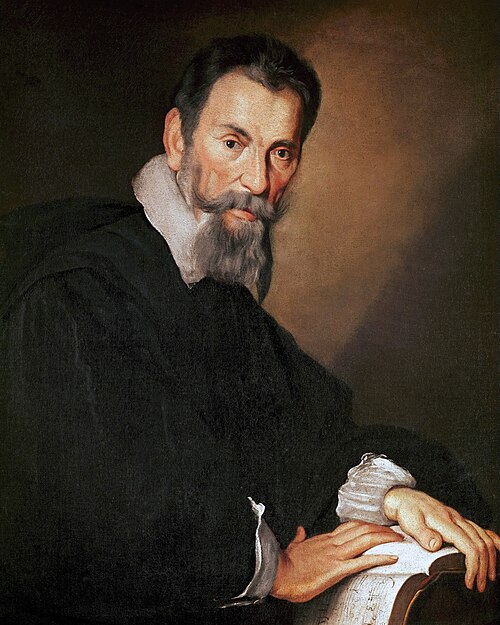
Composer
Claudio Monteverdi
Italian composer, string player, choirmaster, and priest (1567–1643)
1567–1643
528 works in the index
- Born
- 1567
- Died
- 1643
- Birthplace
- Cremona
- Citizenship / historical state
- Republic of Venice
- Period (estimated from birth year)
- Renaissance
Biography
Claudio Monteverdi, the great Italian composer of the early Baroque period, was born on May 15, 1567 in Cremona, east of Milan. He was a gambist, that is, a performer on the viola da gamba, a stringed instrument central to the music of his time.
In 1607, Monteverdi composed LâOrfeo, to a libretto by Alessandro Striggio. This is an operatic re-telling of the classical legend of Orpheus, who descended into Hades in an unsuccessful attempt to bring his beloved Eurydice back to the world of the living. LâOrfeo remains in the operatic repertoire today.
Monteverdi is also remembered for his sacred music, notably his Vesper Psalms, which some musicologists see as foreshadowing Handelâs Messiah and Bachâs St Matthew Passion.
His final work was Lâincoronazione di Poppea (The Coronation of Poppea), composed in 1642, the year before his death. This, too, survives as part of the operative canon.
In this catalogue
- Common listed instruments
- Voice, Piano, violin, Choir, Viola
- Genres represented
- Classical
- Works with composition dates
- 11 of 528
These details describe the indexed sheet music, including arrangements.
Catalogue
Works page 2 of 11
Years are composition dates where known. Instruments describe editions in our catalogue and may include arrangements. A dash means the detail is not recorded.
| Work | Year composed | Catalogue / opus | Key in title | Listed instruments | Genre | Editions |
|---|---|---|---|---|---|---|
| M'e pi' dolce il penar | — | — | — | A Cappella | Classical | 6 |
| Ohime! Se tanto amate | — | — | — | A Cappella | Classical | 4 |
| Faksimile-Teil: Partitur , Libretto, Akt 5 | — | — | — | Choir | Classical | 5 |
| A te le porpore | — | — | — | Voice | Classical | 5 |
| A terra si nel livido | — | — | — | Voice | Classical | 5 |
| Ah Che La Morte Ognora | — | — | — | Voice | Classical | 5 |
| Non imprecare | — | — | — | Voice | Classical | 5 |
| Parmi Veder Le Lagrime | — | — | — | Voice | Classical | 5 |
| Di' tu se fedele from UN BALLO IN MASCHERA | — | — | — | Piano, Voice | Classical | 5 |
| Infelice! e tu credevi from ERNANI | — | — | — | Piano, Voice | Classical | 5 |
| Ella giammai m'amo from DON CARLO | 1867-1886IMSLP | — | — | Piano, Voice | Classical | 5 |
| Ave Maria from Otello | — | — | — | Voice | Classical | 5 |
| Magnificat from Vespers of 1610 | — | — | — | Piano | Classical | 5 |
| Kyrie Eleison | — | — | — | Piano, Flute | Classical | 3 |
| Tra mille fiamme | — | — | — | — | Classical | 4 |
| Sinfonia | — | — | — | Piano, violin, Voice, Viola | Classical | 4 |
| Canzonette d'Amore | — | — | — | Choir | Classical | 4 |
| Verace amor / Wahrhaftge Liebe (gemCh, Bc) | — | — | — | Choir | Classical | 4 |
| Che se tu se il cor mio | — | — | — | A Cappella | Classical | 5 |
| Mit welchem Genu | — | — | — | — | Classical | 4 |
| O viva fiamma | — | — | — | Piano | Classical | 5 |
| Ma, o pianto o duol! | — | — | — | Voice | Classical | 4 |
| Chi mai, fra gli | — | — | — | Voice | Classical | 4 |
| Pur ti riveggo | — | — | — | Voice | Classical | 4 |
| Nei giardin del bello | — | — | — | Voice | Classical | 4 |
| O Don Fatale | — | — | — | Piano, Voice | Classical | 4 |
| La Vergine degli | — | — | — | Voice | Classical | 4 |
| Nella guerra e la | — | — | — | Voice | Classical | 4 |
| Di due figli vivea | — | — | — | Voice | Classical | 4 |
| Vedi! le fosche | — | — | — | Voice | Classical | 4 |
| It's he! What happiness! | — | — | — | Voice | Classical | 4 |
| Partite? Crudele! | 1603 or beforeIMSLP | — | — | Voice | Classical | 4 |
| Tutte le feste | — | — | — | Voice | Classical | 3 |
| D'amor sull'ali rosee from IL TROVATORE | — | — | — | Piano, Voice | Classical | 4 |
| Canzone del salice e Ave Maria di Desdemona from OTELLO | — | — | — | Piano, Voice | Classical | 4 |
| Addio, del passato from LA TRAVIATA | — | — | — | Voice | Classical | 4 |
| Credo in un Dio crudel from OTELLO | — | — | — | Voice | Classical | 4 |
| Vieni, o Levita!... Tu sul labbro de' veggenti from NABUCCO | — | — | — | Piano, Voice | Classical | 4 |
| Madre, pietosa Vergine from LA FORZA DEL DESTINO | — | — | — | Voice | Classical | 4 |
| Ah si, ben mio from IL TROVATORE | — | — | — | Voice | Classical | 4 |
| Dolcissimo Usignolo | — | — | — | Choir | Classical | 3 |
| Baci Soavi E Cari | — | — | — | Choir | Classical | 4 |
| Index of Scenes | — | — | — | — | Classical | 5 |
| Einfuhrung | — | — | — | — | Classical | 5 |
| Beatus vir (Saints' Days) | — | — | — | Choir | — | 3 |
| Christe, redemptor omnium (Christmas) | — | — | — | Choir | — | 2 |
| Amorosa Pupilletta | — | — | — | Mezzo Soprano Voice | Classical | 2 |
| Lidia, Spinna Del Mio Core | — | — | — | Mezzo Soprano Voice | Classical | 2 |
Biographical record: Wikidata, matched on name and checked against dates held in the catalogue. The period label is an estimate from birth year. Authority record: VIAF 44485902. Portrait: Bernardo Strozzi, Public domain, via Wikimedia Commons.