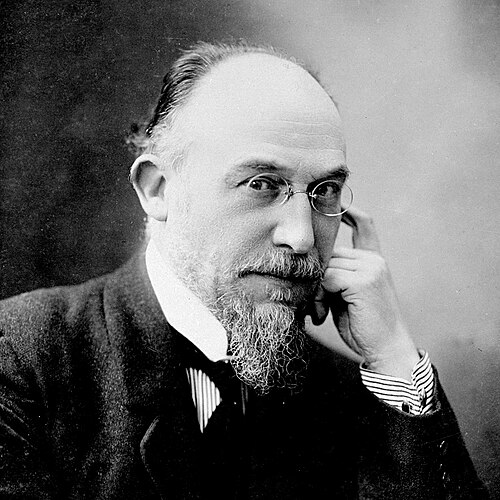
Composer
Erik Satie
French composer and pianist (1866-1925)
1866–1925
526 works and musical collections
- Born
- 1866
- Died
- 1925
- Birthplace
- Honfleur
- Place of death
- rue Pierre-Larousse
- Citizenship / historical state
- France
- Period (estimated from birth year)
- Modern
Biography
Eric Alfred Leslie Satie (17 May 1866 – 1 July 1925), better known as Erik Satie, was a French composer and pianist. The son of a French father and a British mother, he studied at the Paris Conservatoire but was undistinguished and did not obtain a diploma. In the 1880s he worked as a pianist in café-cabarets in Montmartre, Paris, and began composing works, mostly for solo piano, such as his Gymnopédies and Gnossiennes. He also wrote music for a Rosicrucian sect to which he was briefly attached.
Following a period of sparse compositional productivity, Satie entered Paris's second music academy, the Schola Cantorum, as a mature student. His studies there were more successful than those at the Conservatoire. From about 1910 he became the focus of successive groups of young composers attracted by his unconventionality and originality. Among them were the group known as Les Six. A meeting with Jean Cocteau in 1915 led to the creation of the ballet Parade (1917) for Sergei Diaghilev, with music by Satie, sets and costumes by Pablo Picasso, and choreography by Léonide Massine.
Satie's example guided a new generation of French composers away from post-Wagnerian Impressionism towards a sparer, terser style. During his lifetime, he influenced Maurice Ravel, Claude Debussy, and Francis Poulenc, and he is seen as an influence on more recent composers such as John Cage and John Adams. His harmony is often characterised by unresolved chords; he sometimes dispensed with bar-lines, as in his Gnossiennes; and his melodies are generally simple and often reflect his love of old church music. He gave some of his later works absurd titles, such as Véritables Préludes flasques (pour un chien) ("True Flabby Preludes (for a Dog)", 1912), Croquis et agaceries d'un gros bonhomme en bois ("Sketches and Exasperations of a Big Wooden Man", 1913) and Sonatine bureaucratique ("Bureaucratic Sonatina", 1917). Most of his works are brief, and the majority are for solo piano. Exceptions include his "symphonic drama" Socrate (1919) and two late ballets Mercure and Relâche (1924).
Satie never married, and his home for most of his adult life was a single small room, first in Montmartre and, from 1898 to his death, in Arcueil, a suburb of Paris. He adopted various images over the years, including a period in quasi-priestly dress, another in which he always wore identically coloured velvet suits, and is known for his last persona, in neat bourgeois costume, with bowler hat, wing collar, and umbrella. He was a lifelong heavy drinker, and died of cirrhosis of the liver at the age of 59.
Biography excerpt from Wikipedia contributors, available under CC BY-SA 4.0. Formatting and reference markers have been removed; the introduction may be shortened. View contributors and article history.
Life and musical career
- Teachers
- Vincent d'Indy
- Recorded memberships
- Rosicrucianism
- Instruments played
- piano
- Genres
- Romantic music; Impressionism
- Movements
- avant-garde
- Notable works
- Gymnopédies; Gnossiennes
- Official website
- http://www.erik-satie.com
- Birth name
- Éric Alfred Leslie Satie
- Languages used
- French
- VIAF ID
- 88805508
- ISNI
- 0000000121428848
- GND ID
- 118605690
- Library of Congress ID
- n79139256
- MusicBrainz ID
- e1d521ea-5b97-4981-987c-ba988b2a87d7
Recorded in Wikidata. Affiliations may refer to earlier stages of the composer's career.
In this catalogue
- Common listed instruments
- Piano, Voice, Guitar, Trumpet, Bassoon
- Genres represented
- Classical, Pop, Jazz, New Age
- Source entries with composition dates
- 55
These details describe the indexed sheet music, including arrangements.
Catalogue
Sheet music catalogue page 1 of 11
Instruments describe listed editions, including arrangements. Composition dates and keys appear where recorded; collection pages show their individual contents.
| Title | Work details | Listed instruments | Sheet music |
|---|---|---|---|
| Première Gymnopédie: Lent et douloureux | See work details |
12 more instruments
| View sheet music |
| Gymnopédies |
|
| View sheet music |
| Deuxième Gymnopédie: Lent et triste | See work details |
7 more instruments
| View sheet music |
| Troisième Gymnopédie: Lent et grave | See work details |
9 more instruments
| View sheet music |
| Avant-dernières pensées |
|
3 more instruments
| View sheet music |
| Work & excerpts Peccadilles importunes | See work details | Check individual editions | View sheet music |
| Danse Maigre (E.Satie) | See work details |
| View sheet music |
| Trois Gnossiennes |
|
| View sheet music |
| Gnossienne No. 2 | See work details |
| View sheet music |
| Gnossienne No. 1 | See work details |
| View sheet music |
| Quatre petites mélodies: III. Chanson | See work details |
| View sheet music |
| Gnossienne No. 3 | See work details |
| View sheet music |
| Gymnopedie #1 | See work details |
| View sheet music |
| Je te veux |
|
9 more instruments
| View sheet music |
| Sports et Divertissements |
|
| View sheet music |
| Véritables Préludes Flasques (pour un chien) |
|
| View sheet music |
| 3. Regrets des Enfermes - Jonas et Latude (Regrets of the Immured) | See work details |
| View sheet music |
| 1. Le Chant Guerrier du Roi des Haricots (War Song of the Bean King) | See work details |
| View sheet music |
| II. Enfantillages Pittoresques (Picturesque Child's Play) |
|
| View sheet music |
| Ik zeg je geen vaarwel mijn vriend, wij zien elkander weer | See work details |
3 more instruments
| View sheet music |
| Wij houden van Oranje | See work details |
3 more instruments
| View sheet music |
| Hotaru no hikari | See work details |
3 more instruments
| View sheet music |
| Régi, régi dal | See work details |
3 more instruments
| View sheet music |
| Tää ystävyys ei raukene | See work details |
3 more instruments
| View sheet music |
| Famba zvinyoronyoro, tichasanganiswa muroa ra Jesu | See work details |
3 more instruments
| View sheet music |
| Samakkhi Chumnum | See work details |
3 more instruments
| View sheet music |
| Nu flyver mørkets fugle ud | See work details |
3 more instruments
| View sheet music |
| Sonatine bureaucratique |
|
| View sheet music |
| Gymnopedie I | See work details |
| View sheet music |
| Gymnopedie | See work details |
3 more instruments
| View sheet music |
| 1. Severe Reprimande | See work details |
| View sheet music |
| Prelude from Jack in the Box | See work details |
| View sheet music |
| First Gymnnopedie | See work details |
| View sheet music |
| Skuld gammel venskab rejn forgo | See work details |
3 more instruments
| View sheet music |
| Llegó la hora de decir adiós, digamos, al partir, nuestra canción | See work details |
3 more instruments
| View sheet music |
| Purano shei diner kotha | See work details |
3 more instruments
| View sheet music |
| Hail! Sweetest, Dearest Tie That Binds | See work details |
3 more instruments
| View sheet music |
| Plenary | See work details |
3 more instruments
| View sheet music |
| The Good Old Song | See work details |
3 more instruments
| View sheet music |
| Nehmt Abschied Brüder | See work details |
3 more instruments
| View sheet music |
| Jipi Jay | See work details |
3 more instruments
| View sheet music |
| La diva de l'Empire |
|
4 more instruments
| View sheet music |
| Espanana (E.Satie) | See work details |
| View sheet music |
| Gymnopedie Iii | See work details |
| View sheet music |
| Gnossiene No. 1 |
|
| View sheet music |
| Trois Morceaux en forme de poire . Volume 1 also available | See work details |
| View sheet music |
| Parade |
|
| View sheet music |
| La belle excentrique |
|
| View sheet music |
Biographical record: Wikidata, matched on name and checked against dates held in the catalogue. The period label is an estimate from birth year. Authority record: VIAF 88805508. Portrait: Sonia y natalia, CC BY-SA 3.0, via Wikimedia Commons.