JustSheetMusic
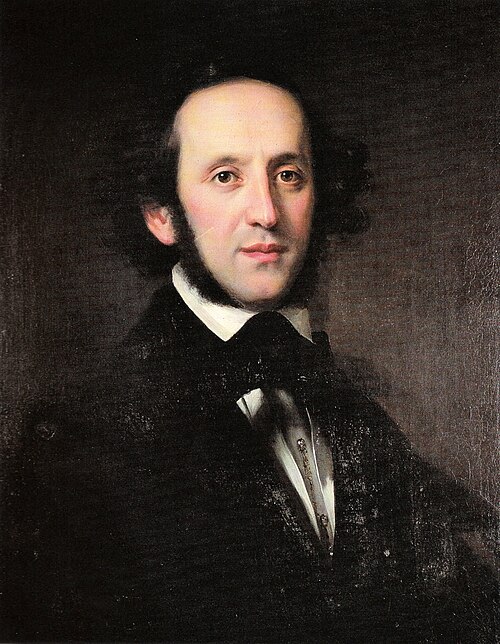
Portrait of Felix Mendelssohn

Composer

Felix Mendelssohn

German composer, pianist, organist and conductor of Jewish descent (1809-1847)

1809–1847

4,109 works in the index

Born
1809
Died
1847
Birthplace
Hamburg
Place of death
Leipzig
Citizenship / historical state
Kingdom of Saxony; Hamburg
Period (estimated from birth year)
Romantic

Biography

Mendelssohn wrote fluently and early, and his music is unusually grateful to play — it lies well under the hand in a way that his contemporaries' often does not.

The Songs Without Words are the most useful thing in this catalogue for a developing pianist: forty-eight short pieces across a wide range of difficulty, several genuinely accessible, all musically substantial. The Violin Concerto is a cornerstone of that instrument's repertoire, and Elijah of the choral one.

He also wrote a great deal of organ music, including six sonatas, which sits in the small category of nineteenth-century organ repertoire that is neither Bach nor French.

Life and musical career

Occupations
composer; pianist; organist; conductor; musicologist; music educator; university teacher; painter; writer; musician
Education
Humboldt-Universität zu Berlin
Teachers
Carl Friedrich Zelter; Ludwig Berger; Marie Bigot; Lea Mendelssohn Bartholdy; Franz Lauska; Ignaz Moscheles
Career institutions / employers
University of Music and Theatre Leipzig
Recorded memberships
Royal Netherlands Academy of Arts and Sciences
Instruments played
organ; piano; violin
Genres
opera; classical music; symphonic music
Movements
Romantic music
Notable works
A Midsummer Night's Dream; Symphony No. 3; Symphony No. 4; Violin Concerto in E minor; The Hebrides; St. Paul; Elijah
Awards
Pour le Mérite for Sciences and Arts order; honorary citizen of Leipzig; Pour le Mérite
Official website
https://www.mendelssohn-stiftung.de/de/
Languages used
German; French; English
VIAF ID
2665666
ISNI
0000000121181195
GND ID
118580779
Library of Congress ID
n79139515
MusicBrainz ID
0e85eb79-1c05-44ba-827c-7b259a3d941a

Recorded in Wikidata. Affiliations may refer to earlier stages of the composer's career.

In this catalogue

Common listed instruments
Piano, Choir, Voice, Organ, percussion
Genres represented
Classical, Christmas, pop, Pop, Jazz
Works with composition dates
120 of 4,109

These details describe the indexed sheet music, including arrangements.

Catalogue

Works page 44 of 86

Years are composition dates where known. Instruments describe editions in our catalogue and may include arrangements. A dash means the detail is not recorded.

Works and available sheet music details
WorkYear composedCatalogue / opusKey in titleListed instrumentsGenreEditions
Lied aus Ruy Blas from 3 Lieder op 77 — op 77— PianoClassical —
Das Aehrenfeld from 3 Lieder Op. 77 — Op. 77— PianoClassical —
Sonntagsmorgen from 3 Lieder Op. 77 — Op. 77— PianoClassical —
Sonata Iii In A Major — —A major OrganClassical 2
Jagdlied — —— Piano, VoiceClassical 6
Liebende Schreibt — —— —Classical 2
Morgengruss — —— Piano, VoiceClassical 4
Morgenlied — —— Piano, VoiceClassical 4
Second Movement - Andante Con Moto (Symphony No.4 'The Italian') — —— —Classical 1
Ave Maria — —— —Classical 1
Mendelssohn: Variations Sérieuses, Opus 54 — Opus 54— Piano— 1
Song Without Words, Opus 19 No. 1 — Opus 19 No. 1— Piano— 1
Song Without Words, Opus 30 No. 1 — Opus 30 No. 1— Piano— 1
Symphony No. 5 "Reformation" (4th Movement): Piano Accompaniment — —— Orchestra— 1
Mendelssohn: Violin Concerto, Op. 64 (Arr. Carl Flesch) — Op. 64— —— 1
Hear, O Lord — —— Choir— 1
March, Op. 108: Bells — Op. 108— —— 1
March, Op. 108: Flute — Op. 108— —— 1
March, Op. 108: Oboe — Op. 108— —— 1
March, Op. 108: Bassoon — Op. 108— —— 1
March, Op. 108: 2nd E — Op. 108— —— 1
March, Op. 108: 1st F Horn — Op. 108— —— 1
March, Op. 108: 1st Trombone — Op. 108— —— 1
March, Op. 108: Baritone T.C. — Op. 108— —— 1
March, Op. 108: Baritone B.C. — Op. 108— —— 1
March, Op. 108: Tuba — Op. 108— —— 1
March, Op. 108: 1st Percussion — Op. 108— —— 1
March, Op. 108: 2nd Percussion — Op. 108— —— 1
March, Op. 108: Timpani — Op. 108— —— 1
Song Without Words, Opus 19 No. 2 — Opus 19 No. 2— Piano— 1
Song Without Words, Opus 19 No. 3 (Hunters' Song) — Opus 19 No. 3— Piano— 1
Song Without Words, Opus 19 No. 4 — Opus 19 No. 4— Piano— 1
Song Without Words, Opus 19 No. 5 — Opus 19 No. 5— Piano— 1
Song Without Words, Opus 19 No. 6 (Venetian Boat Song No. 1) — Opus 19 No. 6— Piano— 1
Song Without Words, Opus 30 No. 2 — Opus 30 No. 2— Piano— 1
Song Without Words, Opus 30 No. 3 — Opus 30 No. 3— Piano— 1
Song Without Words, Opus 30 No. 4 — Opus 30 No. 4— Piano— 1
Song Without Words, Opus 30 No. 5 — Opus 30 No. 5— Piano— 1
Song Without Words, Opus 30 No. 6 (Venetian Boat Song No. 2) — Opus 30 No. 6— Piano— 1
Song Without Words, Opus 38 No. 1 — Opus 38 No. 1— Piano— 1
Song Without Words, Opus 38 No. 2 — Opus 38 No. 2— Piano— 1
Song Without Words, Opus 38 No. 3 — Opus 38 No. 3— Piano— 1
Song Without Words, Opus 38 No. 4 — Opus 38 No. 4— Piano— 1
Song Without Words, Opus 38 No. 5 — Opus 38 No. 5— Piano— 1
Song Without Words, Opus 38 No. 6 (Duetto) — Opus 38 No. 6— Piano— 1
Song Without Words, Opus 53, No. 1 — Opus 53, No. 1— Piano— 1
Song Without Words, Opus 53, No. 2 — Opus 53, No. 2— Piano— 1
Song Without Words, Opus 53, No. 3 — Opus 53, No. 3— Piano— 1

Biographical record: Wikidata, matched on name and checked against dates held in the catalogue. The period label is an estimate from birth year. The biography above is our own. Authority record: VIAF 2665666. Portrait: Eduard Magnus, Public domain, via Wikimedia Commons.