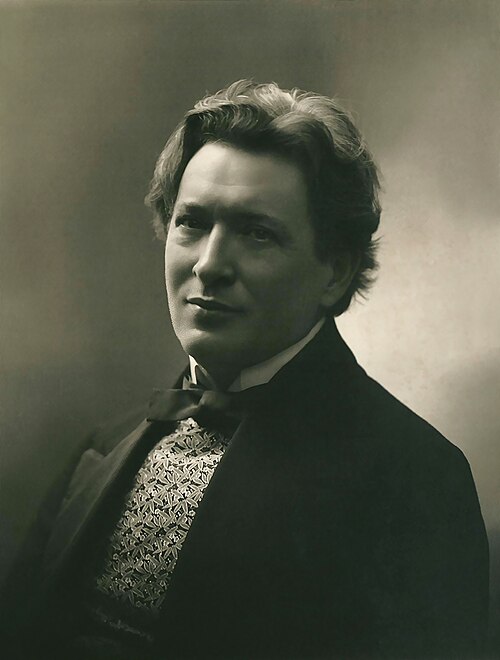
Composer
Ferruccio Busoni
Italian composer, pianist, and conductor (1866–1924)
1866–1924
150 works in the index
- Born
- 1866
- Died
- 1924
- Birthplace
- Empoli
- Citizenship / historical state
- Kingdom of Italy
- Period (estimated from birth year)
- Modern
Biography
Ferruccio Busoni was the only child of a clarinetist father and a pianist mother. He became not only a pianist himself but a conductor and composer. His compositions include a musical setting for a poem by Heinrich Heine, “Du bist wie eine Blume” (“You are like a Flower”) and one for a poem by Lord Byron, “An Babylons Wasserns” (“By the Rivers of Babylon.”) In his 40s Busoni wrote Sketch of a New Esthetic of Music (1907), an important statement of his conviction that a composer is not a lawgiver, that performers must have or take a good deal of interpretive freedom. Musical notation, he wrote, “is primarily an ingenious expedient for catching an inspiration, with the purpose of exploiting it later….It is for the interpreter to resolve the rigidity of the signs [emphasis in original] into the primitive emotion.” Busoni died in Berlin, and is commemorated by a plaque on the spot of his final residence there.
In this catalogue
- Common listed instruments
- Piano, Piano two hands, Clarinet, percussion, Timpani
- Genres represented
- Classical
- Works with composition dates
- 73 of 150
These details describe the indexed sheet music, including arrangements.
Catalogue
Works page 2 of 4
Years are composition dates where known. Instruments describe editions in our catalogue and may include arrangements. A dash means the detail is not recorded.
| Work | Year composed | Catalogue / opus | Key in title | Listed instruments | Genre | Editions |
|---|---|---|---|---|---|---|
| Transcrizione di concerto sopra motivi dell'opera Merlino del Maestro C. Goldmark | — | — | — | — | Classical | 3 |
| Violin Sonata No.1 in E minor, Op.29 | 1890IMSLP | Op.29 | E minor | — | Classical | 3 |
| Von der | — | — | — | — | Classical | 3 |
| Busoni: Solo dramatique K 101 | — | — | — | Piano, Clarinet | Classical | 4 |
| 1. Nach de Wendung | — | — | — | Piano | Classical | 3 |
| 1. Dama | — | — | — | Piano | Classical | 3 |
| Twenty Four Prelude Op.37(Busoni | — | Op.37 | — | — | Classical | 3 |
| 4. Fantasia in Modo Antico | — | — | — | Piano | Classical | 3 |
| 6. Exuent Omnes | — | — | — | Piano | Classical | 3 |
| Die Brautwahl Suite, Op.45, BV261 | 1912IMSLP | Op.45 | — | Tambourine, Triangle, Tamtam, Glockenspiel, Cymbals, Drum, Celesta, Xylophone | Classical | 2 |
| Comedy Overture, Op.38, BV 245 | 1897, rev. 1904IMSLP | Op.38 | — | — | Classical | 2 |
| Editions - Bach: On the Transcription of Bach's Organ Works for the Pianoforte | — | — | — | Piano two hands | Classical | 2 |
| 8 Etudes after Cramer | — | — | — | Piano two hands | Classical | 2 |
| Elegien | 1907 (1909, "Berceuse")IMSLP | — | — | Piano | Classical | 1 |
| Fantasia nach J.S. Bach, BV 253 | 1909IMSLP | — | — | Piano | Classical | 2 |
| Perpetuum mobile, BV 293 | 1922IMSLP | — | — | Piano two hands | Classical | 2 |
| Rondo Arlecchinesco, Op.46, BV 266 | 1915 (April–June)IMSLP | Op.46 | — | — | Classical | 2 |
| Transcription of 2 Toccatas for Organ by J.S. Bach (BWV 564, 565), BV B 29 | — | BWV 564 | — | Piano two hands | Classical | 2 |
| Chromatic Fantasy and Fugue (BWV 903) | 1723?IMSLP | BWV 903 | — | Piano two hands | Classical | 2 |
| J.S. Bach: Fantasy, Adagio and Fugue (BWV 906, 968). Combined and completed for concert performance by Ferruccio Busoni. | — | BWV 906 | — | Piano two hands | Classical | 2 |
| Transcription of J. S. Bach's Goldberg Variations (BWV 988), BV B 35 | — | BWV 988 | — | Piano two hands | Classical | 2 |
| Joh. Seb. Bach: Prelude, Fugue, and Allegro in E | 1740–45?IMSLP | — | — | Piano two hands | Classical | 2 |
| Variations on Liszt's Gondoliera (S.162/1) from Venezia e Napoli | 1923–24IMSLP | S.162/1 | — | Piano two hands | Classical | 2 |
| Duettino concertante nach Mozart für zwei Pianoforte | 1919IMSLP | — | — | — | Classical | 2 |
| Busoni: Serenade K 108 | — | — | — | Piano, Clarinet | Classical | 3 |
| Busoni: Andantino K 107 | — | — | — | Piano, Clarinet | Classical | 3 |
| Busoni: Andante con moto K 72 | — | — | — | Piano, Clarinet | Classical | 3 |
| Busoni: Suite K 88 | — | — | — | Piano, Clarinet | Classical | 3 |
| 6. Erscheinung | — | — | — | Piano | Classical | 1 |
| Scherzino C-Dur op. 33b; 3 -6 Klavierstucke - Nr. 3- | — | op. 33b | — | Piano | Classical | 2 |
| Elegie | — | — | — | Clarinet | — | 2 |
| 6. Trovatore | — | — | — | Piano | Classical | 2 |
| 2. Frohsinn | — | — | — | Piano | Classical | 2 |
| 3. Scherzino | — | — | — | Piano | Classical | 2 |
| 2. Kanonische Variationen und Fuge | — | — | — | Piano | Classical | 3 |
| Waffentanz | — | — | — | Piano | Classical | 2 |
| Nach der Wendung | — | — | — | — | Classical | 1 |
| All' Italia! | — | — | — | — | Classical | 1 |
| Finnish Folk Songs Op.27 | — | Op.27 | — | — | Classical | 1 |
| Nachtlichen, Die | — | — | — | — | Classical | 1 |
| 5 variations over "Kommt ein Vogel geflogen" | — | — | — | — | Classical | 1 |
| Arlecchino, BV 270 | 1914IMSLP | — | — | — | Classical | 1 |
| Concert Piece, Op.31a. Introduction and Allegro | 1890IMSLP | Op.31a | — | — | Classical | 1 |
| Edition of J. S. Bach's Well-Tempered Clavier, BV B 25 | — | — | — | Piano two hands | Classical | 1 |
| Analytical Exposition of the Fugue in Beethoven's Sonata, Op.106 | 1817–18IMSLP | Op.106 | — | Piano two hands | Classical | 1 |
| 1806IMSLP | — | — | Piano two hands | Classical | 1 | |
| Edition of Liszt's Réminiscences de Don Juan (S.418), BV B 71 | 1841IMSLP | S.418 | — | Piano two hands | Classical | 1 |
| Improvisation on the Bach Chorale 'Wie wohl ist mir', BV 271 | 1916IMSLP | — | — | — | Classical | 1 |
Biographical record: Wikidata, matched on name and checked against dates held in the catalogue. The period label is an estimate from birth year. Authority record: VIAF 44484509. Portrait: Varischi & Artico, Public domain, via Wikimedia Commons.