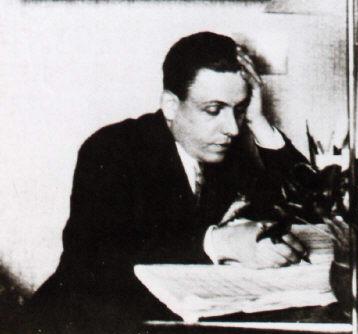
Composer
Francis Poulenc
French composer and pianist (1899–1963)
1899–1963
326 works and musical collections
- Born
- 1899
- Died
- 1963
- Birthplace
- Paris
- Place of death
- Paris
- Citizenship / historical state
- France
- Period (estimated from birth year)
- Modern
Biography
Francis Jean Marcel Poulenc (French: [fʁɑ̃sis ʒɑ̃ maʁsɛl pulɛ̃k]; 7 January 1899 – 30 January 1963) was a French composer and pianist. His compositions include songs, solo piano works, chamber music, choral pieces, operas, ballets, and orchestral concert music. Among the best-known are the piano suite Mouvements perpétuels (1919), the ballet Les Biches (1923), the Concert champêtre (1928) for harpsichord and orchestra, the Organ Concerto (1938), the opera Dialogues des Carmélites (1957), and the Gloria (1959) for soprano, choir, and orchestra.
As the only son of a prosperous manufacturer, Poulenc was expected to follow his father into the family firm, and he was not allowed to enrol at a conservatoire. He studied with the pianist Ricardo Viñes, who became his mentor after the composer's parents died. Poulenc also made the acquaintance of Erik Satie, under whose tutelage he became one of a group of young composers known collectively as "Les Six". In his early works Poulenc became known for his high spirits and irreverence. During the 1930s a much more serious side to his nature emerged, particularly in the religious music he composed from 1936 onwards, which he alternated with his more light-hearted works.
In addition to his work as a composer, Poulenc was an accomplished pianist. He was particularly celebrated for his performing partnerships with the baritone Pierre Bernac (who also advised him in vocal writing) and the soprano Denise Duval. He toured in Europe and America with both of them, and made a number of recordings as a pianist. He was among the first composers to see the importance of the gramophone, and he recorded extensively from 1928 onwards.
In his later years, and for decades after his death, Poulenc had a reputation, particularly in his native country, as a humorous, lightweight composer, and his religious music was often overlooked. In the 21st century, more attention has been given to his serious works, with many new productions of Dialogues des Carmélites and La Voix humaine worldwide, and numerous live and recorded performances of his songs and choral music.
Biography excerpt from Wikipedia contributors, available under CC BY-SA 4.0. Formatting and reference markers have been removed; the introduction may be shortened. View contributors and article history.
Life and musical career
- Occupations
- composer; pianist; music critic
- Education
- Lycée Condorcet
- Teachers
- Charles Koechlin; Ricard Viñes
- Recorded memberships
- Groupe des Six
- Instruments played
- piano
- Genres
- opera; classical music; religious music; choral music
- Movements
- modernism; classical music
- Notable works
- Dialogues of the Carmelites; La voix humaine; Les biches; Concert champêtre; Organ Concerto; Flute Sonata; Concerto for Two Pianos and Orchestra; Gloria; Stabat Mater; Figure humaine
- Birth name
- Francis Jean Marcel Poulenc
- Languages used
- French
- VIAF ID
- 71579067
- ISNI
- 0000000122817124
- GND ID
- 11879308X
- Library of Congress ID
- n80015508
- MusicBrainz ID
- 5e1ef22b-310a-46ad-885b-4897b8c9c85a
Recorded in Wikidata. Affiliations may refer to earlier stages of the composer's career.
In this catalogue
- Common listed instruments
- Piano, Voice, Choir, Clarinet, Flute
- Genres represented
- Classical
- Source entries with composition dates
- 3
These details describe the indexed sheet music, including arrangements.
Catalogue
Sheet music catalogue page 1 of 7
Instruments describe listed editions, including arrangements. Composition dates and keys appear where recorded; collection pages show their individual contents.
Biographical record: Wikidata, matched on name and checked against dates held in the catalogue. The period label is an estimate from birth year. Authority record: VIAF 71579067. Portrait: Unknown author Unknown author, Public domain, via Wikimedia Commons.