Composer
Franz Schubert
1797–1828
7,293 works in the index
- Era
- Romantic
- Nationality
- Archduchy of Austria
- Born in
- Himmelpfortgrund
Schubert wrote over six hundred songs before dying at thirty-one, and it is the songs that dominate this catalogue. If you sing, this is the central repertoire; if you accompany, the piano parts are full partners rather than support, and considerably harder than they sound.
The song cycles — Die schöne Müllerin, Winterreise, Schwanengesang — are published complete and in high, medium and low keys. Buying the wrong transposition is the standard mistake here, because the cycles sit in a range that punishes guessing.
For pianists the Impromptus and Moments musicaux are the accessible way in, and the four-hand duets are among the best music written for two people at one instrument. The late sonatas are enormous and are not a place to start.
Catalogue
Works page 119 of 152
Fantasie in F Minor, Op. 103
Overture in F Major, Op. 34
Sonata in B-flat Major, Op. 30
Sonata No. 20 in A Major, Op. Posth, Movement 3: Scherzo and Trio
Sonata No. 18 in G Major, Op. 78, Movement 1: Fantasie
Sonata No. 18 in G Major, Op. 78, Movement 2: Andante
Sonata No. 18 in G Major, Op. 78, Movement 4: Allegretto
Impromptu in E-flat Major, Op. 90, No. 2
Impromptu in G-flat Major, Op. 90, No. 3
Impromptu in A-flat Major, Op. 90, No. 4
Grand Rondeau in A Major, Op. 107
Polonaise No. 1 in D Minor from "Four Polonaises", Op. 75
Polonaise No. 2 in B-flat Major from "Four Polonaises", Op. 75
Polonaise No. 3 in E Major from "Four Polonaises", Op. 75
Polonaise No. 4 in F Major from "Four Polonaises", Op. 75
Introduction, Four Variations on an Original Theme and Finale, Op. 82, No. 2
Rondo Brilliant, No. 3 from "Divertissement on French themes"
Eight Variations on a French song, Op. 10
Eight Variations on an Original Theme, Op. 35
March in E-flat Major, No. 1 from "Six Grandes Marches", Op. 40
March in G Minor, No. 2 from "Six Grandes Marches", Op. 40
March in B Minor, No. 3 from "Six Grandes Marches", Op. 40
March in D Major, No. 4 from "Six Grandes Marches", Op. 40
March in E-flat Major, No. 5 from "Six Grandes Marches", Op. 40
March in E Major, No. 6 from "Six Grandes Marches", Op. 40
Stabat Mater, D383, No. 1: "Jesus Christus schwebt am Kreuze!"
Stabat Mater, D383, No. 2: "Bei des Mittlers Kreuze standen bang"
Stabat Mater, D383, No. 3: "Liebend neiget er sein Antlitz"
Stabat Mater, D383, No. 4: "Engel freuten sich der Wonne"
Stabat Mater, D383, No. 5: "Wer wird Zahren sanften Mitleids"
Stabat Mater, D383, No. 6: "Ach, was hatten wir empfunden"
Stabat Mater, D383, No. 7: "Erben sollen sie am Throne"
Stabat Mater, D383, No. 8: "Sohn des Vaters, aber leiden, leiden mussen deine Bruder"
Stabat Mater, D383, No. 9: "O du herrlicher, du herrlicher Vollender"
Stabat Mater, D383, No. 10: "Erdenfreuden und ihr Elend"
Stabat Mater, D383, No. 11: "Dass dereinst wir, wenn im Tode"
Stabat Mater, D383, No. 12: "Amen, amen, amen"
Mass No. 5 in A-flat Major, D678, No. 1: Kyrie
Mass No. 5 in A-flat Major, D678, No. 2: Gloria
Mass No. 5 in A-flat Major, D678, No. 3: Credo
Mass No. 5 in A-flat Major, D678, No. 4: Sanctus
Mass No. 5 in A-flat Major, D678, No. 5: Benedictus
Mass No. 5 in A-flat Major, D678, No. 6: Agnus Dei
Mass No. 5 in A-flat Major, D678, No. 7: Anhang I - Cum sancto Spiritu
Sonata No. 19 in C Minor, Op. Posth
Mass No. 5 in A-flat Major, D678, No. 8: Anhang II - Zweite Fassung des Osanna
Sonata No. 20 in A Major, Op. Posth, Movement 1: Allegro
Sonata No. 20 in A Major, Op. Posth, Movement 2: Andantino
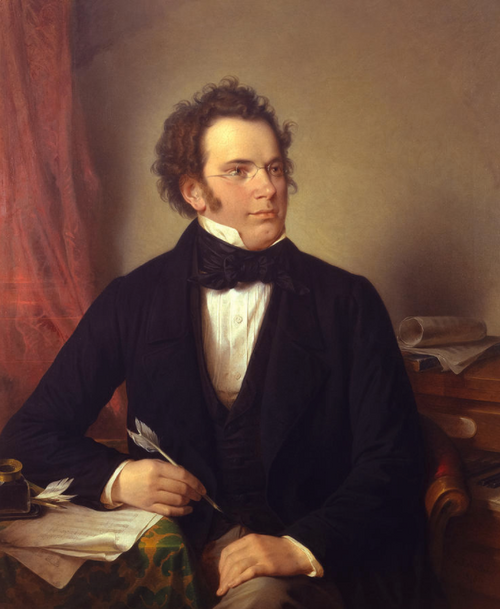
Dates, era and nationality from Wikidata, matched on name and verified against any dates already held here. The biography above is our own. Portrait: Wilhelm August Rieder, Public domain, via Wikimedia Commons.