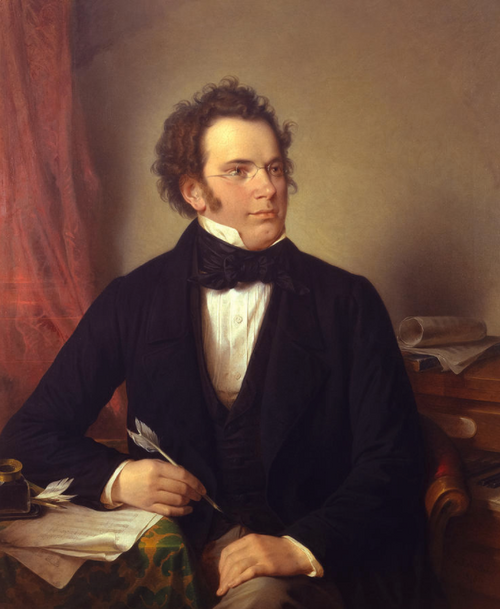
Composer
Franz Schubert
Austrian composer (1797–1828)
1797–1828
6,176 works in the index
- Born
- 1797
- Died
- 1828
- Birthplace
- Himmelpfortgrund
- Place of death
- Vienna
- Citizenship / historical state
- Austrian Empire; Archduchy of Austria
- Period (estimated from birth year)
- Romantic
Biography
Schubert wrote over six hundred songs before dying at thirty-one, and it is the songs that dominate this catalogue. If you sing, this is the central repertoire; if you accompany, the piano parts are full partners rather than support, and considerably harder than they sound.
The song cycles — Die schöne Müllerin, Winterreise, Schwanengesang — are published complete and in high, medium and low keys. Buying the wrong transposition is the standard mistake here, because the cycles sit in a range that punishes guessing.
For pianists the Impromptus and Moments musicaux are the accessible way in, and the four-hand duets are among the best music written for two people at one instrument. The late sonatas are enormous and are not a place to start.
Life and musical career
- Teachers
- Antonio Salieri
- Genres
- classical music
- Notable works
- Symphony No. 8; Symphony No. 9; Symphony No. 3; Winterreise; Death and the Maiden; Ellens dritter Gesang
- Birth name
- Franz Peter Schubert
- Languages used
- German
- VIAF ID
- 29719275; 48146998424018940534
- ISNI
- 0000000120958492
- GND ID
- 118610961
- Library of Congress ID
- n50000561
- MusicBrainz ID
- f91e3a88-24ee-4563-8963-fab73d2765ed
Recorded in Wikidata. Affiliations may refer to earlier stages of the composer's career.
In this catalogue
- Common listed instruments
- Piano, Voice, Low Voice, violin, Clarinet
- Genres represented
- Classical, pop, Pop, Jazz, Children
- Works with composition dates
- 322 of 6,176
These details describe the indexed sheet music, including arrangements.
Catalogue
Works page 49 of 129
Years are composition dates where known. Instruments describe editions in our catalogue and may include arrangements. A dash means the detail is not recorded.
| Work | Year composed | Catalogue / opus | Key in title | Listed instruments | Genre | Editions |
|---|---|---|---|---|---|---|
| Ecossaise D 529 Nr. 6 | — | — | — | Clarinet | Classical | 0 |
| Ecossaise D 529 Nr. 8 | — | — | — | Clarinet | Classical | 0 |
| Ecossaise D 783 Nr. 1 | — | — | — | Clarinet | Classical | 0 |
| Anhang: 1. Dona nobis pacem. Zweite Bearbeitung | — | — | — | Organ, Oboe, Bassoon, Choir, Horn, Clarinet, Trombone | Classical | 1 |
| D 703 | — | — | — | Cello, violin, Viola | Classical | 1 |
| Violin Sonata (Sonatina) No. 2 in A minor, op. 137, no. 2 (posth.), D385 | — | op. 137, no. 2 | A minor | violin | Classical | 0 |
| Violin Sonata (Sonatina) No. 3 in G minor, op. 137, no. 3 (posth.), D408 | — | op. 137, no. 3 | G minor | violin | Classical | 0 |
| Op.posth/D.70 | — | D.70 | — | violin | Classical | 1 |
| Play And Count Aloud | — | — | — | violin | Classical | 1 |
| Stampede | — | — | — | violin | Classical | 1 |
| Sonatina in A Minor, op. posth. 137, no. 2, D 385 - Second Movement | — | — | A minor | violin | Classical | 1 |
| in D, D 94 | — | — | — | Cello | Classical | 1 |
| in C, D 32 | — | — | — | Cello | Classical | 1 |
| in B, D 36, in C, D 46 | — | — | — | Cello | Classical | 0 |
| Satz in C, D 3 | — | — | — | Cello | Classical | 0 |
| 11 Faksimiles | — | — | — | Cello, violin, Viola | Classical | 0 |
| Nr. 4 Ouverture in B (Bruchstuck aus einer Fassung fur Streichquartett), D 470 | — | — | — | Cello, violin, Viola | Classical | 0 |
| Nr. 2 Trio in B, D 471 (Unvollendeter 2. Satz) | — | — | — | Cello, violin, Viola | Classical | 1 |
| An Den Fruhling | — | — | — | Trombone | Classical | 0 |
| Junglingswoone | — | — | — | Trombone | Classical | 2 |
| Andantino Grazioso Op 5 No 8 (Matteo Carcassi) | — | Op 5 No 8 | — | Guitar | Classical | 0 |
| Liebesbothschaft | — | — | — | Guitar | — | 0 |
| Bumpin' Bad | — | — | — | Guitar | Classical | 0 |
| Theme From Rosamunde | — | — | — | Guitar | Classical | 3 |
| A Waltz From Schubert | — | — | — | Harmonica | Classical | 2 |
| Hanon I | — | — | — | Harmonica | Classical | 0 |
| Cornish Folk Song | — | — | — | Harmonica | Classical | 0 |
| Christ ist erstanden, D 440 - c-Moll/C minor | — | — | — | Choir | Classical | 1 |
| Ehre sei Gott in der Hohe, D 872 no. 2 (Glory to god in the highest) - B-Dur/B-flat major | — | — | — | Choir | Classical | 0 |
| Sanctus, D 872 (Sanctus) - Es-Dur/Eb major | — | — | — | Choir | Classical | 2 |
| Die bretterne Kammer der Toten erbebt; Sehnsucht | — | — | — | Choir | Classical | 0 |
| Holy, Holy, Holy | — | — | — | Choir | Classical | 1 |
| Gray Head,The | — | — | — | Voice | Classical | 2 |
| Last Hope,The | — | — | — | — | Classical | 3 |
| Stormy Morning,The | — | — | — | — | Classical | 3 |
| Afar | — | — | — | — | Classical | 2 |
| Fishermaiden,The | — | — | — | — | Classical | 2 |
| Young Nun,The | — | — | — | Voice | Classical | 4 |
| By The Sea | — | — | — | — | Classical | 3 |
| Question, The | — | — | — | — | Classical | 2 |
| Gen?gsamkeit | — | — | — | Piano, Voice | Classical | 1 |
| Sprache der Liebe | — | — | — | — | Classical | 1 |
| Der Abend | — | — | — | — | Classical | 0 |
| Die Spinnerin | — | — | — | Voice | Classical | 1 |
| Cronnan | — | — | — | — | Classical | 0 |
| Ritter Toggenburg | — | — | — | Piano, Voice | Classical | 1 |
| Der Sieg | — | — | — | Piano, Voice | Classical | 1 |
| Beim Winde | — | — | — | Piano, Voice | Classical | 0 |
Biographical record: Wikidata, matched on name and checked against dates held in the catalogue. The period label is an estimate from birth year. The biography above is our own. Authority record: VIAF 48146998424018940534. Portrait: Wilhelm August Rieder, Public domain, via Wikimedia Commons.