JustSheetMusic
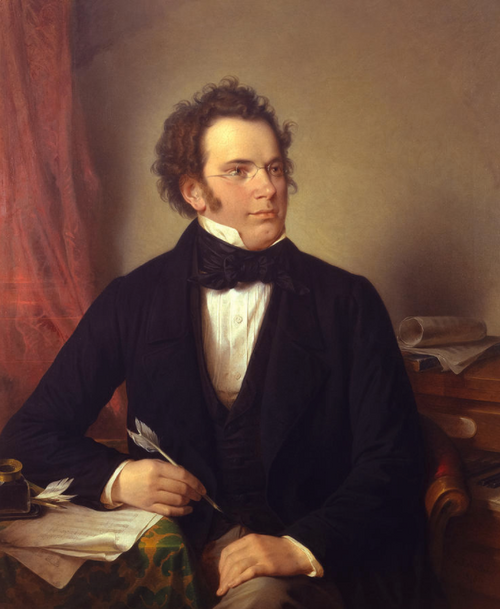
Portrait of Franz Schubert

Composer

Franz Schubert

Austrian composer (1797–1828)

1797–1828

6,176 works in the index

Born
1797
Died
1828
Birthplace
Himmelpfortgrund
Place of death
Vienna
Citizenship / historical state
Austrian Empire; Archduchy of Austria
Period (estimated from birth year)
Romantic

Biography

Schubert wrote over six hundred songs before dying at thirty-one, and it is the songs that dominate this catalogue. If you sing, this is the central repertoire; if you accompany, the piano parts are full partners rather than support, and considerably harder than they sound.

The song cycles — Die schöne Müllerin, Winterreise, Schwanengesang — are published complete and in high, medium and low keys. Buying the wrong transposition is the standard mistake here, because the cycles sit in a range that punishes guessing.

For pianists the Impromptus and Moments musicaux are the accessible way in, and the four-hand duets are among the best music written for two people at one instrument. The late sonatas are enormous and are not a place to start.

Life and musical career

Occupations
composer; pianist; teacher
Education
University of Music and Performing Arts Vienna; Akademisches Gymnasium
Teachers
Antonio Salieri
Instruments played
piano; violin
Genres
classical music
Notable works
Symphony No. 8; Symphony No. 9; Symphony No. 3; Winterreise; Death and the Maiden; Ellens dritter Gesang
Birth name
Franz Peter Schubert
Languages used
German
VIAF ID
29719275; 48146998424018940534
ISNI
0000000120958492
GND ID
118610961
Library of Congress ID
n50000561
MusicBrainz ID
f91e3a88-24ee-4563-8963-fab73d2765ed

Recorded in Wikidata. Affiliations may refer to earlier stages of the composer's career.

In this catalogue

Common listed instruments
Piano, Voice, Low Voice, violin, Clarinet
Genres represented
Classical, pop, Pop, Jazz, Children
Works with composition dates
322 of 6,176

These details describe the indexed sheet music, including arrangements.

Catalogue

Works page 77 of 129

Years are composition dates where known. Instruments describe editions in our catalogue and may include arrangements. A dash means the detail is not recorded.

Works and available sheet music details
WorkYear composedCatalogue / opusKey in titleListed instrumentsGenreEditions
Die Wehmut — —— —— 0
Furcht der Geliebten — —— —— 0
Abschied von der Harfe — —— —— 0
Naturgenu — —— Piano, VoiceClassical 0
Gott im Fr?hling — —— —Classical 0
Die Liebesg?tter — —— —Classical 0
Abschied von der Erde — —— —— 0
Litanei Auf Das Fest Allerseelen D.343 — D.343— —— 0
8 Faksimiles — —— Piano, VoiceClassical 0
Teilband a: op. 1 — op. 1— Piano, VoiceClassical 0
op. 22. op. 1: Erlkonig: Wer reitet so spat D 328 (4. Fassung) — op. 22; op. 1— —— 0
op. 2: Gretchen am Spinnrade: Meine Ruh ist hin D 118 — op. 2— —— 0
Abschied (Nach einer Wallfahrts-Arie bearbeitet): Uber die Berge zieht ihr fort D 475 (Johann Mayrhofer) — —— —— 0
Ruckweg: Zum Donaustrom, zur Kaiserstadt D 476 J. Mayrhofer) — —— Piano, VoiceClassical 1
Auf der Riesenkoppe: Hoch auf dem Gipfel, D 611 — —— Piano, VoiceClassical 0
An den Mond in einer Herbstnacht: Leis sind deine Tritt, D 614 — —— —— 0
Grablied fur die Mutter: Hauche milde Abendluft, D 616 — —— —— 0
Einsamkeit: Gib mir die Fulle der Einsamkeit — —— —— 0
Die gefangenen Sanger: Horst du von den Nachtigallen, D 712 — —— Piano, VoiceClassical 0
D 990 C: Totengraber-Weise: Nicht so duster und so bleich D 869 — —— Piano, VoiceClassical 0
Im Janner 1817: Ich bin von aller Ruh geschieden D 876 — —— Piano, VoiceClassical 0
Lebensmut: O wie dringt das junge Leben D 883 — —— —— 0
Trinklied: Bacchus — —— Piano, VoiceClassical 0
op. 79. Op. 44: An die untergehende Sonne: Sonne, du sinkst, D 457 — op. 79; Op. 44— —— 0
op. 52: 7 Gesange aus Walter Scotts "Fraulein am See" (deutsch/englisch) Ellens Gesang I: Raste Krieger, D 837 — op. 52— —— 0
op. 80: Der Wanderer an den Mond: Ich auf der Erd, am Himmel du (D 870) — op. 80— —— 0
op. 108. op. 92: 1. Der Musensohn: Durch Feld und Wald zu schweifen D 764 (2. Fassung) — op. 108; op. 92— —— 0
2. Auf dem See: Und frische Nahrung, neues Blut D 543 (2. Fassung) — —— —— 0
Nacht und Traume, D 827 - H-Dur/B major — —— —— 0
Am Tage Allerseelen, D 343 - Fis-Dur/F# major — —— ChoirClassical 0
Rastlose Liebe, D 138 - E-Dur/E major — —— —— 0
An den Mond, D 193 - fis-Moll/F# minor — —— —— 0
Die Einsiedelei (D 337): Es rieselt klar und wehend ein Quell (TTBB) — —— —— 0
Der Geistertanz (D 494): Die bretterne Kammer der Toten erbebt (TTBBB) — —— ChoirClassical 0
Trinklied im Winter (D 242): Das Glas gefullt! Der Nordwind brullt (TTB) — —— ChoirClassical 0
Trinklied im Mai (D 427): Bekranzet die Tonnen (TTB) — —— ChoirClassical 0
Wehmut (D 825,1): (Die Abendglocke tonet (TTBB) — —— —— 0
Gesang der Geister uber den Wassern (D 538): Des Menschen Seele gleicht dem Wasser (TTBB) — —— —— 0
"Sonata in D, Op. 53, D. 850" — Op. 53; D. 850— PianoClassical 1
"Sonata in G, Op. 78, D. 894" — Op. 78; D. 894— PianoClassical 1
Theme from Unfinished Symphony [Arranged by Maxwell Eckstein] — —— PianoClassical 0
Marche Militaire [Arranged by Maxwell Eckstein] — —— —— 0
"Deutscher No. 2, from 12 Deutsche, D 420" — —— Piano— 0
"Menuetto in C sharp minor (Interlude), D. 600" — D. 600C-sharp minor PianoClassical 0
"Waltz in Ab minor, Op. 171 No. 8, D. 790/8 (Landler)" — Op. 171 No. 8; D. 790/8A-flat minor PianoClassical 0
"Waltz in Ab, Op. 9 No. 1, D. 365/1" — Op. 9 No. 1; D. 365/1— PianoClassical 0
"Waltz in Ab, Op. 9 No. 5, D. 365/5" — Op. 9 No. 5; D. 365/5— PianoClassical 0
"Waltz in Ab, Op. 9 No. 6, D. 365/6" — Op. 9 No. 6; D. 365/6— PianoClassical 0

Biographical record: Wikidata, matched on name and checked against dates held in the catalogue. The period label is an estimate from birth year. The biography above is our own. Authority record: VIAF 48146998424018940534. Portrait: Wilhelm August Rieder, Public domain, via Wikimedia Commons.