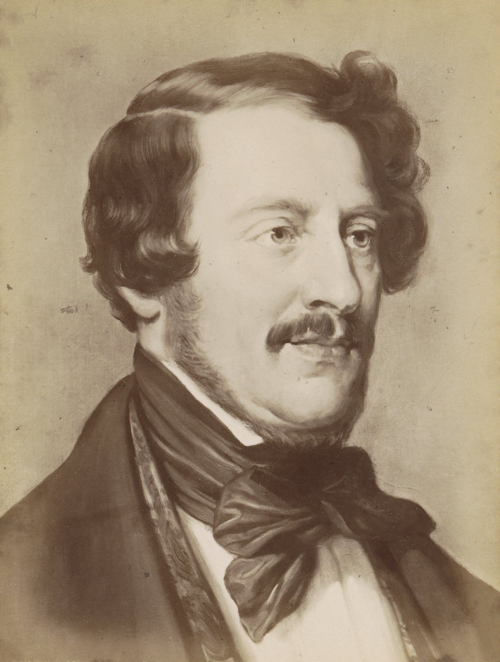
Composer
Gaetano Donizetti
Italian opera composer (1797–1848)
1797–1848
355 works and musical collections
- Born
- 1797
- Died
- 1848
- Birthplace
- Bergamo
- Place of death
- Bergamo
- Citizenship / historical state
- Kingdom of Lombardy–Venetia
- Period (estimated from birth year)
- Romantic
Biography
Domenico Gaetano Maria Donizetti (29 November 1797 – 8 April 1848) was an Italian composer of the early Romantic era, best known for his over 70 operas. Along with Gioachino Rossini and Vincenzo Bellini, he was a leading composer of the bel canto opera style during the first half of the nineteenth century and a probable influence on other composers such as Giuseppe Verdi. Donizetti was born in Bergamo in Lombardy. At an early age, he was taken up by Simon Mayr who enrolled him with a full scholarship in a school which he had set up. There he received detailed musical training. Mayr was instrumental in obtaining a place for Donizetti at the Bologna Academy, where, at the age of 19, he wrote his first one-act opera, the comedy Il Pigmalione, which may never have been performed during his lifetime.
An offer in 1822 from Domenico Barbaja, the impresario of the Teatro di San Carlo in Naples, which followed the composer's ninth opera, led to his move to Naples and his residency there until production of Caterina Cornaro in January 1844. In all, 51 of Donizetti's operas were presented in Naples. Before 1830, success came primarily with his comic operas, the serious ones failing to attract significant audiences. His first notable success came with an opera seria, Zoraida di Granata, which was presented in 1822 in Rome. In 1830, when Anna Bolena was first performed, Donizetti made a major impact on the Italian and international opera scene shifting the balance of success away from primarily comedic operas, although even after that date, his best-known works included comedies such as L'elisir d'amore (1832) and Don Pasquale (1843). Significant historical dramas did succeed; they included Lucia di Lammermoor (the first to have a libretto written by Salvadore Cammarano) given in Naples in 1835, and one of the most successful Neapolitan operas, Roberto Devereux in 1837. Up to that point, all of his operas had been set to Italian libretti.
Donizetti found himself increasingly chafing against the censorship limitations in Italy (and especially in Naples). From about 1836, he became interested in working in Paris, where he saw greater freedom to choose subject matter, in addition to receiving larger fees and greater prestige. From 1838, beginning with an offer from the Paris Opéra for two new works, he spent much of the following 10 years in that city, and set several operas to French texts as well as overseeing staging of his Italian works. The first opera was a French version of the then-unperformed Poliuto which, in April 1840, was revised to become Les martyrs. Two new operas were also given in Paris at that time. Throughout the 1840s Donizetti moved between Naples, Rome, Paris, and Vienna, continuing to compose and stage his own operas as well as those of other composers. From around 1843, severe illness began to limit his activities. By early 1846 he was obliged to be confined to an institution for the mentally ill and, by late 1847, friends had him moved back to Bergamo, where he died in April 1848 in a state of mental derangement due to neurosyphilis.
Biography excerpt from Wikipedia contributors, available under CC BY-SA 4.0. Formatting and reference markers have been removed; the introduction may be shortened. View contributors and article history.
Life and musical career
- Occupations
- composer
- Teachers
- Johann Simon Mayr; Stanislao Mattei
- Genres
- opera; Catholic Mass; cantata
- Notable works
- L'elisir d'amore; Lucia di Lammermoor; Don Pasquale; La Fille du régiment; Maria Stuarda
- Birth name
- Domenico Gaetano Maria Donizetti
- Languages used
- Italian
- VIAF ID
- 74037336
- ISNI
- 0000000121023795
- GND ID
- 118526731
- Library of Congress ID
- n79132358
- MusicBrainz ID
- b8ecf204-6be8-4041-ab11-6d9971ea2711
Recorded in Wikidata. Affiliations may refer to earlier stages of the composer's career.
In this catalogue
- Common listed instruments
- Voice, Piano, Flute, Vocal, Bassoon
- Genres represented
- Classical, Broadway, Pop, Rock
- Source entries with composition dates
- 5
These details describe the indexed sheet music, including arrangements.
Catalogue
Sheet music catalogue page 1 of 8
Instruments describe listed editions, including arrangements. Composition dates and keys appear where recorded; collection pages show their individual contents.
Biographical record: Wikidata, matched on name and checked against dates held in the catalogue. The period label is an estimate from birth year. Authority record: VIAF 74037336. Portrait: Rijksmuseum, CC0, via Wikimedia Commons.