Composer
George Frideric Handel
German-British Baroque composer (1685–1759)
1685–1759
5,055 works in the index
- Born
- 1685
- Died
- 1759
- Birthplace
- Halle (Saale)
- Place of death
- Westminster
- Citizenship / historical state
- Brandenburg-Prussia; Kingdom of Great Britain; Holy Roman Empire
- Period (estimated from birth year)
- Baroque
Biography
Handel spent most of his career in London writing for the public rather than a court, and it shows in the music: direct, grand and built to work in a large room. The catalogue is dominated by the oratorios, the keyboard suites and a great deal of instrumental music.
Messiah is the most-performed choral work in the language and is sold in a bewildering number of editions, from full scholarly scores to simplified singalong versions — check what you are buying, because they are not interchangeable in a rehearsal. The keyboard suites include the variations known as The Harmonious Blacksmith and are more approachable than Bach's equivalent works.
Much of his instrumental music exists in arrangements for combinations he never wrote for. These are legitimate and often excellent, but the listing does not always make clear which you are getting.
Life and musical career
- Occupations
- composer; harpsichordist; organist; violinist; opera composer; impresario; university teacher
- Teachers
- Friedrich Wilhelm Zachow
- Instruments played
- pipe organ; harpsichord; oboe
- Genres
- opera; oratorio; concerto; anthem; classical music; coronation anthem
- Movements
- Baroque music
- Notable works
- Messiah; Water Music; Music for the Royal Fireworks; Giulio Cesare in Egitto; Alcina; Serse; Concerti grossi, Op. 6
- Official website
- http://gfhandel.org
- Birth name
- Georg Friedrich Händel
- Native languages
- German
- VIAF ID
- 5126950
- ISNI
- 0000000122759702
- GND ID
- 118544489
- Library of Congress ID
- n79129204
- MusicBrainz ID
- 27870d47-bb98-42d1-bf2b-c7e972e6befc
Recorded in Wikidata. Affiliations may refer to earlier stages of the composer's career.
In this catalogue
- Common listed instruments
- Piano, Choir, Organ, Voice, Flute
- Genres represented
- Classical, Rock, Christmas, pop, Jazz
- Works with composition dates
- 153 of 5,055
These details describe the indexed sheet music, including arrangements.
Catalogue
Works page 44 of 106
Years are composition dates where known. Instruments describe editions in our catalogue and may include arrangements. A dash means the detail is not recorded.
| Work | Year composed | Catalogue / opus | Key in title | Listed instruments | Genre | Editions |
|---|---|---|---|---|---|---|
| Senza procelle ancora | — | — | — | Piano, Voice | — | 1 |
| Noch ohne St?rme | — | — | — | Piano, Voice | — | 0 |
| O change beyond report | — | — | — | Piano | — | 1 |
| Il mio valore | — | — | — | Piano | — | 1 |
| Dove sei? (O, where art thou?), from Rodelinda, HWV 19 | — | HWV 19 | — | Piano | — | 1 |
| O saget es nicht an zu Gath | — | — | — | Piano | — | 1 |
| Fort, mich h?lt keine Furcht | — | — | — | Piano | — | 1 |
| Arme Tochter, o weine nicht | — | — | — | Piano | — | 1 |
| Allegro Moderato (Harp Concerto In B Flat) | — | — | — | Piano | — | 0 |
| Beautiful Savior | — | — | — | Piano, Horn, Clarinet, percussion, Saxophone | — | 1 |
| Coventry Carol | — | — | — | Piano, Horn, Clarinet, percussion, Saxophone | — | 1 |
| The First Nowell | — | — | — | Piano, Horn, Clarinet, percussion, Saxophone | — | 0 |
| Good King Wenceslas | — | — | — | Piano, Horn, Clarinet, percussion, Saxophone | — | 0 |
| Silent Night | — | — | — | Piano, Horn, Clarinet, percussion, Saxophone | — | 1 |
| We Three Kings | — | — | — | Piano, Horn, Clarinet, percussion, Saxophone | — | 0 |
| What Child Is This? | — | — | — | Piano, Horn, Clarinet, percussion, Saxophone | — | 1 |
| Let's Call The Whole Thing Off | — | — | — | Piano | — | 0 |
| In the bleak midwinter | — | — | — | Piano | — | 1 |
| Sonata #6 In D Major, HWV 385 | — | HWV 385 | D major | Piano, Organ, Oboe, violin | — | 2 |
| Air From The 14th Suite | — | — | — | Piano | — | 1 |
| Passacaglia From The 7th Suite | — | — | — | Piano | — | 1 |
| Chaconne | — | — | — | Piano, Organ | — | 0 |
| Menuet | — | — | — | Piano, Cello, Flute, violin, Horn, Clarinet, Trumpet, Saxophone, Flexible Instrument | — | 1 |
| "Fantasia in C, HWV 490" | — | HWV 490 | — | Piano, Organ | — | 1 |
| "Air in G minor, HWV 467" | — | HWV 467 | G minor | Piano, Organ | — | 3 |
| "Allemande in A, HWV 477" | — | HWV 477 | — | Piano, Organ | — | 1 |
| "Gigue in F, HWV 492" | — | HWV 492 | — | Piano, Organ | — | 1 |
| "Sarabande in G minor, from Suite No. 7 in G minor (1720 coll.), HWV 432" | — | HWV 432 | G minor | Piano | — | 0 |
| Foreword | — | — | — | Piano | — | 1 |
| 8. Gavotta | — | — | — | Piano, harpsichord | — | 0 |
| Air in B flat, HWV 471 | — | HWV 471 | — | Piano | — | 1 |
| Suite in G, HWV 441, I. Allemande | — | HWV 441 | — | Piano | — | 1 |
| Suite in G, HWV 441, II. Allegro | — | HWV 441 | — | Piano | — | 2 |
| Suite in D Minor, HWV 437, III. Courante | — | HWV 437 | D minor | Piano | — | 2 |
| Suite in G Minor, HWV 432 - III. Allegro | — | HWV 432 | G minor | Piano | — | 2 |
| Prelude in F Major | — | — | F major | Piano | — | 1 |
| Courante in E Minor | — | — | E minor | Piano | Classical | 1 |
| Aria con Variazone | — | — | — | Piano | — | 0 |
| Presto in D Minor | — | — | D minor | Piano | — | 0 |
| Why Do The Nations So Furiously Rage (Air From "The Messiah") [Edited by Gregory Castleton] | — | — | — | Piano | — | 0 |
| Come O Wondrous Child | — | — | — | Organ | — | 1 |
| Meditation (Boellmann) | — | — | — | Organ | — | 1 |
| Holy Art Thou | — | — | — | Organ, bass, Tenor, Choir, Alto | — | 1 |
| 5. La Gelosia | — | — | — | harpsichord | — | 0 |
| 7. Duette | — | — | — | harpsichord | — | 0 |
| Vorwort / Zum vorliegenden Band | — | — | — | Piano, harpsichord | — | 0 |
| 2. (Suite Nr. 2) Chaconne G-dur mit 21 Variationen (Fassung IV) HWV 435 | — | HWV 435 | — | harpsichord | — | 0 |
| Erstfassung von Suite Nr. 3, Satz 6 HWV 495a | — | HWV 495a | — | Piano, harpsichord | Rock | 0 |
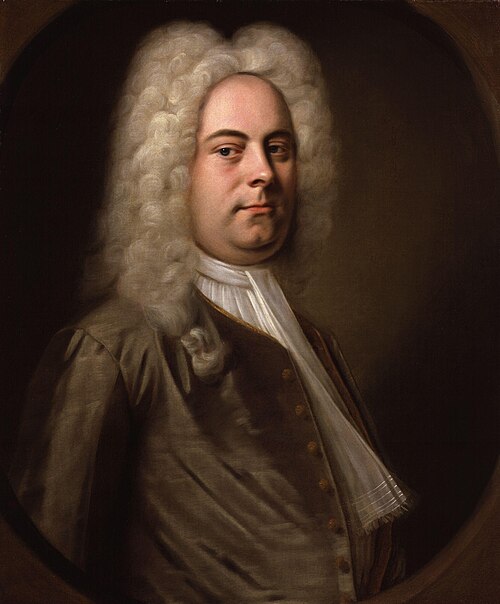
Biographical record: Wikidata, matched on name and checked against dates held in the catalogue. The period label is an estimate from birth year. The biography above is our own. Authority record: VIAF 8931159248059304870007. Portrait: Attributed to Balthasar Denner, Public domain, via Wikimedia Commons.