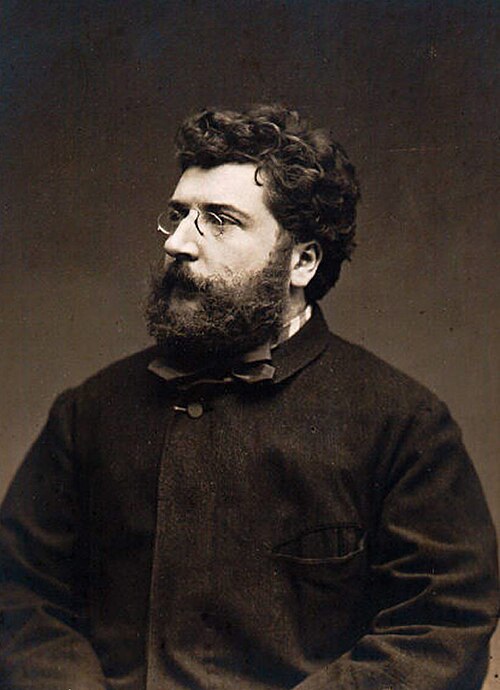
Composer
Georges Bizet
1838–1875
739 works in the index
- Born
- 1838
- Died
- 1875
- Birthplace
- Rue Louise-Émilie-de-La-Tour-d'Auvergne
- Citizenship / historical state
- France
- Period (estimated from birth year)
- Romantic
Biography
Bizet died at thirty-six believing Carmen had failed. It is now the most-performed opera in the world, and it dominates this catalogue in every possible arrangement.
Singers approach him through the Carmen arias — the Habanera and the Toreador Song above all — which appear in every aria anthology by voice type. Instrumentalists get the two suites drawn from the opera and the L'Arlésienne music, both arranged for everything from full orchestra to solo piano.
The one thing to check before buying a Carmen vocal score is whether it uses spoken dialogue or the sung recitatives written by Guiraud after Bizet's death. Both are standard, they are not interchangeable in rehearsal, and editions do not always say on the cover.
In this catalogue
- Common listed instruments
- Piano, Voice, Flute, violin, Orchestra
- Genres represented
- Classical, pop, Jazz, Broadway, Latin
- Works with composition dates
- 33 of 739
These details describe the indexed sheet music, including arrangements.
Catalogue
Works page 4 of 16
Years are composition dates where known. Instruments describe editions in our catalogue and may include arrangements. A dash means the detail is not recorded.
| Work | Year composed | Catalogue / opus | Key in title | Listed instruments | Genre | Editions |
|---|---|---|---|---|---|---|
| "Orchestral Solo from L'arlesienne, Suite I" | — | — | — | Piano, Saxophone | Classical | 4 |
| Les tringles des sistres tintaient Performed by Georges Bizet | — | — | — | — | Classical | 3 |
| Carmen: Acte I. "Avec la garde montante" | — | — | — | Voice, Choir | Classical | 5 |
| Carmen: Acte I. "Sur la place, chacun passe" | — | — | — | Voice, Choir | Classical | 4 |
| Patrie | 1873IMSLP | — | — | — | Classical | 2 |
| Les Pêcheurs de Perles | 1863IMSLP | — | — | — | Classical | 2 |
| Symphony in C Major | 1855 OctoberIMSLP | — | C major | Orchestra, Horn | Classical | 4 |
| Farandole: from L Arlesienne Suit | — | — | — | — | — | 2 |
| Serendade: from The Fair Maid of Pert | — | — | — | — | — | 1 |
| Les tringles des sistres | — | — | — | Voice, Choir | Classical | 3 |
| Je vais danser en votre honneur | — | — | — | Voice, Choir | Classical | 4 |
| C'est des contrebandiers | — | — | — | Voice, Choir | Classical | 3 |
| Je suis Escamillo | — | — | — | Voice, Choir | Classical | 3 |
| Me voila seule dans la nuit | — | — | — | Low Voice | Classical | 2 |
| Nour-Eddin, roi de Lahore, from Djamileh | — | — | — | Mezzo Soprano Voice | Classical | 3 |
| C'est donc ici | — | — | — | Voice Tenor | Classical | 2 |
| Puss in the Corner (Les Quatre Coins) | — | — | — | Piano | Classical | 3 |
| Symphony No. 1 in C Major | — | — | C major | Piano, Harp, Organ, Cello, Flute, Oboe, violin, Bassoon, Double Bass, Horn, Clarinet, Trombone, Timpani, Trumpet | Classical | 2 |
| Beat Out Dat Rhythm On A Drum | — | — | — | Piano, Guitar, Voice | Classical | 3 |
| Stan' Up An' Fight | — | — | — | Piano, Guitar, Voice | Classical | 3 |
| You Talk Just Like My Maw | — | — | — | Piano, Guitar, Voice | Classical | 3 |
| The Wild Rose (Schubert) | — | — | — | Piano | Classical | 2 |
| 2. Le Depart | — | — | — | Piano | Classical | 2 |
| 4. La Bohemienne | — | — | — | Piano | Classical | 2 |
| 6. Le Retour | — | — | — | Piano | Classical | 2 |
| Menuet From L'arlesienne, Suite No. 2 | — | — | — | Organ, Flute | Classical | 3 |
| 1. Overture | — | — | — | Timpani, percussion, Saxophone | Classical | 2 |
| 1. Marche des Contrebandiers | — | — | — | Timpani, percussion | Classical | 2 |
| 3. Seguidille | — | — | — | Timpani, percussion | Classical | 3 |
| Coventry Carol | — | — | — | Harmonica | Classical | 1 |
| C'est toi | — | — | — | Voice | Classical | 2 |
| Euren Toast kann ich wohl erwiden | — | — | — | Low Voice | Classical | 2 |
| Enchanting Night Performed by Georges Bizet | — | — | — | Voice | Classical | 2 |
| S?guedille - Near the ramparts of Seville | — | — | — | Piano | Classical | 2 |
| Je crois entendre from LE PECHEURS DE PERLES | — | — | — | Voice | Classical | 2 |
| Minuet, from L'Arlesienne Suite No. 1 | — | — | — | Piano | Classical | 2 |
| Je n'en dirai rien | — | — | — | Piano, Voice | Classical | 1 |
| Berceuse | — | — | — | Piano, Voice | Classical | 1 |
| L'esprit saint | — | — | — | Piano, Voice | Classical | 1 |
| L'Arlésienne: Suites 1 & 2 | — | — | — | — | Classical | 1 |
| Tarantelle | — | — | — | Piano, Voice | Classical | 1 |
| Pecheurs de Perles, Les | — | — | — | — | Classical | 1 |
| Absence | — | — | — | Piano, Voice | Classical | 1 |
| Songs of the Rhine, no. 6: The Return | — | — | — | — | Classical | 1 |
| Chant d'amour | — | — | — | Piano, Voice | Classical | 1 |
| Farandole: Piano Accompaniment | — | — | — | Orchestra | Classical | 2 |
| Farandole: 1st B | — | — | — | Orchestra | Classical | 2 |
| Farandole: 2nd B | — | — | — | Orchestra | Classical | 2 |
Biographical record: Wikidata, matched on name and checked against dates held in the catalogue. The period label is an estimate from birth year. The biography above is our own. Authority record: VIAF 305420338. Portrait: Étienne Carjat, Public domain, via Wikimedia Commons.