Composer
Giacomo Meyerbeer
German-French composer
1791–1864
113 works and musical collections
- Born
- 1791
- Died
- 1864
- Birthplace
- Tasdorf
- Place of death
- Paris
- Citizenship / historical state
- Kingdom of Prussia
- Period (estimated from birth year)
- Romantic
Biography
Giacomo Meyerbeer (born Jakob Liebmann Meyer Beer; 5 September 1791 – 2 May 1864) was a German opera composer, linking Mozart and Wagner. With his 1831 opera Robert le diable and its successors, he gave the genre of grand opera "decisive character". Meyerbeer's grand opera style was achieved by his merging of German orchestra style with Italian vocal tradition. These were employed in the context of sensational and melodramatic libretti created by Eugène Scribe and were enhanced by the up-to-date theatre technology of the Paris Opéra. They set a standard that helped to maintain Paris as the opera capital of the nineteenth century.
Born to a wealthy Jewish family, Meyerbeer began his musical career as a pianist but soon decided to devote himself to opera, spending several years in Italy studying and composing. His 1824 opera Il crociato in Egitto was the first to bring him a Europe-wide reputation, but it was Robert le diable (1831) which raised his status to great celebrity. His public career, lasting from then until his death, during which he remained a dominating figure in the world of opera, was summarized by his contemporary Hector Berlioz, who claimed that he 'has not only the luck to be talented, but the talent to be lucky.' He was at his peak with his operas Les Huguenots (1836) and Le prophète (1849); his last opera, L'Africaine, was performed posthumously. His operas made him the most frequently performed composer at the world's leading opera houses in the nineteenth century.
At the same time as his successes in Paris, Meyerbeer, as a Prussian Court Kapellmeister (Director of Music) from 1832, and from 1843 as Prussian General Music Director, was also influential in opera in Berlin and throughout Germany. He was an early supporter of Richard Wagner, enabling the first production of the latter's opera Rienzi. He was commissioned to write the patriotic opera Ein Feldlager in Schlesien to celebrate the reopening of the Berlin Royal Opera House in 1844, and he wrote music for certain Prussian state occasions.
Apart from around 50 songs, Meyerbeer wrote little except for the stage. The critical assaults of Wagner and his supporters, especially after Meyerbeer's death, led to a decline in the popularity of his works; his operas were suppressed by the Nazi regime in Germany, and were neglected by opera houses through most of the twentieth century. In the 21st century, however, the composer's major French grand operas have begun to reappear in the repertory of numerous European opera houses.
Biography excerpt from Wikipedia contributors, available under CC BY-SA 4.0. Formatting and reference markers have been removed; the introduction may be shortened. View contributors and article history.
Life and musical career
- Occupations
- composer; conductor; autobiographer; music director; pianist
- Recorded memberships
- Académie des beaux-arts
- Genres
- opera
- Notable works
- Robert le diable; Les Huguenots; Le prophète; L'étoile du nord; Dinorah; L'Africaine
- Awards
- Commander of the Legion of Honour; Pour le Mérite for Sciences and Arts order; Bavarian Maximilian Order for Science and Art; Knight I Class of the Saxon Order of Civil Merit; Knight's Cross of the Order of Franz Joseph; Knight Commander of the Order of the Crown; Order of the Oak Crown; Knight Grand Officer of the Order of Albrecht the Bold; Knight Grand Officer of the Order of the Saxe-Ernestine; 2nd Class Order of the Crown with the Star
- Birth name
- Jakob Liebmann Meyer Beer
- Languages used
- German
- VIAF ID
- 71578779
- ISNI
- 0000000122817116
- GND ID
- 118581945
- Library of Congress ID
- n79140961
- MusicBrainz ID
- e2e5fec1-d87b-4b48-81b1-7e9ab074f348
Recorded in Wikidata. Affiliations may refer to earlier stages of the composer's career.
In this catalogue
- Common listed instruments
- Piano, Voice, Flute, percussion, Timpani
- Genres represented
- Classical
- Source entries with composition dates
- 4
These details describe the indexed sheet music, including arrangements.
Catalogue
Sheet music catalogue page 2 of 3
Instruments describe listed editions, including arrangements. Composition dates and keys appear where recorded; collection pages show their individual contents.
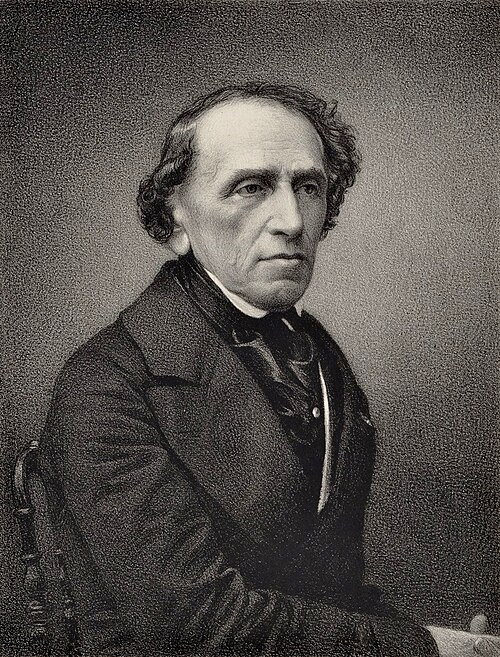
Biographical record: Wikidata, matched on name and checked against dates held in the catalogue. The period label is an estimate from birth year. Authority record: VIAF 71578779. Portrait: Au Ménestrel , Paris, 1865. Uploaded, stiched and restored by JLPC, Public domain, via Wikimedia Commons.