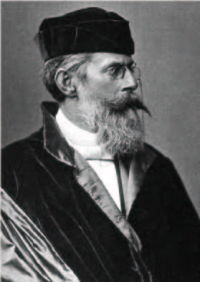
Composer
Heinrich von Herzogenberg
Austrian composer and conductor (1843-1900)
1843–1900
79 works and musical collections
- Born
- 1843
- Died
- 1900
- Birthplace
- Graz
- Place of death
- Wiesbaden
- Citizenship / historical state
- Austrian Empire
- Period (estimated from birth year)
- Romantic
Biography
Heinrich Picot de Peccaduc, Freiherr von Herzogenberg (10 June 1843 – 9 October 1900) was an Austrian composer and conductor descended from a French aristocratic family.
He was born in Graz and was educated at a Jesuit school in Feldkirch and also in Munich, Dresden and Graz before studying law, philosophy and political science at the university of Vienna. He soon turned his energies to music and attended the composition classes of Felix Otto Dessoff until 1864. Early on he was attracted to the music of Richard Wagner, but after studying J. S. Bach's works he became an adherent of the classical tradition and an advocate for the music of Brahms. In 1866 he married Elisabeth von Stockhausen, who had been a piano pupil of Brahms; Brahms's letters to and from both Herzogenbergs form one of the most delightful sections of his correspondence. They lived in Graz until 1872, when they moved to Leipzig. In 1874, with the Bach scholar Philipp Spitta, Herzogenberg founded the Leipzig Bach-Verein, which concerned itself with the revival of Bach’s cantatas. Herzogenberg was its artistic director for ten years, during which time Ethel Smyth was one of his composition pupils. From 1885 he was Professor of Composition at the Hochschule für Musik in Berlin. It was in this capacity that he advised the young Ralph Vaughan Williams to study with Max Bruch. He died suddenly in Wiesbaden, aged 57; in his last years he used a wheelchair due to necrosis of the joints.
Herzogenberg was a well-schooled composer of definite gifts. In 1876 he wrote a set of Variations on a theme of Brahms (his op. 23, for piano four hands, on the Brahms song, Die Trauernde, op. 7 no. 5), but despite Elisabeth’s cajoling Brahms almost never expressed approval of his works. It has been suggested that Brahms was piqued that Herzogenberg had married Elisabeth, of whom he was himself extremely fond. Toward the end of his life, Brahms grudgingly relented somewhat, writing “Herzogenberg is able to do more than any of the others.”
While Herzogenberg has been characterized as a mere epigone of Brahms, many of his compositions show little or no overt Brahmsian influence: for example, his two string trios op. 27 Nos. 1 & 2; while some early compositions, pre-dating his acquaintance with Brahms, have features in common with the older composer.
Towards the end of his life he concentrated on providing music for communal worship in the Lutheran Evangelical Church in Strasbourg, under the influence of Friedrich Spitta, brother of Philipp Spitta, who was professor of theology there, though Herzogenberg himself remained Roman Catholic. His models in these pieces were the Bach oratorios and passions, with chorales designed to be sung by the congregation and played by only a small instrumental ensemble. He also wrote a large-scale Mass in memory of Philipp Spitta, for which Friedrich Spitta selected the text. Several of Herzogenberg’s major works were thought to have been destroyed during World War II but resurfaced during the 1990s.
Biography excerpt from Wikipedia contributors, available under CC BY-SA 4.0. Formatting and reference markers have been removed; the introduction may be shortened. View contributors and article history.
Life and musical career
- Occupations
- composer; composition teacher; musicographer; conductor
- Teachers
- Felix Otto Dessoff; Gustav Nottebohm
- Career institutions / employers
- Berlin University of the Arts
- Recorded memberships
- Academy of Arts, Berlin
- Genres
- symphony; liturgical music; opera
- Birth name
- Leopold Heinrich Picot de Peccaduc Freiherr von Herzogenberg
- Native languages
- German
- Languages used
- German
- VIAF ID
- 61688111
- ISNI
- 0000000110656845
- GND ID
- 119523876
- Library of Congress ID
- n83073216
- MusicBrainz ID
- e5a1c17d-d0ff-41e8-8556-2f9b936f3b52
Recorded in Wikidata. Affiliations may refer to earlier stages of the composer's career.
In this catalogue
- Common listed instruments
- Organ, Choir, Piano, Horn, Oboe
- Source entries with composition dates
- 2
These details describe the indexed sheet music, including arrangements.
Catalogue
Sheet music catalogue page 2 of 2
Instruments describe listed editions, including arrangements. Composition dates and keys appear where recorded; collection pages show their individual contents.
Biographical record: Wikidata, matched on name and checked against dates held in the catalogue. The period label is an estimate from birth year. Authority record: VIAF 61688111. Portrait: Unknown author Unknown author, Public domain, via Wikimedia Commons.