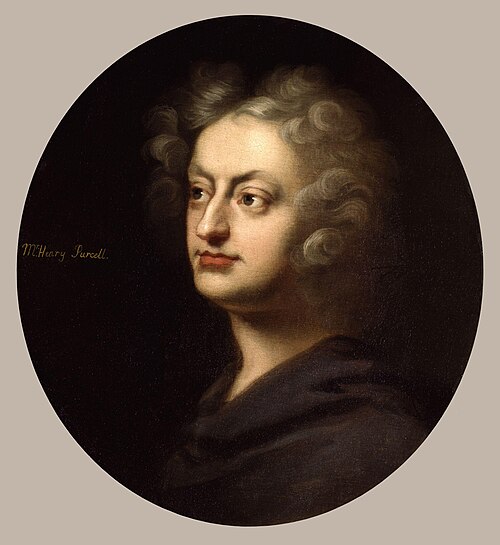
Composer
Henry Purcell
1659–1695
1,644 works in the index
- Born
- 1659
- Died
- 1695
- Birthplace
- Westminster
- Citizenship / historical state
- Kingdom of England
- Period (estimated from birth year)
- Baroque
Biography
Purcell is the last great English composer before the twentieth century and wrote for a world of theatre music, court odes and church anthems that no longer exists, which makes the practical repertoire smaller than the catalogue suggests.
What singers actually use are the songs and the Dido and Aeneas arias, and 'When I am laid in earth' is one of the most-performed pieces in this index. Keyboard players have the harpsichord suites and the grounds, several of which are accessible early. Choirs have the anthems and the funeral music.
His notation leaves ornaments and continuo to convention even more than his continental contemporaries, so editions differ substantially. For the songs in particular, a realised edition with a written-out keyboard part is worth having unless you are able to play from a figured bass.
In this catalogue
- Common listed instruments
- Voice, Piano, harpsichord, Organ, Choir
- Genres represented
- Classical, pop, Baroque, Pop, Latin
- Works with composition dates
- 12 of 1,644
These details describe the indexed sheet music, including arrangements.
Catalogue
Works page 3 of 35
Years are composition dates where known. Instruments describe editions in our catalogue and may include arrangements. A dash means the detail is not recorded.
| Work | Year composed | Catalogue / opus | Key in title | Listed instruments | Genre | Editions |
|---|---|---|---|---|---|---|
| While Thirsis Wrapp'd | — | — | — | harpsichord, Voice | Classical | 4 |
| Pious Celinda | — | — | — | harpsichord, Voice | Classical | 7 |
| I Lov'd Fair Celia | — | — | — | harpsichord, Voice | Classical | 5 |
| Dialogue of Corydon and Mopsa | — | — | — | — | Classical | 8 |
| Largo | — | — | — | Organ | Classical | 6 |
| Vol. 1 - Rigadoon | — | — | — | Cello | Classical | 6 |
| Trumpet Tune Additional credits William Croft | — | — | — | Piano | Classical | 4 |
| Processional [Z. 678] | — | — | — | Piano | Classical | 4 |
| A Farewell | — | — | — | Piano | Classical | 6 |
| Proper Tune | — | — | — | Cello, violin, Viola | Classical | 7 |
| Scottish Tune | — | — | — | Flute | Classical | 6 |
| Marche In C | — | — | — | Piano | Classical | 7 |
| Suite in G Major | — | — | G major | Piano, Organ | Classical | 6 |
| Air in D minor: Clarine | — | — | D minor | — | — | 4 |
| Lilliburlero: Clarine | — | — | — | — | — | 3 |
| Lilliburlero: Flut | — | — | — | — | — | 3 |
| Lilliburlero: Trombon | — | — | — | — | — | 3 |
| Abdelazar: Festival Rondeau: Trumpet | — | — | — | — | — | 4 |
| Air: Trumpe | — | — | — | — | — | 4 |
| Lilliburlero: Tub | — | — | — | — | — | 5 |
| Ah, Belinda, I Am Prest | — | — | — | Low Voice | Classical | 6 |
| Cease, O My Sad Soul | — | — | — | Voice, Low Voice | Classical | 6 |
| Not all my torments | — | — | — | harpsichord, Voice, Low Voice | Classical | 9 |
| O, Lead Me To Some Peaceful Gloom | — | — | — | Low Voice | Classical | 7 |
| An Evening Hymn | — | — | — | Low Voice | Classical | 7 |
| There's Not A Swain On The Plain | — | — | — | Voice, Low Voice | Classical | 7 |
| Come All Ye Songsters | — | — | — | Low Voice | Classical | 6 |
| Fairest Isle (from 'King Arthur') | — | — | — | Piano | — | 5 |
| Hornpipe in G minor from King Arthur | — | — | G minor | Piano | Classical | 13 |
| 16. Chorus: Ho! Ho! Ho! | — | — | — | Choir | Classical | 4 |
| I was glad when they said unto me | — | — | — | Voice, bass, Tenor, Choir, Alto | Classical | 6 |
| In these delightful, pleasant groves | — | — | — | Cello, violin, Voice, Choir, A Cappella, Viola | Classical | 6 |
| On the Brow of Richmond Hill | — | — | — | harpsichord, Voice, Voice High, Low Voice | Classical | 7 |
| I Attempt From Love's Sickness To Fly In Vain (The Indian Queen) | — | — | — | Piano, Voice, Voice High, Low Voice | Classical | 4 |
| What Shall I Do To Show How Much I Love Her (Dioclesian) | — | — | — | Voice High, Low Voice | Classical | 3 |
| 2. You twice ten hundred Deities | — | — | — | — | Classical | 3 |
| We The Spirits Of The Air | — | — | — | Piano, Organ, Voice | Classical | 5 |
| "Minuet in A minor, Z. 649" | — | — | A minor | Piano, Organ | — | 5 |
| 4. Trumpet Tune, Called the Cebell | — | — | — | Piano, harpsichord | Classical | 2 |
| 4. Prelude | — | — | — | Piano, Guitar, harpsichord, Voice, Choir, Timpani, Recorder, percussion | Classical | 3 |
| Christmas Songs | — | — | — | Piano | Classical | 4 |
| Fanfare in C Major | — | — | C major | Organ | Classical | 3 |
| Voluntary for Double Organ | — | — | — | Piano, Organ | Classical | 7 |
| Voluntary in D minor | — | — | D minor | Organ | Classical | 4 |
| Draw Near, You Lovers | — | — | — | harpsichord, Voice | Classical | 5 |
| He Himself Courts | — | — | — | harpsichord, Voice | Classical | 5 |
| I take no pleasure | — | — | — | harpsichord, Voice | Classical | 8 |
| Let Each Gallant Heart | — | — | — | harpsichord, Voice | Classical | 6 |
Biographical record: Wikidata, matched on name and checked against dates held in the catalogue. The period label is an estimate from birth year. The biography above is our own. Authority record: VIAF 5118737. Portrait: anonymous, Public domain, via Wikimedia Commons.