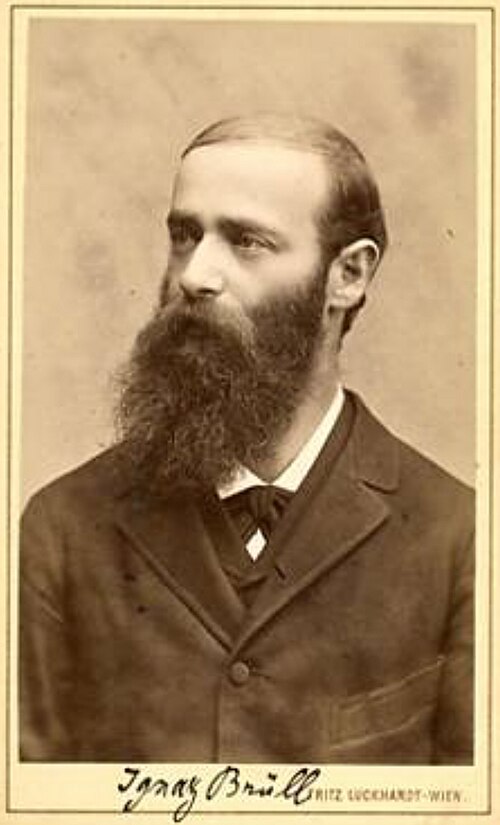
Composer
Ignaz Brüll
Austrian musician (1846–1907)
1846–1907
57 works and musical collections
- Born
- 1846
- Died
- 1907
- Birthplace
- Prostějov
- Place of death
- Vienna
- Citizenship / historical state
- Austria–Hungary; Austrian Empire
- Period (estimated from birth year)
- Romantic
Biography
Ignaz Brüll (7 November 1846 – 17 September 1907) was a pianist and composer from Austria-Hungary. Born in Moravia, he lived and worked in Vienna.
His operatic compositions included Das goldene Kreuz (The Golden Cross), which became a repertory work for several decades after its first production in 1875, but eventually fell into neglect after being banned by the Nazis because of Brüll's Jewish origins. He also wrote a small corpus of finely crafted works for the concert hall and recitals. Brüll's compositional style was lively but unabashedly conservative, in the vein of Mendelssohn and Schumann.
Brüll was also highly regarded as a sensitive concert pianist. Johannes Brahms regularly wanted Brüll to be his partner in private performances of four-hand piano duet arrangements of his latest works. Indeed, Brüll was a prominent member of Brahms's circle of musical and literary friends, many of whom he and his wife frequently entertained.
In recent years, Brüll's concert music has been revived on CD, and well-received recordings are available of his piano concertos, among other non-vocal works.
In 1872 he was appointed professor at the Horak Institute in Vienna.
Biography excerpt from Wikipedia contributors, available under CC BY-SA 4.0. Formatting and reference markers have been removed; the introduction may be shortened. View contributors and article history.
Life and musical career
- Teachers
- Julius Epstein
- Instruments played
- piano
- Genres
- opera
- Notable works
- Das goldene Kreuz
- Languages used
- German
- VIAF ID
- 102407348
- ISNI
- 000000011079835X
- GND ID
- 118660284
- Library of Congress ID
- n82078493
- MusicBrainz ID
- 79d8a394-f65f-4439-a364-813b835dd6c6
Recorded in Wikidata. Affiliations may refer to earlier stages of the composer's career.
In this catalogue
- Common listed instruments
- Piano, Orchestra, Cello, violin
- Genres represented
- Classical
- Source entries with composition dates
- 6
These details describe the indexed sheet music, including arrangements.
Catalogue
Sheet music catalogue page 2 of 2
Instruments describe listed editions, including arrangements. Composition dates and keys appear where recorded; collection pages show their individual contents.
| Title | Work details | Listed instruments | Sheet music |
|---|---|---|---|
| Rhapsodie, Op.65 |
| See edition details | View sheet music |
| 2 Scherzi, Op.20 |
| See edition details | View sheet music |
| 6 Schottische Lieder, Op.18 |
| See edition details | View sheet music |
| Spanish Dance | See work details | See edition details | View sheet music |
| Suite for Violin and Piano, Op.42 |
| See edition details | View sheet music |
| Symphony, Op.31 |
| See edition details | View sheet music |
| Tarantella, Op.6 |
| See edition details | View sheet music |
| 8 Toskanische Lieder, Op.22 |
| See edition details | View sheet music |
| Die Bekehrte (The Encounter) | See work details |
| View sheet music |
Biographical record: Wikidata, matched on name and checked against dates held in the catalogue. The period label is an estimate from birth year. Authority record: VIAF 102407348. Portrait: Fritz Luckhardt , Fotograf (17. März 1843 - 28. November 1894), Public domain, via Wikimedia Commons.