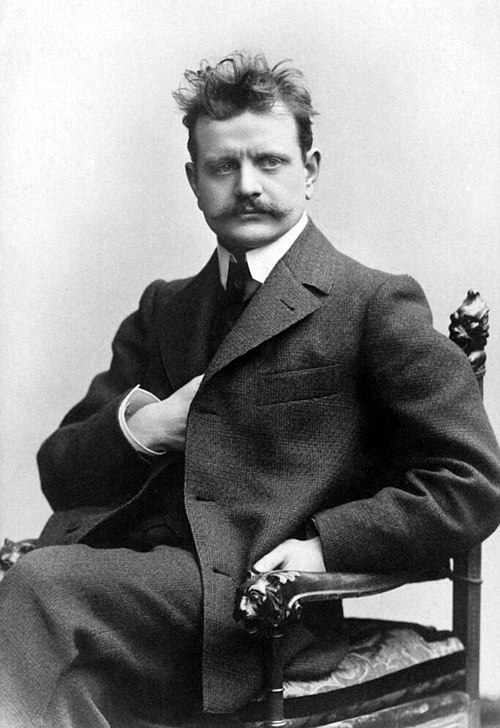
Composer
Jean Sibelius
Finnish composer (1865–1957)
1865–1957
474 works in the index
- Born
- 1865
- Died
- 1957
- Birthplace
- Hämeenlinna
- Citizenship / historical state
- Grand Duchy of Finland
- Period (estimated from birth year)
- Modern
Biography
While some critics of his era found him insufficiently radical, the composer Jean Sibelius (1865-1957) has never had a problem finding audiences who love and enjoy his music. A national hero in his native Finland, Sibelius wrote seven symphonies and likely planned an eighth. Alongside these, his tone poems and concert works exhibit splendidly the distinctive elements of his musical style: expressive melodies, simple but richly orchestrated harmonies and a stately elegance influenced by Tchaikovsky and Bruckner. En Saga, the Karelia suite and the Violin Concerto are among his best-known works, but the most famous is the single-movement symphonic poem Finlandia â its main theme became a quasi-national anthem in Finland and the tune to several Christian hymns.
Sibelius was born Johan, but as a student he changed his first name to its French form, Jean. He began learning music too late to follow a performing career, so he took to composing and had completed the majority of his output by the late 1920s, despite living another three decades.
In this catalogue
- Common listed instruments
- Piano, Tin Whistle, Orchestra, Harmonica, violin
- Genres represented
- Classical, New Age, Australian, Folk
- Works with composition dates
- 116 of 474
These details describe the indexed sheet music, including arrangements.
Catalogue
Works page 5 of 10
Years are composition dates where known. Instruments describe editions in our catalogue and may include arrangements. A dash means the detail is not recorded.
| Work | Year composed | Catalogue / opus | Key in title | Listed instruments | Genre | Editions |
|---|---|---|---|---|---|---|
| 3. Finale - Themes | — | — | — | — | Classical | 1 |
| Alla Gavotta Op. 46 No. 7 | — | Op. 46 No. 7 | — | Piano | Classical | 3 |
| Concerto in D minor Op.47 | — | Op.47 | D minor | Piano, violin | Classical | 2 |
| Thanks Be to God: Score | — | — | — | Choir | Classical | 2 |
| Romance In Db | — | — | — | Piano | Classical, Australian | 1 |
| Rakastava, JS 160C | 1911-12IMSLP | — | — | Triangle, Timpani | Classical | 2 |
| Tulen Synty, op. 32 | 1902 (revised 1910)IMSLP | op. 32 | — | Orchestra, Baritone | Classical | 2 |
| 5 Danses Champêtres for Violin and Piano, Op.106 | 1924IMSLP | Op.106 | — | — | Classical | 1 |
| Fridolin's Folly | 1917IMSLP | — | — | — | Classical | 1 |
| The Lonely Ski Trail | 1925IMSLP | — | — | — | Classical | 1 |
| Maan virsi, Op.95 | 1920IMSLP | Op.95 | — | — | Classical | 1 |
| Mandolinato | 1917IMSLP | — | — | Piano | Classical | 1 |
| Oma maa, Op.92 | 1918IMSLP | Op.92 | — | — | Classical | 1 |
| People of Land and Sea, Op.65a | No.1 - 1911No.2 - 1912IMSLP | Op.65a | — | — | Classical | 1 |
| Row, row, duck | 1899IMSLP | — | — | Voice | Classical | 1 |
| Scènes historiques II, Op.66 | 1912IMSLP | Op.66 | — | Orchestra | Classical | 1 |
| 3 Songs for Chorus, Op.31 | 1896-1904IMSLP | Op.31 | — | — | Classical | 1 |
| Suite Charactèristique, Op.100 | 1922IMSLP | Op.100 | — | — | Classical | 1 |
| Till Thérèse Hahl | 1902IMSLP | — | — | — | Classical | 1 |
| Väinö's Song, Op.110 | 1926IMSLP | Op.110 | — | — | Classical | 1 |
| Valse Chevaleresque, Op.96c | — | Op.96c | — | Orchestra | Classical | 2 |
| Valse Lyrique, Op.96a | — | Op.96a | — | Piano | Classical | 1 |
| 3. Aspen | — | — | — | Piano | Classical | 2 |
| Romance | — | — | — | Piano | — | 1 |
| 2. Etude | — | — | — | Piano | Classical | 2 |
| 3. Carillon | — | — | — | Piano | Classical | 1 |
| 4. Humoresque | — | — | — | Piano | Classical | 0 |
| 12. Capriccietto | — | — | — | Piano | Classical | 2 |
| 13. Harlequinade | — | — | — | Piano | Classical | 2 |
| 1. Bellis | — | — | — | Piano | Classical | 1 |
| 5. Campanula | — | — | — | Piano | Classical | 1 |
| Scherzino | — | — | — | Piano | Classical | 1 |
| Sommerlied (Summer Song) | — | — | — | Piano | Classical | 1 |
| 1. Piece Caracteristique | — | — | — | Piano | Classical | 1 |
| 2. Melodie Elegiaque | — | — | — | Piano | Classical | 1 |
| 3. Danse | — | — | — | Piano | Classical | 1 |
| Petite Marche | — | — | — | Piano | Classical | 1 |
| Seventh Symphony | — | — | — | Piano | Classical | 2 |
| Shenandoah | — | — | — | Piano | Classical | 0 |
| 6. Hochzeitserinnerung = Haamuistelma | — | — | — | Piano | Classical | 2 |
| Valse | — | — | — | Piano, violin | Classical | 1 |
| Berceuse | — | — | — | Piano, violin | Classical | 2 |
| Humoresque II | — | — | — | violin | Classical | 1 |
| 2. Elegie and Musette | — | — | — | Timpani, percussion | Classical | 1 |
| Rock-A-My Soul | — | — | — | Harmonica | Classical | 1 |
| Captain Kidd | — | — | — | Harmonica | Classical | 1 |
| Goin' South | — | — | — | Harmonica | Classical | 0 |
| Irish Hymn | — | — | — | Harmonica | Classical | 1 |
Biographical record: Wikidata, matched on name and checked against dates held in the catalogue. The period label is an estimate from birth year. Authority record: VIAF 59270886. Portrait: Paul Heckscher, Public domain, via Wikimedia Commons.