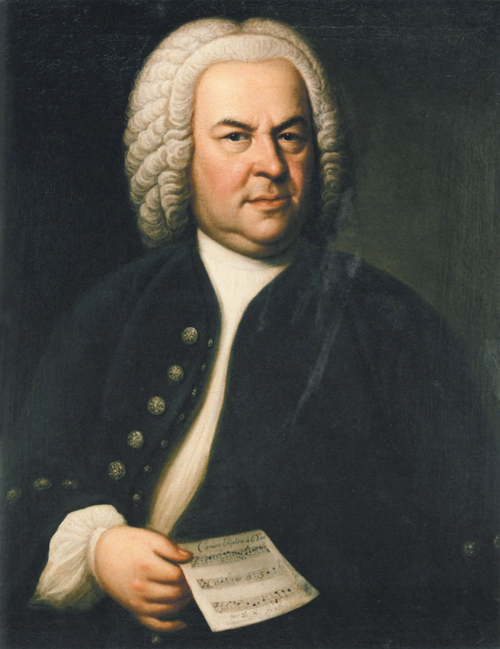
Composer
Johann Sebastian Bach
1685–1750
17,098 works in the index
- Era
- Baroque
- Nationality
- Saxe-Eisenach
- Born in
- Eisenach
Bach wrote more music that ordinary players actually use than any other composer, which is why this catalogue holds over 17,000 entries under his name. He spent his career as a working church and court musician, producing to deadline, and almost none of it was published in his lifetime.
For keyboard players the entry points are the Notebook for Anna Magdalena and the Little Preludes, both genuinely playable within a few years of starting. The Two-Part Inventions come next, then the Well-Tempered Clavier, which is a lifetime's work rather than a stage to pass through. String players meet him through the solo suites and partitas; singers and choirs through the cantatas, Passions and the B minor Mass.
Editions matter here more than for most composers. Bach notated sparingly — little dynamic marking, inconsistent articulation, ornaments left to convention — so every edition is an interpretation. A nineteenth-century performing edition, which is what most free scans are, will hand you a fully marked page reflecting a style of playing that has since been substantially revised. For anything you intend to perform, a modern urtext is worth the outlay.
Catalogue
Works page 131 of 357
Deux Trios
Concerto 3: C Major
Concerto 4: C Major
Herr Jesu Christ, du hochstes Gut, BWV 166 no. 3 (Lord Jesus Christ, thou highest good)
Herr Jesu Christ, du hochstes Gut, BWV 113 no. 2 (Lord Jesus Christ, thou highest good)
Was Gott tut, das ist wohlgetan, BWV 75 no. 14 (Whatever God ordains is right)
Herzlich tut mich verlangen, BWV 159 no. 2 (My longing is unbounded)
Wo soll ich fliehen hin, BWV 199 no. 6 (O where shall I now go)
Christ lag in Todesbanden, BWV 4 no. 4 (Christ lay in death's cold prison)
2. Chorale Settings Handed Down in Copyist's Manuscripts
Wie schon leuchtet die Morgenstern a 4 BWV 764
Herr Christ, der einig Gottessohn
Christ lag in Todesbanden (2x) BWV 718, BWV 695
Praeludium et Fuga: La Minuer
Concerto 1: G Major
Praeludium et Fuga: Sol Majeur
Praeludium et Fuga: Fa Minuer
Praeludium et Fuga: La Majeur
Jesus bleibet meine Freude, BWV 147 no. 6
Du Friedefurst, Herr Jesu Christ, BWV 143 no. 2
Kommt her zu mir, spricht Gottes Sohn, BWV 86 no. 3
Pieces Diverses
Praeludium et Fuga: Si Minuer
Concerto a-moll BWV 593 nach dem Concerto a-moll op.3/8 (RV 522) (2 V,Str,Bc) von Antonio Vivaldi
Auf meinem lieben Gott per Canonem BWV 744
Von Him
There Is A Balm In Gilead
Concerto 2: A Minor
Concerto d-moll BWV 596 nach dem Concerto d-moll op.3/11 (RV 565) (2 V,Vc,Str,Bc) von Antonio Vivaldi
Aria F-dur nach einem Trio-Satz von Francois Couperin
Allein Gott in der Hoh sei Ehr (3x) BWV 717, BWV 711, BWV 715
Allein Gott in der Hoh sei Ehr BWV deest (Emans Nr. 25)
Nun komm, der Heiden Heiland, BWV 36 no. 2 (Now come, the nation's Saviour)
Trio c-moll BWV 585 nach Satz 1 und 2 einer Triosonate c-moll von Johann Friedrich Fasch
Concerto C-dur BWV 595 nach dem 1. Satz eines Concertos von Johann Ernst Prinz von Sachsen-Weimar
Concerto G-dur BWV 592 nach dem Concerto G-dur (V,Str,Bc) von Johann Ernst Prinz von Sachsen-Weimar
Concerto C-dur BWV 594 nach dem Concerto D-dur "Grosso Mogul" (RV 208) (V,Str,Bc) von Antonio Vivaldi
A: Praludien, Toccaten, Fantasien und Fugen II: Toccata in C, BWV 564 / Fantasia in C, BWV 570 / Fantasia in C (Fragment), BWV 573 / Fuga in c (uber ein Thema von Legrenzi), BWV 574 / Fuga in c, BWV 575 / Toccata con Fuga in d
Quatre Concertos
Christum wir sollen loben schon / Was furc
1. Chorale Settings Handed Down in the Autograph
Wie schon leuchtet die Morgenstern a 2 Clav. et Pedal BWV 739
"Sinfonia No. 1 in C, BWV 787"
Lass mich dein sein und bleiben, BWV 95 no. 3
Ach, was ist doch unser Leben a 2 Clav. et Ped. BWV 743
Trio G-dur BWV 586. Ubertragung nach einer unbekannten Vorlage
Fuga super Allein Gott in de Hoh sei Ehr BWV 716
Herr Christ, der einig Gotts Sohn, BWV 22 no. 5 (The only Son from Heaven)
Dates, era and nationality from Wikidata, matched on name and verified against any dates already held here. The biography above is our own. Portrait: Elias Gottlob Haussmann, Public domain, via Wikimedia Commons.