Composer
Johannes Brahms
1833–1897
6,849 works in the index
- Era
- Romantic
- Nationality
- Hamburg
- Born in
- Hamburg
Brahms wrote densely and revised ruthlessly, destroying what did not satisfy him, so the surviving catalogue is smaller than his contemporaries' and uniformly serious. It covers symphonies, concerti, a large body of chamber music, songs and late piano pieces.
For pianists the late Op. 116–119 pieces are the heart of it — short, inward and technically less punishing than the earlier sonatas, though musically demanding. The Hungarian Dances in their four-hand form are the most-played thing he wrote and are genuinely approachable. Singers have over two hundred songs and the German Requiem.
His piano writing assumes a large hand and comfortable tenths appear regularly. Editions differ little; what varies is fingering, and an edition with good fingering is worth paying for here.
Catalogue
Works page 125 of 143
Waltz No. 4 G major Op. 39, No. 4
Waltz No. 5 E major Op. 39, No. 5
Waltz No. 6 C sharp major Op. 39, No. 6
Waltz No. 7 E major Op. 39, No. 7
Waltz No. 8 B flat major Op. 39, No. 8
Waltz No. 9 D minor Op. 39, No. 9
Wie bit du, meine Konigin, Op. 32, No. 9
Vergebleiches Standchen, Op. 84, No. 4
Sapphiche Ode, Op. 94, No. 4
Immer leiser wird Schlummer, Op. 105, No. 2
Sonatas in C Op. 1
F# min Op. 2
F min Op. 5
Hungarian Dances WoO 1 nos. 1Ð10 in the version for piano 2-hands
51 excercises WoO 6
Rakoczi-March a minor App. III no. 10
2 Suite fragments a minor and b minor WoO posth. 3-5
Cadenzas to several piano concertos by Bach, Beethoven and Mozart WoO posth. 11Ð13 and 15
Album leaf App. III no. 5 on no. 7 from Papillons op. 2 by Robert Schumann
Piano Piece B flat major App. III no. 4
3 appendixes
Akademische Festouverture
Waltz No. 13 C major Op. 39, No. 13
Waltz No. 14 A minor Op. 39, No. 14
Waltz No. 15 A major Op. 39, No. 15
Waltz No. 16 F major Op. 39, No. 16
Waltz No. 6 C major Op. 39, No. 6
Waltz, Op. 39, No. 3
Rede, Madchen, Op. 52 no. 1 - E-Dur/E major
Am Gesteine rauscht die Flut, Op. 52 no. 2 - a-Moll/A minor
O die Frauen, Op. 52 no. 3 - A-Dur/A major
O die Frauen (Appendix), Op. 52 no. 3 - B-Dur/B-flat major
Wie des Abends schone Rote, Op. 52 no. 4 - F-Dur/F major
Die grune Hopfenranke, Op. 52 no. 5 - a-Moll/A minor
Ein kleiner, hubscher Vogel, Op. 52 no. 6 - A-Dur/A major
Wohl schon bewandt war es, Op. 52 no. 7 - c-Moll/C minor
Wenn so lind dein Auge mir, Op. 52 no. 8 - As-Dur/Ab major
Am Donaustrande, Op. 52 no. 9 - E-Dur/E major
O wie sanft, Op. 52 no. 10 - G-Dur/G major
Nein, es ist nicht auszukommen, Op. 52 no. 11 - c-Moll/C minor
Schlosser, auf, und mache Schlosser, Op. 52 no. 12 - Es-Dur/Eb major
Vogelein durchrauscht die Luft, Op. 52 no. 13 - As-Dur/Ab major
Sieh, wie ist die Welle klar, Op. 52 no. 14 - Es-Dur/Eb major
Nachtigall, sie singt so schon, Op. 52 no. 15 - As-Dur/Ab major
Ein dunkeler Schacht ist Liebe, Op. 52 no. 16 - f-Moll/F minor
Nicht wandle, mein Licht, Op. 52 no. 17 - Des-Dur/D-flat major
Es bebet das Gestrauche, Op. 52 no. 18
Brahms Hungarian Dance No.5, for piano trio, PB101
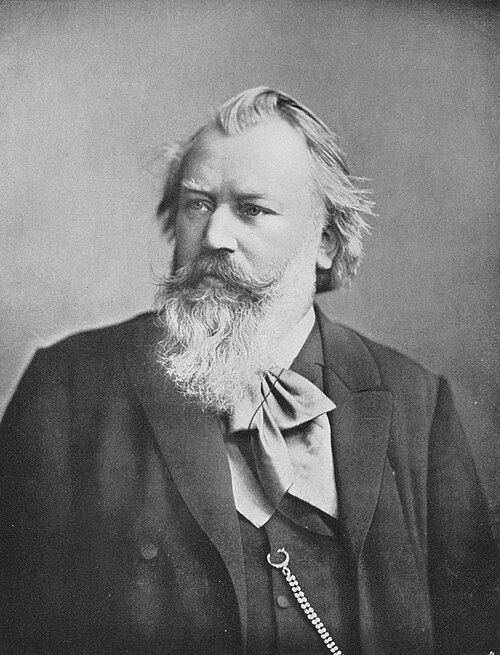
Dates, era and nationality from Wikidata, matched on name and verified against any dates already held here. The biography above is our own. Portrait: C. Brasch , Berlin ( biography ), Public domain, via Wikimedia Commons.