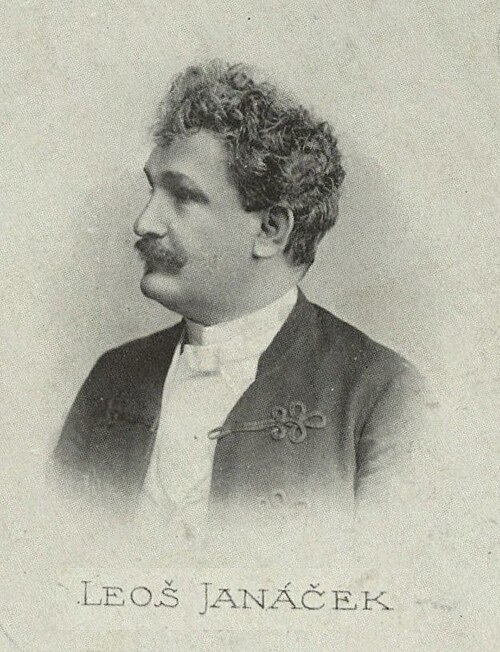
Composer
Leos Janacek
Czech composer (1854–1928)
1854–1928
148 works and musical collections
- Born
- 1854
- Died
- 1928
- Birthplace
- Hukvaldy
- Citizenship / historical state
- Austrian Empire; Czechoslovakia
- Period (estimated from birth year)
- Romantic
Biography
Leoš Janáček (Czech: [ˈlɛoʃ ˈjanaːtʃɛk] ; 3 July 1854 – 12 August 1928) was a Czech composer, music theorist, folklorist, and teacher. He was inspired by Moravian and other Slavic music, including Eastern European folk music, to create an original, modern musical style.
Born in Hukvaldy, Janáček demonstrated musical talent at an early age and was educated in Brno, Prague, Leipzig, and Vienna. He then returned to live in Brno, where he married his pupil Zdenka Schulzová and devoted himself mainly to folkloristic research. His earlier musical output was influenced by contemporaries such as Antonín Dvořák, but around the turn of the century he began to incorporate his earlier studies of national folk music, as well as his transcriptions of "speech melodies" of spoken language, to create a modern, highly original synthesis. The death of his daughter Olga in 1903 had a profound effect on his musical output; these notable transformations were first evident in the opera Jenůfa (often called the "Moravian national opera"), which premiered in 1904 in Brno.
In the following years, Janáček became frustrated with a lack of recognition from Prague, but this was finally relieved by the success of a revised edition of Jenůfa at the National Theatre in 1916, which gave Janáček access to the world's great opera stages. Janáček's later works are his most celebrated. They include operas such as Káťa Kabanová and The Cunning Little Vixen, the Sinfonietta, the Glagolitic Mass, the rhapsody Taras Bulba, two string quartets, and other chamber works. Many of Janáček's later works were influenced by Czech and Russian literature, his pan-Slavist sentiments, and his infatuation with Kamila Stösslová.
After his death in 1928, Janáček's work was heavily promoted on the world opera stage by the Australian conductor Charles Mackerras, who also restored some of his compositions to their original, unrevised forms. In his homeland he inspired a new generation of Czech composers including several of his students. Today he is considered one of the most important Czech composers, along with Dvořák and Bedřich Smetana.
Biography excerpt from Wikipedia contributors, available under CC BY-SA 4.0. Formatting and reference markers have been removed; the introduction may be shortened. View contributors and article history.
Life and musical career
- Selected occupations
- composer; musicologist; pedagogue; conductor; librettist; teacher; folklorist; music critic; music theorist; editing staff; choir director; music educator
- Teachers
- Pavel Křížkovský; Gregor Mendel; František Klácel; František Blažek; František Zdeněk Skuherský; Oscar Paul; Leo Grill; Ernst Ferdinand Wenzel; Wilhelm Rust; Josef Dachs; Franz Krenn
- Recorded memberships
- Sokol Brno I; Czech Academy of Science and Art
- Instruments played
- organ
- Genres
- classical music; opera
- Notable works
- Jenůfa; The Cunning Little Vixen; Káťa Kabanová; The Makropulos Affair; From the House of the Dead; Sinfonietta
- Birth name
- Leo Eugen Janáček
- Languages used
- Czech
- VIAF ID
- 76500434
- ISNI
- 0000000109178188
- GND ID
- 118556878
- Library of Congress ID
- n79071251
- MusicBrainz ID
- edfced8a-01bc-4c22-96b2-da58edd6b8af
Recorded in Wikidata. Affiliations may refer to earlier stages of the composer's career.
In this catalogue
- Common listed instruments
- Piano, Flute, Organ, Harp, percussion
- Genres represented
- Classical
- Source entries with composition dates
- 2
These details describe the indexed sheet music, including arrangements.
Catalogue
Sheet music catalogue page 2 of 4
Instruments describe listed editions, including arrangements. Composition dates and keys appear where recorded; collection pages show their individual contents.
Biographical record: Wikidata, matched on name and checked against dates held in the catalogue. The period label is an estimate from birth year. Authority record: VIAF 76500434. Portrait: Anonymous Unknown author, Public domain, via Wikimedia Commons.