Composer
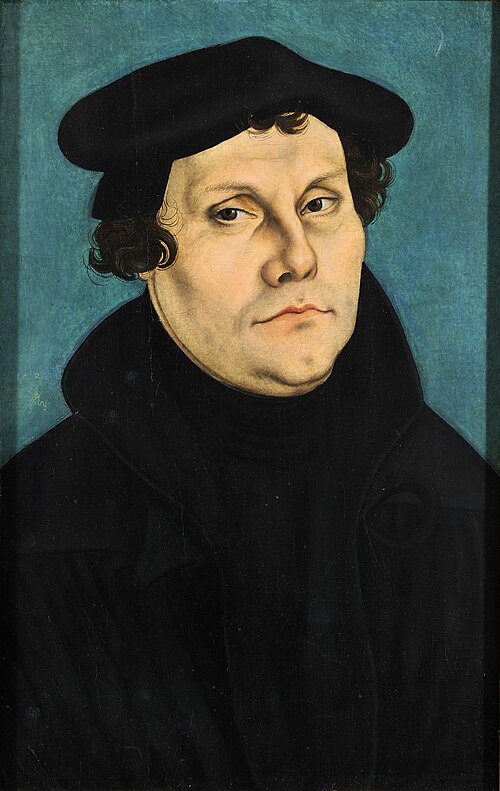
Martin Luther
German priest and theologian (1483–1546)
1483–1546
49 works and musical collections
- Born
- 1483
- Died
- 1546
- Birthplace
- Eisleben
- Place of death
- Eisleben
- Citizenship / historical state
- Holy Roman Empire; Electorate of Saxony
- Period (estimated from birth year)
- Renaissance
Biography
Martin Luther ( LOO-thər; German: [ˈmaʁtiːn ˈlʊtɐ] ; 10 November 1483 – 18 February 1546) was a German priest, theologian, author, hymnwriter, professor, and former Augustinian friar. Luther was the seminal figure of the Protestant Reformation, and his theological beliefs form the basis of Lutheranism. He is considered one of the most influential figures in Western and Christian history.
Born in Eisleben, Luther was ordained to the priesthood in 1507. He came to reject various teachings and practices of the Roman Catholic Church, in particular the view on indulgences and papal authority. Luther initiated an international debate on these in works like his Ninety-five Theses, which he authored in 1517. In 1520 Pope Leo X demanded that Luther renounce all of his writings, and when Luther refused to do so, excommunicated him in January 1521. Later that year the Holy Roman Emperor, Charles V, condemned Luther as an outlaw at the Diet of Worms. At the time of Luther's death in 1546, his excommunication was still in effect.
Luther taught that justification is not earned by any human acts or intents or merit. He preached it instead is received only as the free gift of God's grace through the believer's faith in Jesus. Luther held that good works were a necessary fruit of living faith, part of the process of sanctification. Luther's theology challenged the authority and office of the pope and bishops by teaching that the Bible is the only source of divinely revealed knowledge on the Gospel, and opposed sacerdotalism – the belief that a priesthood was needed as an intermediary between God and individuals or humanity; he considered all baptised Christians to be a holy priesthood. Those who identify with these, as well as Luther's wider teachings, are called Lutherans, although Luther insisted on Christian or Evangelical (German: evangelisch), as the only acceptable names for persons who professed Christ.
Luther's translation of the Bible into German (1534) made the Bible vastly more accessible to the laity, which had a tremendous impact on both the Church and German culture. It fostered the development of a standard version of the German language, added several principles to the art of translation, and influenced the writing of an English translation, the Tyndale Bible. His hymns influenced the development of singing in Protestant churches. His marriage to Katharina von Bora, a former nun, set a model for the practice of clerical marriage, allowing Protestant clergy to marry.
Biography excerpt from Wikipedia contributors, available under CC BY-SA 4.0. Formatting and reference markers have been removed; the introduction may be shortened. View contributors and article history.
Life and musical career
- Selected occupations
- translator; theologian; lawyer; Bible translator; hymnwriter; Protestant reformer; philosopher; pastor; writer; preacher; composer; scribe
- Education
- University of Erfurt (1392-1816)
- Career institutions / employers
- University of Wittenberg
- Notable works
- Ninety-five Theses; Luther Bible
- Birth name
- Martin Luder
- Languages used
- Latin; New High German; German; Ancient Greek; Hebrew
- VIAF ID
- 14773105
- ISNI
- 0000000121214073
- GND ID
- 118575449
- Library of Congress ID
- n79089628
- MusicBrainz ID
- 5a90e31d-52f3-4966-8ce0-7c3818fccca3
Recorded in Wikidata. Affiliations may refer to earlier stages of the composer's career.
In this catalogue
- Common listed instruments
- Flute, Piano, Vocal, Choir, Clarinet
- Genres represented
- R&B, Classical, Jazz, pop
- Source entries with composition dates
- 0
These details describe the indexed sheet music, including arrangements.
Catalogue
Sheet music catalogue page 2 of 2
Instruments describe listed editions, including arrangements. Composition dates and keys appear where recorded; collection pages show their individual contents.
| Title | Work details | Listed instruments | Sheet music |
|---|---|---|---|
| Ein feste Burg ist unser Gott for string quartet | See work details |
| View sheet music |
Biographical record: Wikidata, matched on name and checked against dates held in the catalogue. The period label is an estimate from birth year. Authority record: VIAF 14773105. Portrait: Lucas Cranach the Elder, Public domain, via Wikimedia Commons.