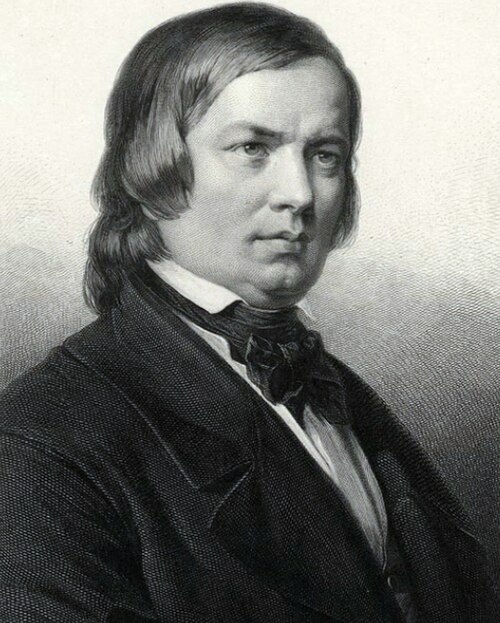
Composer
Robert Schumann
German composer, pianist and critic (1810–1856)
1810–1856
5,066 works in the index
- Born
- 1810
- Died
- 1856
- Birthplace
- Zwickau
- Place of death
- Endenich
- Citizenship / historical state
- Kingdom of Saxony
- Period (estimated from birth year)
- Romantic
Biography
Schumann wrote in concentrated bursts — a year of songs, a year of chamber music — and the catalogue reflects that clustering. The piano cycles and the songs are what most people come for.
Album für die Jugend is the rare case of a great composer writing genuinely well for beginners, and it remains one of the best first books of real repertoire. Kinderszenen is harder than its title suggests but within reach of an intermediate player; Carnaval, Kreisleriana and the Fantasie are advanced.
His songs, especially Dichterliebe and the Liederkreis settings, sit alongside Schubert's at the centre of the German song repertoire and are published in the usual high, medium and low editions.
Life and musical career
- Occupations
- composer; pianist; music critic; conductor; musicologist; music educator; writer; art historian; art critic
- Career institutions / employers
- University of Music and Theatre Leipzig
- Recorded memberships
- Leipzig Fraternity Germania
- Instruments played
- piano
- Notable works
- Symphony No. 1; Symphony No. 2; Symphony No. 3; Kinderszenen
- Languages used
- German
- VIAF ID
- 7575259
- ISNI
- 0000000120955419
- GND ID
- 118611666
- Library of Congress ID
- n50000565
- MusicBrainz ID
- 3cd3882c-00f8-4362-a0c2-ad89ed248533
Recorded in Wikidata. Affiliations may refer to earlier stages of the composer's career.
In this catalogue
- Common listed instruments
- Piano, Voice, violin, Low Voice, Clarinet
- Genres represented
- Classical, Jazz, pop, Pop, Children
- Works with composition dates
- 177 of 5,066
These details describe the indexed sheet music, including arrangements.
Catalogue
Works page 63 of 106
Years are composition dates where known. Instruments describe editions in our catalogue and may include arrangements. A dash means the detail is not recorded.
Biographical record: Wikidata, matched on name and checked against dates held in the catalogue. The period label is an estimate from birth year. The biography above is our own. Authority record: VIAF 7575259. Portrait: Williamtosun, Public domain, via Wikimedia Commons.