Composer
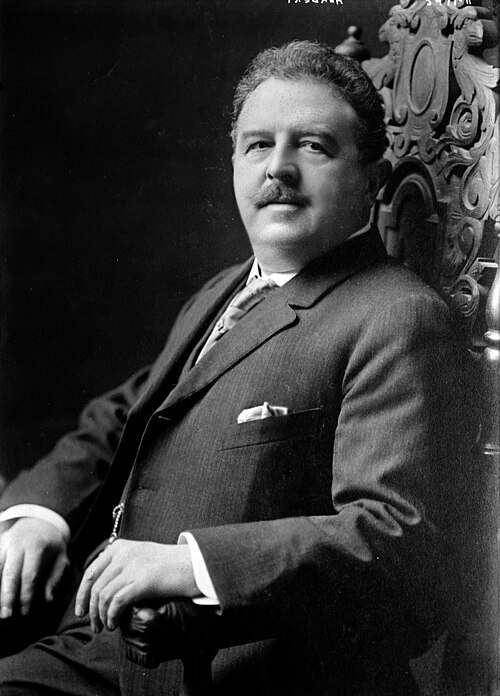
Victor Herbert
American composer (1859–1924)
1859–1924
78 works and musical collections
- Born
- 1859
- Died
- 1924
- Birthplace
- Guernsey
- Place of death
- New York City
- Citizenship / historical state
- United Kingdom of Great Britain and Ireland; United States
- Period (estimated from birth year)
- Romantic
Biography
Victor August Herbert (February 1, 1859 – May 26, 1924) was an American composer, cellist and conductor of English and Irish ancestry and German training. Although Herbert enjoyed important careers as a cello soloist and conductor, he is best known for composing many successful operettas that premiered on Broadway from the 1890s to World War I. He was also prominent among the Tin Pan Alley composers and was later a founder of the American Society of Composers, Authors, and Publishers (ASCAP). A prolific composer, Herbert produced two operas, a cantata, 43 operettas, incidental music to 10 plays, 31 compositions for orchestra, nine band compositions, nine cello compositions, five violin compositions with piano or orchestra, 22 piano compositions and numerous songs, choral compositions and orchestrations of works by other composers, among other music.
In the early 1880s, Herbert began a career as a cellist in Vienna and Stuttgart, during which he began to compose orchestral music. Herbert and his opera singer wife, Therese Förster, moved to the U.S. in 1886 when both were engaged by the Metropolitan Opera. In the U.S., Herbert continued his performing career, while also teaching at the National Conservatory of Music, conducting and composing. His most notable instrumental compositions were his Cello Concerto No. 2 in E minor, Op. 30 (1894), which entered the standard repertoire, and his Auditorium Festival March (1901). He conducted the Pittsburgh Symphony from 1898 to 1904 (taking over from founding conductor Frederic Archer) and then founded the Victor Herbert Orchestra, which he conducted throughout the rest of his life.
Herbert began to compose operettas in 1894, producing several successes, including The Serenade (1897) and The Fortune Teller (1898). Some of the operettas that he wrote after the turn of the 20th century were even more successful: Babes in Toyland (1903), Mlle. Modiste (1905), The Red Mill (1906), Naughty Marietta (1910), Sweethearts (1913) and Eileen (1917). After World War I, with the change of popular musical tastes, Herbert began to compose musicals and contributed music to other composers' shows. While some of these were well-received, he never again achieved the level of success that he had enjoyed with his most popular operettas.
Biography excerpt from Wikipedia contributors, available under CC BY-SA 4.0. Formatting and reference markers have been removed; the introduction may be shortened. View contributors and article history.
Life and musical career
- Occupations
- composer; conductor; screenwriter; cellist
- Recorded memberships
- American Academy of Arts and Letters
- Instruments played
- cello
- Genres
- operetta
- Official website
- https://vherbert.com/
- Pseudonym
- Frank Roland
- Languages used
- English
- VIAF ID
- 12491557
- ISNI
- 0000000083575897
- GND ID
- 11877400X
- Library of Congress ID
- n79105792
- MusicBrainz ID
- 717d1c41-76a2-4203-9f36-f5d2dc873cc6
Recorded in Wikidata. Affiliations may refer to earlier stages of the composer's career.
In this catalogue
- Common listed instruments
- Piano, Harp, percussion, violin, Flute
- Genres represented
- Classical, Christmas, Broadway, American, Children
- Source entries with composition dates
- 11
These details describe the indexed sheet music, including arrangements.
Catalogue
Sheet music catalogue page 2 of 2
Instruments describe listed editions, including arrangements. Composition dates and keys appear where recorded; collection pages show their individual contents.
Biographical record: Wikidata, matched on name and checked against dates held in the catalogue. The period label is an estimate from birth year. Authority record: VIAF 12491557. Portrait: Bain News Service, publisher, Public domain, via Wikimedia Commons.