JustSheetMusic
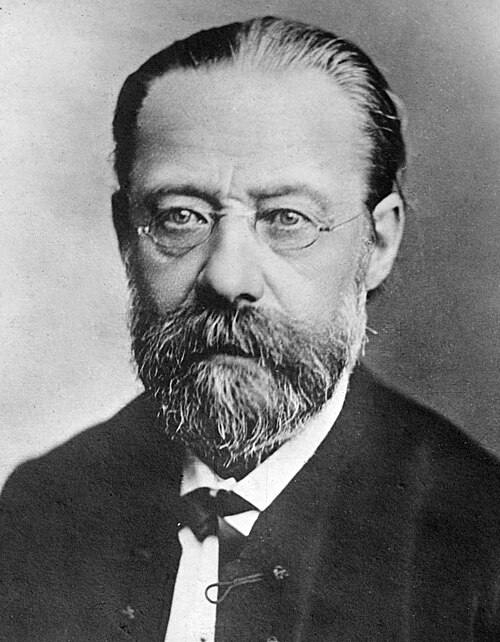
Portrait of Bedrich Smetana

Composer

Bedrich Smetana

Czech composer

1824–1884

254 works and musical collections

Browse sheet music

Born
1824
Died
1884
Birthplace
Litomyšl
Place of death
Prague
Citizenship / historical state
Austrian Empire; Austria–Hungary
Period (estimated from birth year)
Romantic

Biography

Bedřich Smetana (2 March 1824 – 12 May 1884) was a Czech composer who pioneered the development of a musical style that became closely identified with his people's aspirations to a cultural and political "revival". He has been regarded in his homeland as the father of Czech music. Internationally he is best known for his 1866 opera The Bartered Bride and for the symphonic cycle Má vlast ("My Fatherland"), which portrays the history, legends and landscape of the composer's native Bohemia. It contains the famous symphonic poem "Vltava", also popularly known by its German name "Die Moldau" (in English, "The Moldau").

Smetana was naturally gifted as a composer, and gave his first public performance at the age of six. After conventional schooling, he studied music under Josef Proksch in Prague. His first nationalistic music was written during the 1848 Prague uprising, in which he briefly participated. After failing to establish his career in Prague, he left for Sweden, where he set up as a teacher and choirmaster in Gothenburg, and began to write large-scale orchestral works.

In the early 1860s, a more liberal political climate in Bohemia encouraged Smetana to return permanently to Prague. He threw himself into the musical life of the city, primarily as a champion of the new genre of Czech opera. In 1866 his first two operas, The Brandenburgers in Bohemia and The Bartered Bride, were premiered at Prague's new Provisional Theatre, the latter achieving great popularity. In that same year, Smetana became the theatre's principal conductor, but the years of his conductorship were marked by controversy. Factions within the city's musical establishment considered his identification with the progressive ideas of Franz Liszt and Richard Wagner inimical to the development of a distinctively Czech opera style. This opposition interfered with his creative work, and may have hastened a decline in health that precipitated his resignation from the theatre in 1874.

By the end of 1874, Smetana had become completely deaf but, freed from his theatre duties and the related controversies, he began a period of sustained composition that continued for almost the rest of his life. His contributions to Czech music were increasingly recognised and honoured, but a mental collapse early in 1884 led to his incarceration in an asylum and subsequent death. His reputation as the founding father of Czech music has endured in his native country, where advocates have raised his status above that of his contemporaries and successors. However, relatively few of Smetana's works are in the international repertory, and most foreign commentators tend to regard Antonín Dvořák as a more significant Czech composer.

Biography excerpt from Wikipedia contributors, available under CC BY-SA 4.0. Formatting and reference markers have been removed; the introduction may be shortened. View contributors and article history.

Source revision used for this excerpt

Life and musical career

Occupations
composer; conductor; teacher; pedagogue; pianist; music educator; musician; music arranger
Education
Akademické gymnázium Štěpánská
Teachers
Josef Proksch
Career institutions / employers
Harmonious Society; Hlahol Prague; Provisional Theatre
Recorded memberships
Umělecká beseda
Instruments played
piano; violin
Genres
classical music; opera; symphonic poem
Movements
Romantic music
Notable works
The Bartered Bride; Má vlast; String Quartet No. 1
Native languages
Czech
Languages used
Czech
VIAF ID
95207407
ISNI
0000000121441890
GND ID
118615017
Library of Congress ID
n50053339
MusicBrainz ID
6eb5695e-cf7b-4b94-b441-a09901127ef9

Recorded in Wikidata. Affiliations may refer to earlier stages of the composer's career.

In this catalogue

Common listed instruments
Piano, violin, Cello, Flute, percussion
Genres represented
Classical
Source entries with composition dates
3

These details describe the indexed sheet music, including arrangements.

Catalogue

Sheet music catalogue page 4 of 6

Instruments describe listed editions, including arrangements. Composition dates and keys appear where recorded; collection pages show their individual contents.

Works and musical collections with sheet music details
Title Work details Listed instruments Sheet music
The Lark In The Morning See work details
  • violin
View sheet music Work & edition details
Thompson's Jig See work details
  • violin
View sheet music Work & edition details
Timour The Tartar See work details
  • violin
View sheet music Work & edition details
Trip To Sligo See work details
  • violin
View sheet music Work & edition details
Predmluva / Preface / Vorwort See work details
  • Cello
  • violin
  • Viola
View sheet music Work & edition details
III Largo sostenuto See work details
  • Cello
  • violin
  • Viola
View sheet music Work & edition details
IV Vivace See work details
  • Cello
  • violin
  • Viola
View sheet music Work & edition details
Die Moldau See work details See edition details View sheet music Work & edition details
The Swallows Arrived See work details
  • Voice
  • A Cappella
View sheet music Work & edition details
2. Vznikajici Vasen (Erwachende Leidenschaft) See work details
  • Piano
View sheet music Work & edition details
4. Touha (Die Sehnsucht) See work details
  • Piano
View sheet music Work & edition details
5. Valecnik (Der Krieger) See work details
  • Piano
View sheet music Work & edition details
1. Furiant, T. 112b/1 See work details
  • Piano
View sheet music Work & edition details
2. Slepicka, T. 112b/2 See work details
  • Piano
View sheet music Work & edition details
3. Cibulicka, T. 112b/5 See work details
  • Piano
View sheet music Work & edition details
4. Obkrocak, T. 112b/8 See work details
  • Piano
View sheet music Work & edition details
5. Sousedska, T. 112b/9 See work details
  • Piano
View sheet music Work & edition details
6. La Fete des Paysans Bohemiens, T. 112/6 See work details
  • Piano
View sheet music Work & edition details
Jirinkova (Dahlia) Polka, T. 8 See work details
  • Piano
View sheet music Work & edition details
Polka z Opery "Dve vdovy", T. 109 See work details
  • Piano
View sheet music Work & edition details
Encore - Dance of the Comedians See work details
  • Piano
  • Cello
  • Viola
Classical
View sheet music Work & edition details
Ah, My Darling We Could Grow Together See work details
  • Voice
Classical
View sheet music Work & edition details
Marenka'a Aria See work details
  • Voice
View sheet music Work & edition details
Op.Chorus Of Villagers See work details
  • Voice
  • Choir
View sheet music Work & edition details
The Moldau Performed by Bedrich Smetana See work details See edition details View sheet music Work & edition details
Vltava
Year composed
1874 ↗
See edition details View sheet music Work & edition details
Serenade See work details
  • Piano
View sheet music Work & edition details
Petite Valse See work details
  • Piano
View sheet music Work & edition details
Mouvement Perpetuel See work details
  • Piano
View sheet music Work & edition details
The First Love Letter See work details
  • Piano
View sheet music Work & edition details
Improvisation See work details
  • Piano
View sheet music Work & edition details
Polka poetique, G minor, op. 8,2 Performed by Friedrich Smetana
Catalogue / opus
op. 8
  • Piano
  • harpsichord
View sheet music Work & edition details
Aus Der Heimat See work details
  • Piano
  • violin
Classical
View sheet music Work & edition details
Moldau See work details See edition details View sheet music Work & edition details
Thema Aus 'Die Moldau' See work details See edition details View sheet music Work & edition details
Och, jaky zal!... Ten lasky sen See work details See edition details View sheet music Work & edition details
"Song : No. 2 from 'Album Leaves', Op. 2" Performed by Bedrich Smetana
Catalogue / opus
Op. 2
  • Piano
View sheet music Work & edition details
Nevinnost See work details
  • Piano
View sheet music Work & edition details
String Quartet No. 1 See work details
  • String Quartet
View sheet music Work & edition details
String Quartet No.2 See work details
  • String Quartet
View sheet music Work & edition details
Vltava (Ma Vlast No.2) [Smetana, Bedrich] See work details See edition details View sheet music Work & edition details
Country Wedding Dance (from The Moldau): 1st Violin See work details See edition details View sheet music Work & edition details
Country Wedding Dance (from The Moldau): 2nd Violin See work details See edition details View sheet music Work & edition details
Country Wedding Dance (from The Moldau): 3rd Violin (Viola ) See work details See edition details View sheet music Work & edition details
Country Wedding Dance (from The Moldau): Viola See work details See edition details View sheet music Work & edition details
Country Wedding Dance (from The Moldau): Cello See work details See edition details View sheet music Work & edition details
Country Wedding Dance (from The Moldau): String Bass See work details See edition details View sheet music Work & edition details
Country Wedding Dance (from The Moldau): Score See work details See edition details View sheet music Work & edition details

Biographical record: Wikidata, matched on name and checked against dates held in the catalogue. The period label is an estimate from birth year. Authority record: VIAF 95207407. Portrait: Unknown author Unknown author, Public domain, via Wikimedia Commons.