Composer
Franz Liszt
1811–1886
2,144 works in the index
- Born
- 1811
- Died
- 1886
- Birthplace
- Raiding
- Citizenship / historical state
- Kingdom of Hungary
- Period (estimated from birth year)
- Romantic
Biography
Liszt wrote more piano music than anyone else worth playing, invented the modern recital, and left a catalogue so large and so revised that identifying which version of a piece you are buying is a real problem.
Most of it is very hard. The exceptions are worth knowing: the Consolations, several of the Années de pèlerinage pieces, and the Liebesträume are within reach of a good amateur. The Hungarian Rhapsodies, the Transcendental Études and the B minor Sonata are not, and no edition marked "simplified" will make them so without removing the point.
He revised constantly and published several versions of the same work — the Transcendental Études exist in three, of increasing difficulty, and editions do not always say which. His transcriptions of other composers are a separate world again: the Schubert song transcriptions are among the finest things he wrote and are frequently catalogued under Schubert.
In this catalogue
- Common listed instruments
- Piano, Voice, Organ, harpsichord, Orchestra
- Genres represented
- Classical, Christmas, pop, Jazz, New Age
- Works with composition dates
- 384 of 2,144
These details describe the indexed sheet music, including arrangements.
Catalogue
Works page 2 of 45
Years are composition dates where known. Instruments describe editions in our catalogue and may include arrangements. A dash means the detail is not recorded.
| Work | Year composed | Catalogue / opus | Key in title | Listed instruments | Genre | Editions |
|---|---|---|---|---|---|---|
| 6 Chants polonais, S. 480: 3. Das Ringlein | — | S. 480 | — | Piano | Classical | 17 |
| S'il est un charmant gazon (Hugo) | 1844 (1st version)1849–59 (2nd version)IMSLP | — | — | Voice | Classical | 12 |
| Symphonic Poem No.8 (4-hand Piano Arrangement) | 1854–56IMSLP | — | — | Piano, Hands | Classical | 10 |
| Symphonic Poem No.10 (4-hand Piano Arrangment) | 1858IMSLP | — | — | Piano, Hands | Classical | 10 |
| Totentanz. Paraphrase on the Dies Irae. (2-piano Arrangement) | 1847IMSLP | — | — | Piano | Classical | 10 |
| Consolation | — | — | — | Piano, harpsichord, Flute, violin | Classical | 12 |
| Ricordanza (Ab Major) | — | — | — | Piano | Classical | 12 |
| Etude in A-Flat Major [Op. 1, No. 9; S. 136] | — | Op. 1, No. 9; S. 136 | A-Flat major | Piano | Classical | 11 |
| The Shepherds at the Manger [S. 186/3] | — | S. 186/3 | — | Piano | Classical | 10 |
| Consolation No. 2 in E major | 1844IMSLP | — | E major | Piano | Classical | 11 |
| Liszt: Harmonies Poétiques and Réligieuses | — | — | — | Piano | Classical | 10 |
| Liszt: Soirees de Vienne | — | — | — | Piano | Classical | 10 |
| Liszt: Late Piano Works | — | — | — | Piano | Classical | 10 |
| Liszt: Harmonies Po | — | — | — | — | Classical | 10 |
| Sonata for Piano in B minor, S. 178 | 1852-53IMSLP | S. 178 | B minor | Piano | Classical | 9 |
| Au bord d'une source, S. 160 no. 4 | — | S. 160 no. 4 | — | Piano | Classical | 8 |
| Der du von dem Himmel bist (Goethe) | 1842IMSLP | — | — | Piano, Voice, Low Voice | Classical | 10 |
| Du bist wie eine Blume (Heine) | 1843 (1st version)1849 (2nd version)IMSLP | — | — | Voice, Voice High | Classical | 15 |
| Kling leise, mein Lied | 1848 (1st version)1849–60 (2nd version)IMSLP | — | — | Voice, Voice High | Classical | 12 |
| 8 Variations (on an original theme) | 1824IMSLP | — | — | Piano | Classical | 7 |
| Capriccio alla turca sur des motifs de Beethoven (Ruines d'Athènes) | 1846IMSLP | — | — | Piano | Classical | 9 |
| Eroica (Eb Major) | — | — | — | Piano | Classical | 10 |
| Chapelle de Guillaume Tell (William Tell's Chapel) | — | — | — | Piano | Classical | 10 |
| Gondoliera (Gondolier's Song [based on the song "La biondina in gondoletta" by Giovanni Battista Peruchini]) | — | — | — | Piano | Classical | 9 |
| Soirees Musicales No. 9, La Danza, Tarantella Napolitana (Rossini) | — | — | — | Piano | Classical | 9 |
| Consolation No.5 | — | — | — | Piano | Classical | 12 |
| March (Tchaikovsky) | — | — | — | Piano | Classical | 8 |
| Etude XI (Harmonie du soir) | — | — | — | Piano | Classical | 9 |
| Venezie e Napoli : Gondoliera | 1859IMSLP | — | — | Piano | Classical | 10 |
| Elsas Traum | 1854IMSLP | — | — | Piano | Classical | 10 |
| Etude in D Minor [Op. 1, No. 4; S. 136] | 1851IMSLP | Op. 1, No. 4; S. 136 | D minor | Piano | Classical | 10 |
| The Shepherds at the Manger [S. 186:3] | — | S. 186:3 | — | Piano | Classical | 9 |
| Consolation No. 1 [G. 172, No. 1] | — | — | — | Piano, Organ | Classical | 10 |
| Liszt: Hungarian Rhapsodies (Volume I, Nos. 1 | — | — | — | Piano | Classical | 9 |
| Hungarian Rhapsody no. 11 in A minor, S. 244 no. 11 | 1847IMSLP | S. 244 no. 11 | A minor | Piano | Classical | 7 |
| Réminiscences de Norma (Bellini) | 1841IMSLP | — | — | Piano | Classical | 9 |
| Angiolin dal biondo crin (Marchese C. Bocella) | 1839 (1st version)?1849 (2nd version)IMSLP | — | — | Voice | Classical | 13 |
| Es war ein König in Thule (Goethe) | 1842 (1st version)1856 (2nd version)IMSLP | — | — | Piano, Voice, Low Voice | Classical | 8 |
| O quand je dors (Hugo) | 1842 (1st version)1849 (2nd version)IMSLP | — | — | Voice, Low Voice | Classical | 8 |
| Wie singt die Lerche schön (Hoffmann von Fallersleben) | 1855IMSLP | — | — | Voice, Voice High | Classical | 8 |
| Symphonic Poem No.11 (4-hand Piano Arrangment) | 1855–57IMSLP | — | — | Piano, Hands | Classical | 8 |
| Waltz (in A major) | 1823–25?IMSLP | — | A major | Piano | Classical | 10 |
| Consolations | 1844IMSLP | — | — | Piano | Classical | 9 |
| Paysage (F Major) | 1851IMSLP | — | — | Piano | Classical | 9 |
| Sposalizio (Piano solo) | — | — | — | Piano, Harp, Timpani, percussion | Classical | 11 |
| La Campanella | — | — | — | Piano | Classical | 6 |
| Sonetto 123 del Petrarca (Petrarch's Sonnet 123) | — | — | — | Piano | Classical | 10 |
| Variations on a Theme of Bach, J. S. (from the Cantata, Weinen, klagen, sorgen, zagen) | — | — | — | Piano | Classical | 9 |
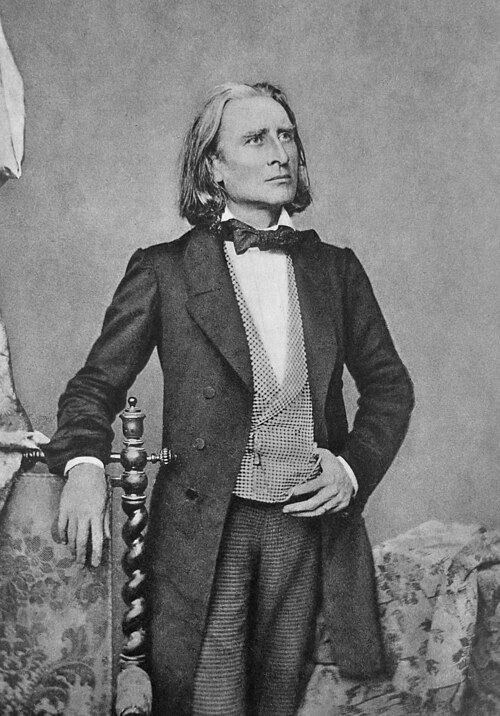
Biographical record: Wikidata, matched on name and checked against dates held in the catalogue. The period label is an estimate from birth year. The biography above is our own. Authority record: VIAF 64199483. Portrait: Franz Hanfstaengl, Public domain, via Wikimedia Commons.