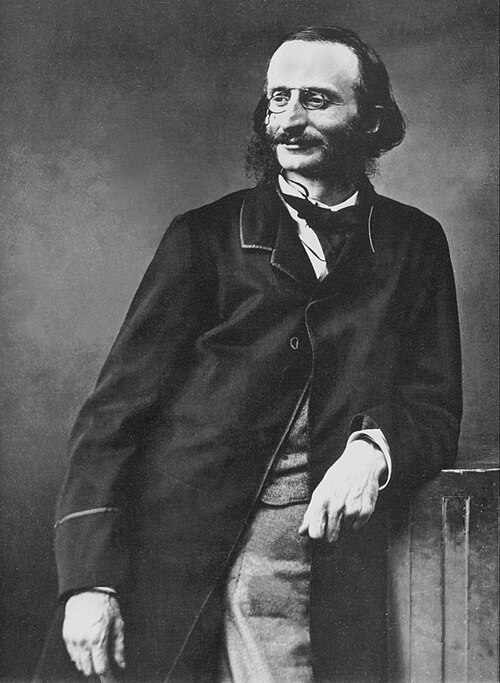
Composer
Jacques Offenbach
German-born French composer (1819–1880)
1819–1880
362 works and musical collections
- Born
- 1819
- Died
- 1880
- Birthplace
- Cologne
- Place of death
- Paris
- Citizenship / historical state
- France; Kingdom of Prussia
- Period (estimated from birth year)
- Romantic
Biography
Jacques Offenbach (; 20 June 1819 – 5 October 1880) was a German-born French composer, cellist and impresario. He is remembered for his nearly 100 operettas of the 1850s to the 1870s, and his uncompleted opera The Tales of Hoffmann. He was a powerful influence on later composers of the operetta genre, particularly Franz von Suppé, Johann Strauss II and Arthur Sullivan. His best-known works were continually revived during the 20th century, and many of his operettas continue to be staged in the 21st. The Tales of Hoffmann remains part of the standard opera repertory.
Born in Cologne, Kingdom of Prussia, the son of a synagogue cantor, Offenbach showed early musical talent. At the age of 14, he was accepted as a student at the Paris Conservatoire; he found academic study unfulfilling and left after a year, but remained in Paris. From 1835 to 1855 he earned his living as a cellist, achieving international fame, and as a conductor. His ambition, however, was to compose comic pieces for the musical theatre. Finding the management of Paris's Opéra-Comique company uninterested in staging his works, in 1855 he leased a small theatre in the Champs-Élysées. There, during the next three years, he presented a series of more than two dozen of his own small-scale pieces, many of which became popular.
In 1858 Offenbach produced his first full-length operetta, Orphée aux enfers ("Orpheus in the Underworld"), with its celebrated can-can; the work was exceptionally well received and has remained his most played. During the 1860s, he produced at least eighteen full-length operettas, as well as more one-act pieces. His works from this period include La belle Hélène (1864), La Vie parisienne (1866), La Grande-Duchesse de Gérolstein (1867) and La Périchole (1868). The risqué humour (often about sexual intrigue) and mostly gentle satiric barbs in these pieces, together with Offenbach's facility for melody, made them internationally known, and translated versions were successful in Vienna, London, elsewhere in Europe and in the US.
Offenbach became associated with the Second French Empire of Napoleon III: the emperor and his court were genially satirised in many of Offenbach's operettas, and Napoleon personally granted him French citizenship and the Légion d'honneur. With the outbreak of the Franco-Prussian War in 1870, and the fall of the empire, Offenbach found himself out of favour in Paris because of his imperial connections and his German birth. He remained successful in Vienna, London and New York. He re-established himself in Paris during the 1870s, with revivals of some of his earlier favourites and a series of new works, and undertook a popular US tour. In his last years he strove to finish The Tales of Hoffmann, but died before the premiere of the opera, which has entered the standard repertory in versions completed or edited by other musicians.
Biography excerpt from Wikipedia contributors, available under CC BY-SA 4.0. Formatting and reference markers have been removed; the introduction may be shortened. View contributors and article history.
Life and musical career
- Occupations
- composer; cellist; conductor; theatre entrepreneur; theatre manager; chapelmaster
- Education
- Conservatoire de Paris
- Teachers
- Fromental Halévy; Louis-Pierre Norblin
- Career institutions / employers
- Théâtre de l'Ambigu-Comique; Opéra-Comique; Théâtre des Bouffes-Parisiens; Comédie-Française; Théâtre des Variétés-Amusantes
- Instruments played
- cello
- Genres
- opera; opéra bouffe; operetta; classical music
- Movements
- Romanticism
- Notable works
- The Tales of Hoffmann; Orpheus in the Underworld
- Nickname
- Offre-un-bock
- VIAF ID
- 10034167
- ISNI
- 0000000121204289
- GND ID
- 118589598
- Library of Congress ID
- n80040739
- MusicBrainz ID
- 27bc8cf5-72e1-4888-87de-259fbcaac3ff
Recorded in Wikidata. Affiliations may refer to earlier stages of the composer's career.
In this catalogue
- Common listed instruments
- Voice, Piano, Cello, Accordion, Organ
- Genres represented
- Classical, Rock, Pop, Children, Christmas
- Source entries with composition dates
- 12
These details describe the indexed sheet music, including arrangements.
Catalogue
Sheet music catalogue page 1 of 8
Instruments describe listed editions, including arrangements. Composition dates and keys appear where recorded; collection pages show their individual contents.
| Title | Work details | Listed instruments | Sheet music |
|---|---|---|---|
| Can Can | See work details |
8 more instruments
| View sheet music |
| Work & excerpts La vie parisienne | See work details | Check individual editions | View sheet music |
| Work & excerpts Orphée aux Enfers | See work details | Check individual editions | View sheet music |
| Duos for 2 Cellos, Op.49 |
| See edition details | View sheet music |
| Elle a fui, la tourterelle | See work details |
| View sheet music |
| Peuh! cette biere (Offenbach-Tales of Hoffmann) |
|
| View sheet music |
| Belle nuit (Offenbach-Tales of Hoffmann) | See work details |
| View sheet music |
| Vive la Compagnie | See work details |
| View sheet music |
| Galop | See work details | See edition details | View sheet music |
| Can Can from Orpheus | See work details |
2 more instruments
| View sheet music |
| Maria (Polka-Mazurka) | See work details |
| View sheet music |
| Drig! Drig! (Offenbach-Tales of Hoffmann) |
|
| View sheet music |
| Lavender Blue | See work details |
| View sheet music |
| Moonlight Bay | See work details |
| View sheet music |
| Going Home | See work details |
| View sheet music |
| Elle a fui, la tourterelle, from Les Contes d'Hoffmann | See work details |
| View sheet music |
| Louise (Grande Valse) | See work details |
| View sheet music |
| Nathalie (Schottisch Du Tambourin) | See work details |
| View sheet music |
| Clarisse (Varsoviana) | See work details |
| View sheet music |
| Dance the Polka | See work details |
| View sheet music |
| Jingle Bells | See work details |
| View sheet music |
| Non, aucun hote |
|
| View sheet music |
| Barcarolla | See work details |
| View sheet music |
| Rondeau | See work details |
| View sheet music |
| Elle a fui | See work details | See edition details | View sheet music |
| Andante cantabile | See work details |
| View sheet music |
| Rachel (Grande Valse) | See work details |
| View sheet music |
| Emilie (Polka-Mazurka) | See work details |
| View sheet music |
| Delphine (Redowa) | See work details |
| View sheet music |
| Augustine (Schottisch Des Clochettes) | See work details |
| View sheet music |
| Juanita | See work details |
| View sheet music |
| Polka | See work details | See edition details | View sheet music |
| Reverie | See work details |
| View sheet music |
| Work & excerpts La jolie parfumeuse | See work details | Check individual editions | View sheet music |
| Can Can from Orpheus and the Underworld | See work details |
| View sheet music |
| Frankie and Johnny | See work details |
| View sheet music |
| Madeleine (Polka Villageoise) | See work details |
| View sheet music |
| Barcarole from "The Tales of Hoffmann" | See work details |
6 more instruments
| View sheet music |
| Where Shall I Be? | See work details |
| View sheet music |
| Pomme d'Api, Couplets de Catherine | See work details |
| View sheet music |
| Duo in G Major |
|
| View sheet music |
| La Périchole: Overture | See work details |
| View sheet music |
| La Diva | See work details | See edition details | View sheet music |
| Work & excerpts La Grande-Duchesse de Gérolstein | See work details | Check individual editions | View sheet music |
| Work & excerpts Jeanne qui pleure et Jean qui rit | See work details | Check individual editions | View sheet music |
| Madame L'Archiduc |
|
| View sheet music |
| Le Violoneux |
|
| View sheet music |
| Down in the Valley | See work details |
| View sheet music |
Biographical record: Wikidata, matched on name and checked against dates held in the catalogue. The period label is an estimate from birth year. Authority record: VIAF 10034167. Portrait: Nadar, Public domain, via Wikimedia Commons.