Composer
Jean-Philippe Rameau
French composer and music theorist (1683–1764)
1683–1764
292 works and musical collections
- Born
- 1683
- Died
- 1764
- Birthplace
- Dijon
- Place of death
- Paris
- Citizenship / historical state
- Kingdom of France
- Period (estimated from birth year)
- Baroque
Biography
Jean-Philippe Rameau (; French: [ʒɑ̃filip ʁamo]; (1683-09-25)25 September 1683 – (1764-09-12)12 September 1764) was a French composer and music theorist of the late Baroque era. Regarded as one of the most important French composers and music theorists of the 18th century, he replaced Jean-Baptiste Lully as the dominant composer of French opera and is also considered the leading French composer of his time for the harpsichord, alongside François Couperin.
Little is known about Rameau's early years. It was not until the 1720s that he won fame as a major theorist of music with his Treatise on Harmony (1722) and also in the following years as a composer of masterpieces for the harpsichord, which circulated throughout Europe. He was almost 50 before he embarked on the operatic career on which his reputation chiefly rests today. His debut, Hippolyte et Aricie (1733), caused a great stir and was fiercely attacked by the supporters of Lully's style of music for its revolutionary use of harmony.
Nevertheless, Rameau's pre-eminence in the field of French opera was soon acknowledged, and he was later attacked as an "establishment" composer by those who favoured Italian opera during the controversy known as the Querelle des Bouffons in the 1750s. Rameau's music had gone out of fashion by the end of the 18th century, and it was not until the 20th that serious efforts were made to revive it. Today, his work is frequently performed and recorded.
Biography excerpt from Wikipedia contributors, available under CC BY-SA 4.0. Formatting and reference markers have been removed; the introduction may be shortened. View contributors and article history.
Life and musical career
- Occupations
- composer; choreographer; musicologist; music theorist; organist; harpsichordist; theorist; writer; musician
- Education
- Collège des Godrans
- Recorded memberships
- Académie des Sciences, Arts et Belles-Lettres de Dijon
- Instruments played
- violin
- Movements
- Baroque music
- Notable works
- Dardanus; Pièces de clavecin en concerts; Traité de l'harmonie réduite à ses principes naturels; Pièces de Clavecin; Castor et Pollux; Les Indes galantes; Hippolyte et Aricie; Platée
- Awards
- Order of Saint Michael
- Languages used
- French
- VIAF ID
- 39563041
- ISNI
- 0000000122785978
- GND ID
- 118598090
- Library of Congress ID
- n50000571
- MusicBrainz ID
- b29a3b55-785c-4072-9daf-0153cac864b6
Recorded in Wikidata. Affiliations may refer to earlier stages of the composer's career.
In this catalogue
- Common listed instruments
- Piano, Organ, Voice, percussion, harpsichord
- Genres represented
- Classical, Jazz, Pop
- Source entries with composition dates
- 16
These details describe the indexed sheet music, including arrangements.
Catalogue
Sheet music catalogue page 7 of 7
Instruments describe listed editions, including arrangements. Composition dates and keys appear where recorded; collection pages show their individual contents.
| Title | Work details | Listed instruments | Sheet music |
|---|---|---|---|
| Rameau for Violin Duo | See work details |
| View sheet music |
| Danse des sauvages, for Saxophone Quartet - Score & Parts | See work details |
| View sheet music |
| Allemande, Courante and 'Le Rappel Des Oiseaux' From Pieces De Clavecin | See work details | See edition details | View sheet music |
| Les Sauvages From Nouvelles Suites De Pieces De Clavecin | See work details | See edition details | View sheet music |
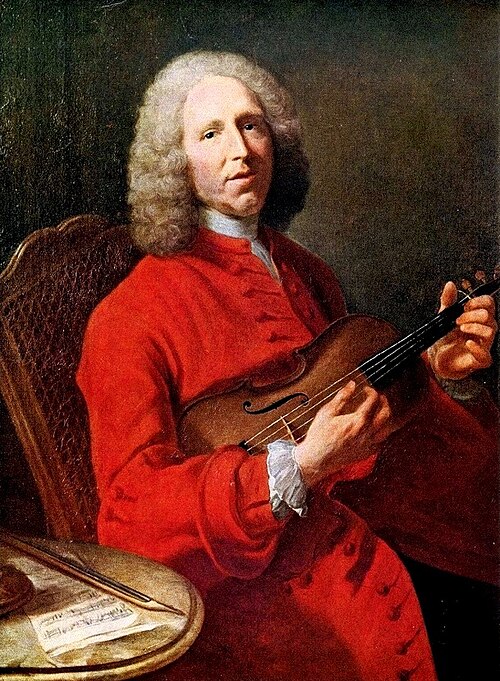
Biographical record: Wikidata, matched on name and checked against dates held in the catalogue. The period label is an estimate from birth year. Authority record: VIAF 39563041. Portrait: Attributed to Joseph Aved / Formerly attributed to Jean-Baptiste-Siméon Chardin, Public domain, via Wikimedia Commons.