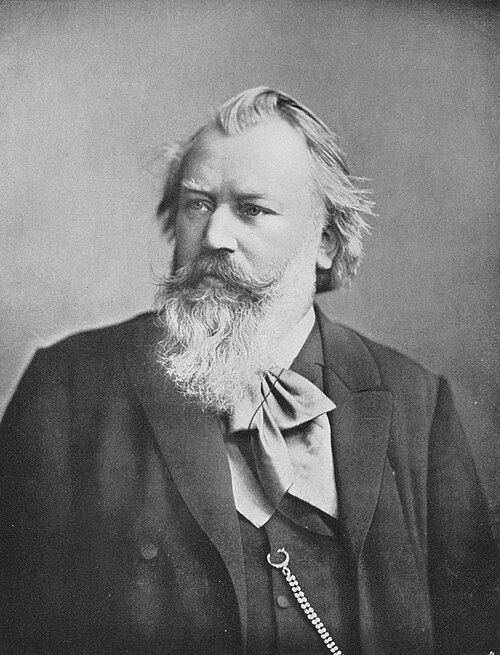
Composer
Johannes Brahms
German composer (1833–1897)
1833–1897
4,957 works in the index
- Born
- 1833
- Died
- 1897
- Birthplace
- Hamburg
- Place of death
- Vienna
- Citizenship / historical state
- Hamburg; Germany
- Period (estimated from birth year)
- Romantic
Biography
Brahms wrote densely and revised ruthlessly, destroying what did not satisfy him, so the surviving catalogue is smaller than his contemporaries' and uniformly serious. It covers symphonies, concerti, a large body of chamber music, songs and late piano pieces.
For pianists the late Op. 116–119 pieces are the heart of it — short, inward and technically less punishing than the earlier sonatas, though musically demanding. The Hungarian Dances in their four-hand form are the most-played thing he wrote and are genuinely approachable. Singers have over two hundred songs and the German Requiem.
His piano writing assumes a large hand and comfortable tenths appear regularly. Editions differ little; what varies is fingering, and an edition with good fingering is worth paying for here.
Life and musical career
- Teachers
- Eduard Marxsen
- Career institutions / employers
- University of Music and Performing Arts Vienna; Wiener Singakademie; Gesellschaft der Musikfreunde
- Recorded memberships
- Académie des beaux-arts; Academy of Arts, Berlin; University singers and bards of Vienna; Sängerschaft zu St. Pauli Jena
- Movements
- Romantic music
- Notable works
- Symphony No. 4; Symphony No. 1; Academic Festival Overture; Tragic Overture; A German Requiem; Symphony No. 3; Hungarian Dances; Clarinet Sonatas
- Awards
- Pour le Mérite for Sciences and Arts order; Bavarian Maximilian Order for Science and Art; Royal Philharmonic Society Gold Medal; honorary doctor of the University of Wrocław; honorary doctorate from the University of Cambridge; honorary citizen of Hamburg; Order of Leopold; Austrian Decoration for Science and Art
- Official website
- https://www.brahms-institut.de/index.php/de/allgemeines
- Pseudonym
- G.W. Marks
- Languages used
- German
- VIAF ID
- 7573295
- ISNI
- 0000000121195925
- GND ID
- 118514253
- Library of Congress ID
- n79077221
- MusicBrainz ID
- c70d12a2-24fe-4f83-a6e6-57d84f8efb51
Recorded in Wikidata. Affiliations may refer to earlier stages of the composer's career.
In this catalogue
- Common listed instruments
- Piano, Voice, Choir, Low Voice, Orchestra
- Genres represented
- Classical, Jazz, pop, Pop, Christmas
- Works with composition dates
- 255 of 4,957
These details describe the indexed sheet music, including arrangements.
Catalogue
Works page 60 of 104
Years are composition dates where known. Instruments describe editions in our catalogue and may include arrangements. A dash means the detail is not recorded.
| Work | Year composed | Catalogue / opus | Key in title | Listed instruments | Genre | Editions |
|---|---|---|---|---|---|---|
| Romances from Magelone No 2, Ho! Broadsword and spear are meet for the foe | — | — | — | Low Voice | Classical | 1 |
| Sind es Schmerzen | — | — | — | Low Voice | Classical | 2 |
| Romances from Magelone No 3, Are they sorrow, are they pleasure | — | — | — | Low Voice | Classical | 1 |
| Romances from Magelone No 5, Wilt deign to be near me | — | — | — | Low Voice | Classical | 1 |
| Wie soll ich die Freude | — | — | — | Low Voice | Classical | 2 |
| Romances from Magelone No 6, O joy out of measure, the hour of our greeting | — | — | — | Low Voice | Classical | 1 |
| Romances from Magelone No 8, The hour of our parting | — | — | — | Low Voice | Classical | 1 |
| Ruhe, S?ssliebchen | — | — | — | Low Voice | Classical | 0 |
| Romances from Magelone No 9, Rest thee, my lady | — | — | — | Low Voice | Classical | 1 |
| Romances from Magelone No 11, As fame and power fast fade away | — | — | — | Low Voice | Classical | 1 |
| Romances from Magelone No 12, Must we then once more be parted | — | — | — | Low Voice | Classical | 1 |
| Romances from Magelone No 14, How free and fresh | — | — | — | Low Voice | Classical | 1 |
| Treue Liebe dauert lange | — | — | — | Low Voice | Classical | 2 |
| Romances from Magelone No 15, Love long tried hath long endured | — | — | — | Low Voice | Classical | 1 |
| By the Window | — | — | — | Low Voice | Classical | 2 |
| Ein Sonnett | — | — | — | Low Voice | Classical | 2 |
| A Sonnet | — | — | — | Low Voice | Classical | 2 |
| That I would no more see thee | — | — | — | Low Voice | Classical | 2 |
| Dost thou yet seek to detain me | — | — | — | — | Classical | 2 |
| Ah, sweet my love, thou charmest me | — | — | — | — | Classical | 2 |
| Von waldbekr?nzter H?he | — | — | — | — | Classical | 0 |
| From where the upland towers | — | — | — | — | Classical | 2 |
| Wenn du nur zuweilen l?chelst | — | — | — | — | Classical | 0 |
| Grant me but one single smile | — | — | — | — | Classical | 2 |
| Not a Breath in Heaven Stirs | — | — | — | — | Classical | 2 |
| On the Lake | — | — | — | — | Classical | 2 |
| Tears | — | — | — | — | Classical | 2 |
| So clear thine eyes | — | — | — | — | Classical | 2 |
| Heimweh | — | — | — | — | Classical | 2 |
| The Flow'rs that Bloom'd for me, a Child | — | — | — | — | Classical | 2 |
| Phanomen | — | — | — | Alto | Classical | 1 |
| Die Boten Der Liebe | — | — | — | Voice, Choir, Alto | Classical | 2 |
| Wiegenlied | — | — | — | Voice High, Low Voice | — | 0 |
| O Tod, o Tod | — | — | — | Low Voice | Classical | 0 |
| Abschied | — | — | — | Voice, Low Voice | Classical | 1 |
| Salome | — | — | — | Voice, Low Voice | Classical | 1 |
| Abendregen | — | — | — | — | — | 0 |
| Sommerf?den | — | — | — | Low Voice | Classical | 0 |
| Mondenschein | — | — | — | Voice, Low Voice | Classical | 1 |
| Ade! | — | — | — | Voice, Low Voice | Classical | 1 |
| Versunken | — | — | — | Voice, Low Voice | Classical | 1 |
| Todessehnen | — | — | — | Voice, Low Voice | Classical | 1 |
| Mit vierzig Jahren | — | — | — | Voice, Low Voice | Classical | 1 |
| Kein Haus, keine Heimat | — | — | — | Voice, Low Voice | Classical | 1 |
| Es schauen die Blumen | — | — | — | Voice, Voice High, Low Voice | Classical | 3 |
| Feldeinsamkeit | — | — | — | Voice High | — | 0 |
| Sapphische Ode | — | — | — | — | — | 0 |
| None has ever mourn'd in sooth | — | — | — | — | Classical | 1 |
Biographical record: Wikidata, matched on name and checked against dates held in the catalogue. The period label is an estimate from birth year. The biography above is our own. Authority record: VIAF 7573295. Portrait: C. Brasch , Berlin ( biography ), Public domain, via Wikimedia Commons.