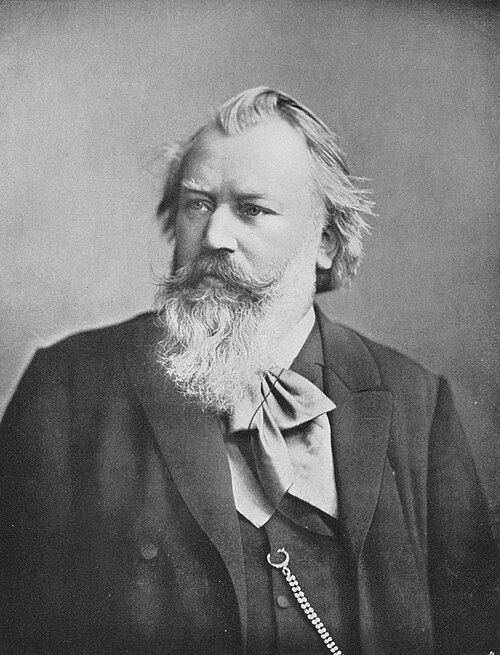
Composer
Johannes Brahms
1833–1897
4,957 works in the index
- Born
- 1833
- Died
- 1897
- Birthplace
- Hamburg
- Citizenship / historical state
- Hamburg
- Period (estimated from birth year)
- Romantic
Biography
Brahms wrote densely and revised ruthlessly, destroying what did not satisfy him, so the surviving catalogue is smaller than his contemporaries' and uniformly serious. It covers symphonies, concerti, a large body of chamber music, songs and late piano pieces.
For pianists the late Op. 116–119 pieces are the heart of it — short, inward and technically less punishing than the earlier sonatas, though musically demanding. The Hungarian Dances in their four-hand form are the most-played thing he wrote and are genuinely approachable. Singers have over two hundred songs and the German Requiem.
His piano writing assumes a large hand and comfortable tenths appear regularly. Editions differ little; what varies is fingering, and an edition with good fingering is worth paying for here.
In this catalogue
- Common listed instruments
- Piano, Voice, Choir, Low Voice, Orchestra
- Genres represented
- Classical, Jazz, pop, Pop, Christmas
- Works with composition dates
- 255 of 4,957
These details describe the indexed sheet music, including arrangements.
Catalogue
Works page 98 of 104
Years are composition dates where known. Instruments describe editions in our catalogue and may include arrangements. A dash means the detail is not recorded.
Biographical record: Wikidata, matched on name and checked against dates held in the catalogue. The period label is an estimate from birth year. The biography above is our own. Authority record: VIAF 7573295. Portrait: C. Brasch , Berlin ( biography ), Public domain, via Wikimedia Commons.