Composer
Ludwig van Beethoven
German composer (1770-1827)
1770–1827
6,206 works in the index
- Born
- 1770
- Died
- 1827
- Birthplace
- Bonn
- Place of death
- Vienna
- Citizenship / historical state
- Electorate of Cologne; Austrian Empire
- Period (estimated from birth year)
- Classical
Biography
Beethoven sits on the hinge between the Classical style he inherited and the Romantic one he made possible, and the catalogue spans both: thirty-two piano sonatas, sixteen string quartets, nine symphonies, five piano concerti and a large body of songs and chamber music.
The piano sonatas are the most-bought and the most misjudged. The famous ones — the Moonlight, the Pathétique, the Waldstein — are advanced works, and the first movement of the Moonlight being playable early does not make the rest of it so. The genuine starting points are the two sonatas of Op. 49 and the bagatelles, including the one everyone knows as Für Elise.
He revised heavily and his manuscripts are difficult, so editions disagree about specific notes and markings more than you might expect from a composer this recent. If you are working with a teacher, use theirs.
Life and musical career
- Occupations
- composer
- Teachers
- Christian Gottlob Neefe; Joseph Haydn; Antonio Salieri; Johann Baptist Schenk; Johann Georg Albrechtsberger; Gilles van der Eeden; Muzio Clementi; Andrea Luchesi
- Recorded memberships
- Royal Netherlands Academy of Arts and Sciences
- Genres
- classical music; art music; opera; symphony; sonata
- Movements
- Classical period; Romantic music
- Notable works
- Für Elise; Symphony No. 9; Piano Sonata No. 14; Missa Solemnis; Piano Sonata No. 8; Symphony No. 5; Symphony No. 6; Piano Sonata No. 21; Piano Sonata No. 23; Violin Sonata No. 9; Symphony No. 3; Fidelio
- Awards
- Bröckemännche Award
- Official website
- https://beethoven.de
- Native languages
- German
- Languages used
- German
- VIAF ID
- 32182557
- ISNI
- 0000000121268987
- GND ID
- 118508288
- Library of Congress ID
- n79107741
- MusicBrainz ID
- 1f9df192-a621-4f54-8850-2c5373b7eac9
Recorded in Wikidata. Affiliations may refer to earlier stages of the composer's career.
In this catalogue
- Common listed instruments
- Piano, violin, Cello, Orchestra, Voice
- Genres represented
- Classical, pop, Jazz, Pop, Christmas
- Works with composition dates
- 358 of 6,206
These details describe the indexed sheet music, including arrangements.
Catalogue
Works page 105 of 130
Years are composition dates where known. Instruments describe editions in our catalogue and may include arrangements. A dash means the detail is not recorded.
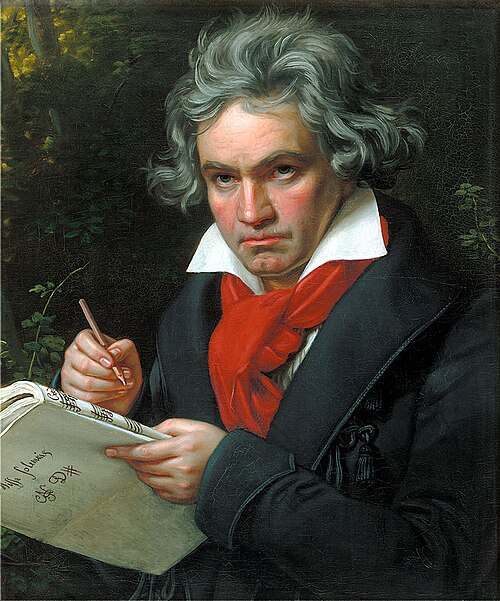
Biographical record: Wikidata, matched on name and checked against dates held in the catalogue. The period label is an estimate from birth year. The biography above is our own. Authority record: VIAF 32182557. Portrait: Joseph Karl Stieler, Public domain, via Wikimedia Commons.